Showing posts with label Southwark. Show all posts

Sunday, February 01, 2026

Walking with family and friends: London Bridge to Bermondsey... and beyond

New prisoners in an old prison
New prisoners in an old gaol.

Saturday January 31, 2026:

Cloudy with sunny spells, winds at 4 mph, 10°C (50°F)

Erin is really into art, often designing dresses and fashion items.

So, I decided that we should visit the Fashion and Textile Museum, where an exhibition celebrating sixty years of Cosprop was being held.

Cornerstone by Austin Emery
''Cornerstone' by Austin Emery.

Erin invited our friend, Steve, and, after meeting at Watford underground station, we set off. We changed trains at Finchley Road and took a Jubilee line train to London Bridge. The museum was just a few minutes walk from the station, so we stopped at Chapter 72 for some drinks, before exploring this part of Bermondsey. 

Just before 11:00 we joined the queue for the museum and waited to go in. A sign had been affixed to the door, stating that the next two visiting times were fully booked, requiring some in the queue to book timed slots for later in the day. We, fortunately, had pre-booked our tickets.

On entering the museum we were each handed a booklet containing almost 50 pages of detailed information on each of the items on display, how Cosprop was formed and a brief history.

Miss Havisham's dress from Great Expectations
1820s wedding dress for Miss Havisham from Great Expectations (1967).

The first item of clothing, on display, was Miss Havisham's dress from Great Expectations (1967), followed by uniforms from The Charge of the Light Brigade (1968) and War and Peace (1972).

Thursday, January 08, 2026

Winchester Palace Great Hall

Winchester Palace Gable End
Ruins of the Great Hall of Winchester Palace.

Being one of the wealthiest and most important of England's Diocese, at the time, the Diocese of Winchester owned land from England's south coast up to the south bank of the River Thames.

Southwark, the oldest of London's Boroughs, was the perfect place for Winchester Palace to be built. 

Winchester Palace, was built in 1144 by Bishop Henry of Blois, brother of King Stephen. It was to become the London townhouse for the Bishop of Winchester. 

The 80 acres of land adjoining the River Thames were governed according to the laws of 'The Liberty of the Bishop of Winchester', from 1127. In this term 'Liberty' meant jurisdiction. By the end of the 15th century 'The Liberty of the Bishop of Winchester' was shortened to 'Liberty of The Clink'.

A map showing the location of Winchester Palace
A Medieval map showing the location of Winchester Palace.

The palace was arranged around two courtyards, which housed many buildings. These included a brew-house, butchery and the first of  Southwark's six prisons... The Clink. As a townhouse, from where the bishops could escape from everyday stresses of governance, the palace also had a pleasure garden, a bowling alley and tennis courts.

The interior of the great hall as it may have appeared in the 15th century © Historic England (illustration by Liam Wales)
The interior of the great hall as it may have appeared in the 15th century
© Historic England (illustration by Liam Wales)

In the 17th century the palace was divided into tenements and warehouses. In the 19th century a fire ravaged the area and the ruins of the palace were rediscovered. 

Thursday, December 04, 2025

Tanner Street Drinking Fountain, Bermondsey

Tanner Street Drinking Fountain

In the corner of Tanner Street Park, behind low iron railings, there is a drinking fountain with a remarkable history. This is the Tanner Street Drinking Fountain.

This drinking fountain began its life as a turret at the top of tower of St Olaf's Church, Tooley Street.

Henry Flitcroft designed the church, which was constructed with Portland stone, in 1737. By the early 20th century the church had fallen into disrepair and so, in 1918, permission was granted to demolish part of the church. However, a stipulation was attached:

"...that provision should be made for the preservation of the tower thereof and for the maintenance of a portion of the site of the old church and of the old churchyard as a public open space and for the perpetuation of the name of St Olave in connection with such site."

Tanner Street Drinking Fountain

Subsequently, the riverside area around Hay's Wharf was being developed and, as such, a request was submitted to demolish the tower.

A fierce Parliamentary debate ensued. Eventually permission was granted to demolish the tower, on the condition that Bermondsey Borough Council use some of the proceeds from the sale of the church land, in Tooley Street, to establish a recreation ground in nearby Tanner Street. Also, as an acknowledgement of the original church, the turret/cupola should be retained as a drinking fountain.

Eventually the drinking fountain fell into disrepair and, during the upgrading of Tanner Street Park, was restored in 2018, by Southwark Council.

Monday, November 24, 2025

Ragged School, Southwark

Ragged School, Southwark

The Mint & Gospel Lighthouse Mission was created in 1888, in a small building on what is now called Ayres Street. It then moved to premises on Clenham Street. However, this building was in such a poor state that The Ragged School Union and Shaftesbury Society provided them with a new building on Union Street.

This building was opened in 1907 and was set up as a charity to help disadvantaged children.

Ragged School building Union Street

In 1840, the London City Mission used the term 'ragged' to describe the 570 children who used the five schools that they had established. The term 'ragged' referred to children who often wore ragged or worn-out clothing, no shoes or lacked the clothing to attend any other school.

In 1844, the London Ragged School Union was formed with over 20 ragged schools across the city.

Saturday, November 01, 2025

Family trip to London: Day 1, Southwark

Sir Walter Raleigh quote
Wise words.

Thursday October 30, 2025.

Having taken a few days off work, Emma and I took Keilyn to London, while Erin was staying with friends.

We set off, via taxi, to Watford Metropolitan station to board a train to Finchley Road and from there a Jubilee line train to Waterloo.

On leaving Waterloo station we crossed Waterloo Road and headed for the Bus Cafe, for a spot of lunch. Full English breakfasts were ordered and devoured, washed down with coffee and tea.

With our bellies full we left the bus garage and headed along The Cut and onto Union Street. We passed the Embassy Tea House and the London Fire Brigade Headquarters, before crossing Southwark Bridge Road. We then passed the old Tram shelter, which is now a gourmet burger restaurant, and the Mint & Gospel Lighthouse Mission building, before turning up Redcross Way beside Crossbones Graveyard.

Redcross Way brought us to Dirty Lane and the arches beneath the mainline railway of Cannon Street station. This eventually brought us to Clink Street. Keilyn's face lit up when she discovered that we were going into the Clink Prison Museum, a place she had wanted to visit for ages.

Clink Prison Museum entrance
"The Clink": the prison that gave its name to all others.

We descended the stairs, paying our dues at the booth, before entering the site of the original Clink Prison. The prison that gave its name to all others.

Information boards told the history of the prison from its earliest inception, in 1144, to its closure in 1780. Manacles, locks, swords, torture implements, chastity belts and much more were on display, many of which could be handled, allowing you to feel the weight of the chains, giving a sense of how it would feel to be manacled for days on end.

There was also information on Crossbones Graveyard and the Winchester Geese, the Liberty of the Clink, the Bishop of Winchester and a brief mention of the other five prisons that were in Southwark.

Executioner
"Off with his head!"

As we walked through the Clink Keilyn was keeping an eye out for the 'ghosts' that had been hidden around the museum. These 'ghosts' were small puppets and, should you find all ten, you received a sweet on leaving the gift shop. Of course, Keilyn spotted all ten and received her lollipop as we left the prison.


We continued along Clink Street and joined the throng of tourists, passing the Golden Hinde and turned onto Cathedral Street and then Montague Close, where we sat in Minerva Square to rest our legs and have a drink. We then continued along Montague Close and joined Tooley Street, before turning along St Olaf Stairs and joining The Queen's Walk along the River Thames. Countless wooden sheds were in various stages of being built and painted, ready for the Christmas season, while the old City Hall is in the middle of a major refurbishment, with much of its glass having been removed.

Royal Mail Penfold Postbox
A Victorian era postbox.

We looked at the Royal Mail Penfold Postbox, a relic of the Victorian era, before we turned south along Duchess Walk to Queen Elizabeth Street. After buying an ice cream, for Keilyn, and some more refreshments and snacks, we walked along Tower Bridge Road and headed for our hotel... Premier Inn London Tower Bridge Hotel.

The view from the fifth floor
The view from our hotel room.

After checking in, Keilyn grabbed the room key and took the lift to the top floor, all the while we were hoping for a room with a view. And we were not disappointed. We could just make out the top of the London Eye and half of the dome of St Paul's Cathedral, but we had a clear view of The Shard, which was perfect.

Tuesday, October 21, 2025

Walking with Erin: British Film Institute to Crossbones Graveyard... and beyond

Small Car Big City
A 'Small Car Big City' Mini Cooper.

Saturday October 18, 2025.

It had been a while since Erin and I had taken a trip to London, so we needed to plan something. Erin found out about 'A Wicked Celebration' taking place at the British Film Institute, on the Southbank, so we decided that that would be our starting point.

We left home and made the short walk to Watford Metropolitan station and boarded a train for Baker Street. We changed at Finchley Road, where we boarded a Jubilee line train to Waterloo. 

Paddington Bear Mural
Paddington Bear mural.

As we had plenty of time before the exhibition opened, we took a slow walk from Waterloo station, along Concert Hall Approach, and passed a great mural to Paddington Bear on the way. We then  explored the various external floors of the Southbank Centre. I have walked along the Southbank before, but never visited the various raised plazas that make up the Southbank Centre.

Southbank Centre Sculpture
Water feature sculptures at the Southbank Centre.

The views from these raised walkways offered nice views of the River Thames, while different sculptures were dotted around, too.

Once we had seen enough we made our way down to street level and Theatre Road. For an exhibition about the phenomenon that is 'Wicked', there were no advertising signs or posters to say that it was on, which was a surprise. 

Prometheus EVA Suit
Vickers (Charlize Theron) EVA Suit, from Prometheus (2012).

We made our way into the BFI, via the Cinema and Box Office entrance, and climbed the stairs and joined a small queue of about twenty people.

Ozian Coins
Ozian coins.

After about ten minutes we were climbing the stairs to the Mezzanine Gallery and exploring 'A Wicked celebration'. Large panels, containing photographs and snippets of information, lined the wall, detailing the behind-the-scenes making of the movie. 

Erin and Glinda's costume
Erin with Glinda's costume.

Then there were the four small glass cabinets that held replica props, such as Ozian coins and Glinda's wand. At the end of the gallery were Elphaba and Glinda's dresses, protected behind glass, that allowed people to see the intricacy of their design.

Once we had seen everything, which didn't take long, we headed outside and sat and ate our lunch by the National Theatre.

Once we had eaten we decided to head towards London Bridge, by following The Queen's Walk. As Erin doesn't enjoy walking, as much as Keilyn, I thought that it would be easier if we walked towards underground stations, should she suddenly tire. Wooden huts, selling their wares, were already open and decorated for Christmas. 

Blackfriars Station Commemorative Plaque
Blackfriars Station commemorative plaque.

We passed Gabriel's Wharf, Thames Beach, Oxo Wharf and Sea Containers House, before we turned down Marigold Avenue onto Upper Ground. We then turned south, onto Blackfriars Road, passing the original entrance to Blackfriars station, heading to The Cut, where we stopped at a Tesco Express for some more snacks.

Ragged School, Southwark
The Mint & Gospel Lighthouse Mission Shaftesbury Society.

From here we headed along Union Street, passing the London Fire Brigade Headquarters, an original tram shelter, which is now a 'Heard' burger restaurant, that looks rather nice. We then passed the old Ragged School building and, opposite, discovered that Crossbones Graveyard and Garden of Remembrance was open. So, we went in. 

La Catrina
La Catrina, donated by the Mexican Ambassador to the United Kingdom.

Besides a few volunteers, and a handful of other visitors, the place was remarkably empty. While Erin picked up an information booklet I made a donation and, soon, we were exploring this historic place. As we walked slowly around I told Erin about its history.

Monday, September 15, 2025

Tibetan Peace Garden, Southwark

Tibetan Peace Garden

Language Pillar
The overall design of the Tibetan Peace Garden symbolises the meeting of East and West, by bringing together contemporary western imagery with traditional Tibetan culture. The circular shape of the garden, for example, is based on the fundamental Buddhist image, the Wheel of Dharma. 

As you walk into the Tibetan Peace Garden, the first thing you come across is the Language Pillar. Built in Portland stone, its design is based on the famous Sho Pillar in front of the Potala Palace in Lhasa. It carries His Holiness the Dalai Lama's message of peace and harmony in four languages: Tibetan, Hindi, English and Chinese. The pillar is topped by 'precious jewels' set upon three steps representing peace, understanding and love.

Walking from the pillar towards the garden, you will see in the pathway a circular logo, cast in bronze and set in Kilkenny stone. The two Tibetan syllables in the centre mean 'Virtue' and 'Foundation', and the six 'vajras' represent the perfections of generosity, discipline, patience, diligence, concentration and wisdom as well as the six mythological families of the Tibetan people. This is the logo of the Tibet Foundation, who commissioned the Tibetan Peace Garden.


Friday, August 29, 2025

Walking with friends: Waterloo to Vauxhall Pleasure Gardens... and beyond

Charlie Chaplin Plaque

Wednesday August 27, 2025.

Having arrived back from our family holiday, in Lanzarote, on Monday, I was itching to get back to walking London's streets and discover new places.

Fortunately, I still had some time off, before I return to work next month.

My friend and colleague, Steve, also had this week off from work, so we met at Watford underground station and set off for London. Our Metropolitan line train took us to Finchley Road, where we switched to a Jubilee line train to take us to Waterloo, where our walk would begin.

As the weather forecast said rain was due in the afternoon, we both had light coats with us 

Exiting Waterloo station, we crossed Waterloo Road and made our way to the Waterloo Bus Garage, where we would have breakfast at the Bus Cafe. Now, Waterloo Bus Garage is a significant place as it became the first fully electric bus depot, in Europe, in 2016.

Full English Breakfast

On entering the Bus Cafe we grabbed an available table, before I ordered two Full English breakfasts, with coffee. We didn't have to wait too long before it was served to us. As we ate the rain, that was promised for the afternoon, suddenly released a deluge. 

After we had finished we got speaking with a man at a neighbouring table. It turns out he had just flown in from Canada and, on hearing about the Bus Cafe, had entered to try his first ever Full English breakfast. A mum and daughter, at another table, were also here on their first visit. The rest of the cafe was full of bus drivers on their breaks or preparing to start their shifts.

London Ambulance Service Headquarters

We left the Bus Cafe and headed down Waterloo Road towards the London Ambulance Service Headquarters, where we looked at the three ambulances preserved on the forecourt, taking photos and reading about the history of the London Ambulance Service.

From here we headed down Pearman Street, crossed Westminster Bridge Road and continued down King Edward Walk, crossed Lambeth Road and cut through Geraldine Mary Harmsworth Park to reach Kennington Road.

ARP Stretchers as railings

We followed Kennington Road until we turned down Chester Way, then Kennington Lane where we turned down White Hart Street. It was here, on the Kennings Estate that we discovered some ARP stretchers being used as railings. Eventually we found ourselves on Kennington Park Road.

From here we rejoined Kennington Road and made our way to 'The Dog House', as we had heard great things about it. Plus, we were getting thirsty. Unfortunately, the pub was late in opening, so we entered 'The Tommyfield', which stands opposite.

Comedy Legends

We ordered our drinks and grabbed a table, from where we checked out the pub. It turns out that this pub has comedy nights, where various comedy figures have played.

Suitably hydrated we crossed Kennington Lane and entered 'The Dog House'. And what a delight it was. We had entered into what, at one time had been the 'public' bar, where a glass cabinet held taxidermied birds, while teapots hung from the ceiling. A short corridor, covered in small movie posters promoting various horror and science fiction films.

An eclectic interior

Entering the 'Saloon' bar we discovered more taxidermied animals, while empty bird cages hung from the ceiling. The walls were adorned with random photos, prints, African tribal masks and so much more. A small snug had oriental parasols hanging above it. It is an eclectic place. After looking around as much as we could and having spoken with the landlord, about the building, we took our drinks outside to the beer garden and relaxed.

Charlie Chaplin's House

On leaving 'The Dog House' we passed the house where Charlie Chaplin had lived, from 1889-1978, before crossing Kennington Road and heading down Black Prince Road. We passed 'The Black Prince' pub and Venn Park, before reaching Tyers Street, where we stopped for a drink at 'The Jolly Gardeners'. 

Charlie Chaplin Senior's piano

Now, I have been here before and this pub houses a piano that was, supposedly, played by Charlie Chaplin Senior. It is stood in the corner of the pub, in a sorry looking state. There is no plaque or information that states its history, but it is still an intriguing piece to look at. After looking at the piano we sat in the open-air garden and sipped our drinks.

The Queen's Head

On leaving the pub we continued along Black Prince Road, where I pointed out 'The Queen's Head' pub, which is now a bistro. At one time, in its past, this pub was frequented by Charlie Chaplin as it was run by his Uncle. It was here that he drew inspiration for his "Tramp" character, after noticing a patron, Archibald Binks, who wore large loose fitting trousers and walked with a shuffle.

Doulton Building

We continued our walk until we reached the 'Doulton' building, with its ornate office building, on the corner of Lambeth High Street. This is one of my favourite buildings in the area.

Steve with some firemen

Turning up Lambeth High Street we stopped, so that Steve could have his photo taken with some firemen.
 
If Places were Faces London drawing

We then entered 'The Windmill Pub'. This is another pub that I had visited before and was eager to show Steve its wonderful interior and its amazing and entertaining 'If Places Were Faces, London' drawing. And Steve loved it, spending far too much time laughing at the names and faces on it. We then looked around the pub, before sitting to sip our drinks.

National Crime Agency Headquarters

We then headed back down Lambeth High Street and back along Black Prince Road until we reached Vauxhall Walk, which we followed, passing the National Crime Agency building, until we reached Vauxhall Pleasure Gardens. 

Thursday, July 17, 2025

'Nancy's Steps', Old London Bridge

Steps of old London Bridge
'Nancy's Steps'.

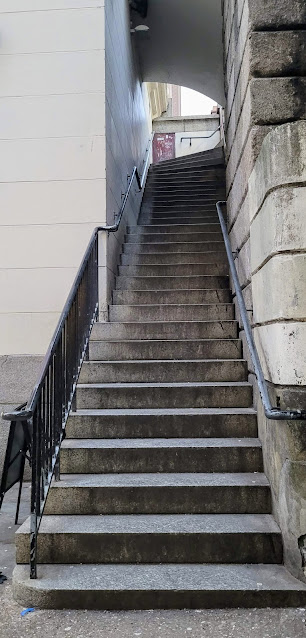
These steps, on the southwest side of London Bridge, the arch and a few remaining pedestrian alcoves are pretty much all that is left, in England, of John Rennie's London Bridge. 

Victoria Park London Bridge Alcove
Old London Bridge pedestrian alcove, Victoria Park.

One alcove sits in the quadrangle of Guy's Hospital, while another can be found in Victoria Park.

The rest of the bridge was sold to Robert McCulloch, who had it dismantled and shipped to America, where it was rebuilt in Lake Havasu City, Arizona.

One of the surviving pieces of John Rennie's London Bridge
A surviving arch of John Rennie's London Bridge.

These steps are often called 'Nancy's Steps', in reference to the character of Nancy, from the novel 'Oliver Twist', by Charles Dickens.

In the novel Bill Sikes murders Nancy in a room, while Bill's dog, Bull's-Eye, watches on. 

However, in the 1968 movie, 'Oliver!', Nancy is murdered on the steps of London Bridge by Bill Sikes.

Surely Some Mistake
Shorely Shome Mishtake.

This makes the Blue Plaque, affixed to the wall of the surviving arch of John Rennie's London Bridge, incorrect.

You can read more about London Bridge by clicking on the link below.


Monday, January 06, 2025

Tram Shelter, Southwark

Tram Shelter, Southwark
A relic from a bygone era.

On the junction of Union Street and Southwark Bridge Road, there is a cafe bar that resides in a wonderful relic from a bygone era.

The building began life as a tram shelter and stands on a pedestrian island near Flat Iron Square. 

It is a single storey building with timber framed doors, a pitched plain clay tile roof with a ventilation lantern. A semicircular window, above the door adds to the charm of this 1930s building.

Audrey's Cafe
A tram shelter repurposed as a cafe bar.

Trams once trundled by this building on their way to the northern end of Southwark Bridge and, in the other direction, to the Hop Exchange, close to Borough High Street.

Like much of this area, in and around Southwark, a lot has been lost to redevelopment, so it is nice to see that this almost 100 year old building has been repurposed.

The two London Plane trees offer some shade to patrons who choose to dine outside in the summer months.

Monday, November 25, 2024

Marshalsea Prison South Wall

Marshalsea Prison South Wall

Angel Place is an alley that leads from Borough High Street to Tennis Street, passing St George's Churchyard Gardens.

The wall that separates the gardens from the alley is all that remains of the south wall of Marshalsea Prison, a notorious debtor's prison that stood, in one state or another, on this site.

Marshalsea Prison Flagstone

Brief History

The first Marshalsea Prison, 1373-1811, was located at what is now 161 Borough High Street and housed men accused of crimes at sea, political prisoners and debtors.

Monday, November 18, 2024

Free School, Rotherhithe

Rotherhithe Free School

Peter Hills and Robert Bell founded the Free School in 1613, as a way to educate the children of impoverished seafarers and mariners.

Peter Hills died in 1614, leaving a sum of six pounds per year for the ongoing maintenance of the school. When it opened the school had just eight boys and is thought to be the first elementary school in London.

In the 1700s the free school raised new funds, as the six ponds per year was now insufficient to keep the school maintained. With new capital the school expanded, giving it room for 65 boys and 50 girls, too.

In 1739 an amicable fund was set up to supply funding to for an additional 12 boys.  

In 1742 it became known as the Charity School. The original building was on the northside of Saint Marychurch street, adjoining St Mary's church. 

Thursday, November 14, 2024

ARP Stretcher Railings

ARP Stretchers as Railings

Wandering London's streets, as I often do, I am still surprised by the extraordinary things hidden in plain sight.

Take the railings, in the photo above. At first glance they appear to be your standard railings, which are quite often found south of the river, in places like Bermondsey, Brixton, Camberwell, Deptford, Southwark, etc..  There even some north of the River Thames, in Poplar.

However, these are no ordinary railings. They are almost 80 years old and once served a very different purpose.

ARP Stretchers as Railings

During World War II many of the metal fences and railings, around various houses and buildings, were removed, so that the metal could be used for the war effort.