Showing posts with label Tower Hamlets. Show all posts

Thursday, January 15, 2026

West India Docks

A map of the West India Docks

The next time you’re visiting Canary Wharf, take a moment to look beyond the towering glass and steel. You are standing in a place with a history that is as rich, complex, and sometimes brutal, as any in London: Welcome to the West India Docks.

Once the beating heart of a global trading empire, these docks tell a fascinating story of ambition, immense wealth, human cost, and ultimate transformation.

Former entrance to the Millwall Dock

Before the West India Docks, the River Thames was a chaotic mess of ships, theft, and congestion. Enter the powerful West India merchants, who successfully lobbied for dedicated, secure docks. The result was the West India Dock Act of 1799, paving the way for a revolutionary development on the Isle of Dogs.

Thursday, August 21, 2025

'Sculptures' by Andrew Baldwin, Trinity Buoy Wharf

Cab Tree sculpture
Andrew Baldwin's 'Cab Tree' above the Orchard Cafe.

Trinity Buoy Wharf is full of things to discover. From its historic buildings and vessels, to exhibitions and sculptures.

Many of these sculptures, dotted around the site, are free to visit and were created by Andrew Baldwin. They are an eclectic mix.

Aqua Gill sculpture
'Aqua Gill' by Andrew Baldwin.

A master blacksmith and welder, for 28 years, Andrew Baldwin always had an interest in Victorian engineering. This, coupled with his skill at metalworking and his wild imagination, is what has helped him create some seriously outlandish sculptures.

Quirky, eerie, scary and wonderful in equal measure, these mechanical sculptures are fascinating to behold.

Profile of Trinity Buoy Wharf in metal
Trinity Buoy Wharf Chain Store and Lighthouse.

Then there are the non-mechanical sculptures, such as a metal lighthouse and this profile of Trinity Buoy Lighthouse and Chain Store.


Andrew Baldwin's work is constantly changing and evolving, but there is always a varied selection of his work on display, all over the Trinity Buoy Wharf site. 

'Man' sculpture
A Robin visits Andrew Baldwin's 'Man' sculpture.

Monday, July 21, 2025

'Longplayer' by Jem Finer

Longplayer Live instrument
Part of the 'Longplayer Live' instrument.

Within Trinity Buoy Wharf Lighthouse is a unique musical experience. A musical composition, entitled 'Longplayer', that will play for 1,000 years.

On the first floor you can walk around part of the 66-foot-wide orchestral instrument, which is used to perform 'Longplayer Live', while listening to 'Longplayer' being streamed into the room.

However, the Lantern Room, at the top of the Lighthouse, is the best place to hear 'Longplayer', while taking in the unique views on offer.

Longplayer timepiece
'Longplayer' has been running since the year 2000.

What is 'Longplayer'?

'Longplayer' is the brainchild of Jem Finer and is a 1,000-year-long musical composition that has been playing continuously since the first moments of the year 2000. It is designed to play on, without interruption and repetition, until the last moments of 2999.

Since it began, 'Longplayer' has been performed simultaneously by a number of computers around the world - from its primary location at Trinity Buoy Wharf Lighthouse to listening posts in Alexandria, Brisbane and San Francisco. It can also be heard anywhere in the world via an online audio stream at Longplayer.org.

Longplayer Live instrument
Singing Bowls.

How does it work?

Composed by Jem Finer, 'Longplayer' is written for a set of highly resonant 'Singing Bowls', an ancient type of standing bell. These bells are sounded according to a precisely timed score, itself based on six simple algorithms. The resulting music is made up of six continuous, interlocking musical patterns whose harmonic and rhythmic interactions change gradually over hours, days, decades and centuries.

Thursday, May 01, 2025

'Timepiece Sundial' by Wendy Ann Taylor

Sundial at the Tower Hotel

The sundial is one of man's oldest astronomical instruments.

In this particular form, known as an Equinoctial Sundial, the dial is in the same plane as the Earth's equator and the gnomon, or rod, is parallel to the axis of the Earth pointing true north.

Sundial face

The shadow of the gnomon moving across the dial indicates the time. In summer the shadow falls on the face of the dial, in winter on the inner edge.

Thursday, April 03, 2025

'Time and Tide Bell' by Marcus Vergette

Time and Tide Bell, Trinity Buoy Wharf

Attached to the sea wall of Trinity Buoy Wharf is this bell, designed by the sculptor Marcus Vergette.

The unique design of the bell, developed by Marcus Vergette and Dr Neil McLachlan, means the bell is rung by the river to mark each high tide. Uniquely, from just one strike the bell sounds different notes one after the other to form a melody.

"Fixed in space, rung by the power of nature, yet making ever-changing sounds, the bell symbolises the complex relationship between man and his environment. The Time and Tide Bell creates, celebrates and reinforces connections between our history and our environment. Here at Trinity Buoy Wharf Leamouth, it will serve as a powerful marker of sea level rise at the very heart of our maritime history." 
- Marcus Vergette

Time and Tide Bell by Marcus Vergette

The Trinity Buoy Wharf Bell was launched at high tide on September 19, 2010.

Part of the 'Time and Tide Series', this 3 metre tall bell, cast in aluminium bronze, is third in a planned series of twelve bells, located throughout the United Kingdom. 

The first bell was installed at Appledore, North Devon, while the second was installed at Great Bernera, Outer Hebrides.

Time and Tide Bell


Monday, March 24, 2025

Retracting Footbridge, St Katharine Docks

Telford's Retracting Footbridge
The original footbridge.

St Katharine Docks, which was the only major project of Thomas Telford in London, opened in 1828. His idea was to use as much of the land as possible for warehouses and to limit quayside space, ensuring cargo was lifted directly into the warehouses.

Because of the way he designed the docks, narrow footpaths allowed workers to walk around the site. However, to get from one side of the dock to the other could take some time, so Thomas Rhodes, the resident engineer of Telford, designed this retractable bridge, between the Central Basin and the East Dock.

Constructed with iron castings and wrought iron forgings, by John Lloyd, the bridge was linked to rail-mounted cast iron counterweight boxes that allowed it to stretch across the dock. Using a rack and pinion system the bridge could be retracted into the masonry of the dock walls.

Thomas Telford's Retracting Footbridge
The housing for the bridge.

Thursday, March 06, 2025

A Chimney disguised as a Lamppost, Tower Bridge

Tower Bridge Lamppost and Chimney

Tower Bridge is used by over 40,000 people and nearly 21,000 vehicles everyday. But, I wonder how many people have spotted this little oddity on its north approach.

At first glance it appears to be one of the many lampposts that line the approach to the bridge, but without its lamp. 

But it isn't. 

Tower Bridge Chimney

It is, in fact, a chimney.

But why is the chimney here, on the northern approach road? 

To find out more we need to travel back to 1894, when the bridge opened.

Monday, March 03, 2025

Orchard Place and Trinity Buoy Wharf: A Brief History

Bow Creek Lighthouse

The Hope and Orchard

Throughout the middle ages Orchard Place was green and rural, remaining that way into the late 18th century.

Orchard House and its orchard, which took up most of the eastern branch, was owned by Mr Wright from 1743-1766.

Goodluck Hope took up much of the northern branch of the peninsula and belonged to the Manor of Stepney. It had a cooperage, a fishery, grazing meadows and a good sized house, called Handlebury. It was also known as Hanbury or Handle Hall and was demolished in 1804.

In 1810 Robert Wigram, who was an East India merchant who had helped to set up the East India Dock Company, in 1803, bought Goodluck Hope, calling it the Wigram Estate.

In 1815 the East India Company bought Orchard House, as the new East India Docks were just next door.

The first industry on Bow Creek was a copperas works. Bow Creek was ideal for this work as London Clay was full of iron pyrites, from which copperas could be extracted. Copperas, an iron sulphate, was used as an ingredient in sulphuric acid, as a fixative for wool and, up until the 19th century, it made the black of ink.

By the late 18th century competition from the north had grown too strong for copperas works in the south. This, along with other factors, saw the last of the copperas works close, early in the 19th century.

Orchard Place Map

Mapping History

Between 1700 and 1820 Orchard Place was transformed from a semi-rural backwater to a busy centre of national importance for trade and industry. So many businesses sprang up, went bust or grew and moved that the maps of 19th century Orchard Place are different every decade.

The Age of Iron and Steam

In 1810 an iron bridge was built to provide a road linking East India Docks and Canning Town, but had to be torn down, in 1887, after a collier barge crashed into it.

In 1840 a railway was opened to link Orchard Place with the City, with trains leaving from Fenchurch Street and arriving at Blackwall station. This would become the London and Blackwall Railway that not only transported goods, but people who were taking trips to the seaside via a paddle steamer. These steamers went to Gravesend and Rosherville Gardens, Northfleet.

In 1862 the Great Eastern Railway was formed, running services to East Anglia. It's locomotives were built at Stratford, while the engine sheds were just up river from Orchard Place.

In 1902 the Midlands manufacturers, Baldwins Limited, brought the Blackwall Galvanised Iron Company to Orchard Place, where they had workshops for much of the 20th century. One of the directors was Stanley Baldwin, who would go on to become Prime Minister.

The Thames Plate Glass Company

The Thames Plate Glass Company, founded in 1835, was the only plate glass factory in the South of England, and was famed for the size of glass it produced and for the finish. No other glass company could match the size of glass produced here. Nearly half of its employees were women, as their 'superior delicacy of touch' allowed for better grinding and polishing of the glass.

Its glass was used for lenses, mirrors, theatre scenery and the Bow Creek Lighthouse, which still stands, and in which Michael Faraday experimented.

In 1862 Henry Dircks and John Pepper used Thames Plate Glass to create a theatrical optical illusion that would go on to be called 'Dr Pepper's Ghost'. So popular was this illusion that the company sold out of Ghost glass.

Well known for embracing the latest technologies, the Thames Plate Glass Company was the first to use the glass rollers designed by Sir Henry Bessemer.

In 1874, following competition from the North, and abroad, the company closed.

Monday, February 10, 2025

Bow Creek Lighthouse: London's Only Lighthouse

Bow Creek Lighthouse


On the Leamouth Peninsula, where the River Thames and Bow Creek meet, lies Trinity Buoy Wharf, in the London Borough of Tower Hamlets.

The site was used by the Brethren of Trinity House, now known as Corporation of Trinity House, from 1803, with the sea wall being constructed in 1822.

Bow Creek Lighthouses
A photo of both lighthouses, circa 1900s.

Originally there were two lighthouses, with one being built in 1852, by James Walker, and the other between 1864-1866, by James Douglas. The former was demolished in the 1920s, while the latter one still stands today.

Both lighthouses were used to train lighthouse keepers and for testing lighting systems, not for their true purpose, as the River Thames is not that dangerous a stretch of water.

The original lantern, at the top of the lighthouse, came from the Paris Exposition of 1867, where Trinity House had demonstrated improved systems of electric lighting for lighthouses.

Michael Faraday's Workshop

Michael Faraday set up a workshop, next door to the lighthouse, and carried out experiments here, discovering the principles underlying electromagnetic induction, electrolysis and diamagnetism.

Thursday, January 16, 2025

'Vitreous Enamel' by Dale Devereux Barker RE

Vitreous Enamel by Dale Devereux Barker

Walking along Cloister's Walk, in St Katharine Docks, you will discover a plethora of bright panels fixed into the arches that separate Cloister's Walk from St Katharine's Way.

Cloister's Walk

There are one hundred and thirty five of these panels, with nine panels per arch.

Some of the designs are repeated, but sometimes with a different colour. However, each tells a story.

Keilyn with the Vitreous Enamel Panels

Dale Devereux Barker RE was commissioned for this project by Taylor Woodrow Properties, back in 1998. 

Monday, January 13, 2025

Victoria Park Cemetery: Meath Gardens

Victoria Park Cemetery Gravestones
Headstones.

Victoria Park Cemetery opened in 1845 and was the last of the eight private garden cemeteries to open.

The cemetery was unconsecrated and, when it opened, had two chapels, designed by the architect Arthur Ashpitel, 

Victoria Park Cemetery gate
The great Gothic archway.

The great Gothic archway, restored in 2017, still stands at one of the entrances emblazoned with 'VPC 1845'.

During its short existence over 300,000 bodies were interred here, with three-quarters of them being children.

Although well-managed initially, it was a poor financial venture and became insolvent in 1853, leading to its closure in 1876.

Victoria Park Cemetery gravestones
Headstones.

Following its closure the monuments were cleared... But, the bodies were never removed.

Thursday, November 21, 2024

Grove Road Bridge: Site of the first V-1 attack in London

Grove Road Bridge

This bridge is typical of many railway bridges in London, or the rest of the country for that matter. However, this bridge has a special place in London history and to find out more we must travel back to 1944.

On Tuesday June 13, 1944, at around 04:30, the first V-1 flying bomb, also known as 'buzz bomb' or 'doodlebug', to hit London, detonated on this railway bridge, which carries the London North Eastern Railway from Liverpool Street.

The blast severely damaged the bridge and demolished twelve houses and over fifty others were damaged, with much of the damage occurring on Antill Road, Belhaven Street and Burnside Street.

Six people lost their lives, while another forty-two were injured.

Grove Road Bridge

The bridge, being a vital transport route, was repaired and operational by 19:45 on June 14. This repaired bridge would stay in place until the entire bridge was replaced in 1948.

Monday, September 30, 2024

London's 'Magnificent Seven' Cemeteries. But, originally, there were eight

Highgate Cemetery West

During the 1830s and 1840s eight private cemeteries were created in an attempt to solve the problem of overcrowding in Victorian London's churchyards. 

This was brought about by a number of factors that included the rapidly increasing rates in birth and mortality and a migration of people from rural areas to the city, due, in part, to the Industrial Revolution.

In 1831 London suffered a cholera epidemic and public health became a major issue. It was believed that poisonous vapours from decomposing bodies was a factor in the outbreak of both cholera and typhoid.

As churchyards became full graves were dug at a depth of just 3 feet (1 metre) and, within a few months, were used again. 

'Resurrection Men' were another problem. These Resurrectionists would raid cemeteries in order to snatch a body, which would then be sold to hospitals for medical students to dissect. These body snatchers would select a grave and then dig a hole at the head end. They then broke the coffin and, using a rope, dragged out the body, thus not having to do a full excavation. They were also careful not to take any jewellery or clothes, as this would result in more serious charges, punishable by transportation to the colonies. Bodies belonged to no one, so their removal was a far less serious charge. 

Watch House Rotherhithe

Such was the proliferation of 'body snatching' that Watch Houses were built, besides graveyards, and were manned by armed watchmen.

In 1832 an Act was passed by Parliament that encouraged the construction of private cemeteries outside central London.

Between 1833 and 1845 eight garden cemeteries were established, four of which were consecrated by the Bishop of London, Charles James Blomfield.

Bunhill Fields Cemetery

According to census records London's population was one million, in 1801, but had doubled to two million by 1841. At this point London had a death rate of over 45,000 people a year, or 125 people a day.

In 1981 Hugh Meller, an architectural historian, dubbed the surviving group of cemeteries 'The Magnificent Seven', after the movie of the same name.

Each of these cemeteries is unique, making them all worthy of a visit.

Kensal Green Cemetery (General Cemetery of All Souls)

Opened 1833, in the Royal Borough of Kensington and Chelsea, and founded by George Frederick Carden, a barrister. 

The main buildings were designed in the Greek Revival style, by John Griffith, and it originally covered an area of 54 acres, which was later increased to 72 acres.

It is still in operation.

Kensal Green

West Norwood Cemetery (South Metropolitan Cemetery)

Opened 1837, in the London Borough of Lambeth.

The main buildings were designed in the Gothic style, by Sir William Tite and covers an area of 40 acres.

In 1966 it was purchased by Lambeth Council who run it with the Diocese of Southwark.

It is still in operation, partially.

West Norwood

Highgate Cemetery

Opened 1839 (west) 1860 (east), in the London Borough of Camden.

Architect Stephen Geary chose this site for its views over London, which had once been the grounds of Ashurst House but now had St Michael's Church built on it in 1832.

Stephen Geary was assisted by David Ramsay, a nurseryman, in making Highgate the most beautiful and popular cemetery of its time.

It is still in operation.

Highgate

Abney Park Cemetery

Opened 1840, in the London Borough of Hackney.

Situated in the grounds of Abney House, once home to Isaac Watts, this cemetery was left unconsecrated, making it a popular burial ground for Dissenters, especially after Bunhill Fields closed to burials.

The chapel was the first non-denominational cemetery chapel in Europe.

In 1979 the London Borough of Hackney took ownership of the site.

It is still in operation.

Abney Park

Brompton Cemetery (West of London and Westminster Cemetery)

Opened 1840, in the Royal Borough of Kensington and Chelsea.

Stephen Geary was the original architect, but he was replaced by Benjamin Baud who designed a more formal layout, including the central avenue and domed chapel.

It is the only Crown Cemetery and is managed by The Royal Parks.

It is still in operation.

Brompton

Nunhead Cemetery (All Saints' Cemetery)

Opened 1840, in the London Borough of Southwark.

Built on a hill, with views over London, it was designed by architect James Bunstone Bunning, who had replaced Stephen Geary.

In 1976 it was purchased after it was allowed to fall into neglect by its owners United Cemeteries Limited, who were looking to build on some of the land.

It is still in operation.

Nunhead

Tower Hamlets Cemetery (City of London and Tower Hamlets Cemetery) (Bow Cemetery)

Opened 1841 (closed in 1966), in the London Borough of Tower Hamlets.

Many of the burials here were made in common graves. In 1966 it closed, when the Greater London Council bought it, with the intention of turning it into a park. Many of the monuments and trees were removed, but, following a public outcry, it became a nature reserves and urban woodland.

It is no longer in operation.

Tower Hamlets

Victoria Park Cemetery

Opened in 1845 (closed in 1876), in the London Borough of Tower Hamlets.

This was the last of the eight garden cemeteries, but was the first to close.

Following its closure the monuments were cleared and it was turned into a public park, opening in 1894.

It is now called Meath Gardens, with only its original archway, inscribed with 'VPC', giving any hint to its original purpose. I wonder how many people use this park, without realising what lies beneath?

Meath Gardens

Thursday, September 26, 2024

Olympic Bell (London 2012)

Olympic Bell London 2012

The Olympic Bell, which Bradley Wiggins rung to signal the opening of the London 2012 Olympics, now hangs rather forlornly outside the London Stadium.

It is a monster of a bell that will, in all likelihood, hang hear for the rest of its days, never to be rung again. This seems to be a waste of a bell, to me, as a bell is designed and tuned to be rung.

Having never seen it up close I was shocked by the sheer size of it.

Olympic Bell Inscription
"Be not afeard; the isle is full of noises" - The Tempest

Brief History

The Whitechapel Bell Foundry was commissioned to make the bell for the London 2012 Olympic Games, in September 2011. They finalised the design, kettering and tuning but found that no longer had the capability to cast such a massive bell. Controversially, they subcontracted the casting to Royal Eijsbouts, in the Netherlands. The Loughborough based Taylor's Bell Foundry, which had also tendered to the cast the bell, took exception at the bell being cast by a non-British company. 

The framework, from which to hang the bell, and the hammer mechanism, which alone weighed a half-ton, were made by various companies. In total there were twenty different companies, from three countries, that brought the bell to completion.

Thursday, August 15, 2024

'Girl with a Dolphin' by David Wynne

Girl with a Dolphin fountain

On the north bank of the River Thames, just east of Tower Bridge, there is a wonderful fountain of a girl swimming with a dolphin.

It is a stunning sculpture that has stood on this spot since 1973 and is passed by millions of visitors, each year. Because of its location, beside Tower Bridge, it offers some great photo opportunities.

Girl with a Dolphin and Tower Bridge

This bronze sculpture is the work of David Wynne, who, throughout his career, focussed much of his work on animals. His most famous piece is 'Guy the Gorilla' in Crystal Palace Park.

David Wynne studied zoology at Cambridge University, but this just led him to become a sculptor.

In order to get this statue correct, David swam with a dolphin for hours, feeling that this more practical approach would make the sculpture more realistic.

His approach worked, as this bronze sculpture seems to have caught a moment in time. The young girl, with her hair trailing behind her, is swimming down, while the dolphin rises to meet her,

Because this is a bronze sculpture, David Wynne had to use double cantilevers to ensure that the weight of the bronze could be held, thereby ensuring 'Girl with a dolphin' would continue to swim, for years to come.

'Girl with a dolphin' has a twin. On Cheyne way, Chelsea, there is a similar statue named 'Boy with a dolphin'. It depicts a boy, modelled on David's son, Roly, holding on to the dolphin's fin as they swim through the water. 

This sculpture was unveiled in 1974..

Tragically, Roly took his own life in 1999, so his father dedicated the statue to Roly.

David Wynne died in 2014.

Thursday, April 25, 2024

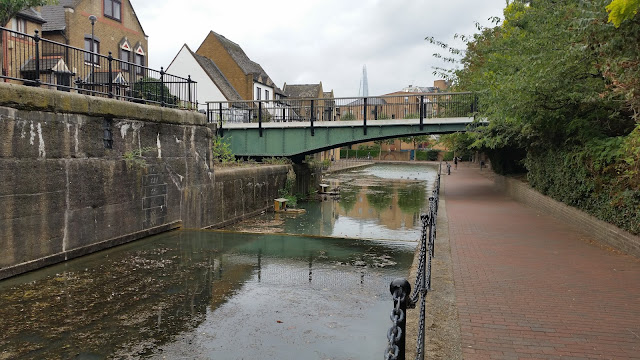
Ornamental Canal, Wapping

Ornamental Canal, Wapping
Looking along the Ornamental Canal towards The Shard.

Just to the east of St Katherine Docks and Marina you will find Hermitage Basin, a small oasis amid a now residential area. This basin is all that is left of the London Docks, which were filled in for redevelopment in around 1983.

Ornamental Canal, Wapping
The old walls of the London Docks.

To keep the history of the London Docks alive a canal was designed, that would link Hermitage Basin to Shadwell Basin. This canal was not designed for river traffic and so was built as an ornamental reminder of bygone times.

Ornamental Canal, Wapping
Not navigable, but full of wildlife. 

The former dock walls were used as features along the Ornamental Canal, which would pass alongside Tobacco Dock, the only warehouses to survive the redevelopment, as it made its way in a north-easterly direction towards Shadwell Basin.

Tobacco Dock and ships
The Tobacco Dock warehouses were built in 1812.

As the canal nears Shadwell Basin it passes beneath Wapping Woods, so the towpath leads you up through this wonderful little park, before rejoining the canal near Shadwell Basin.

Monday, February 26, 2024

Millwall Slipway

London The Unfinished City
Hydraulic ram.

Historic places can be easily missed, even when walking the streets and roads of London.

It was while wandering along Westferry Road, on the Isle of Dogs, that I found what looked like a car park and an ordinary entranceway to the River Thames.

London The Unfinished City
At first glance it looks like a simple slipway.

What made me stop were the bollards at the top of the ramp. These weren't your typical car park bollards, but ones that I have seen countless times near docks and mooring sites. So, I decided to take a closer look.

Heading down the slipway I saw some obviously old machinery, to my left. On closer inspection I discovered that this was a hydraulic ram, once used for closing the long disappeared lock gates.

London The Unfinished City
Hydraulic ram.

The ramp itself was modern, although, as I approached the foreshore, a portion of the old ramp could be seen almost completely covered by sand, rubble and pieces of clay pipes that litter London's beaches.

Tuesday, April 11, 2023

Victoria Park

London The Unfinished City
Bonner Gate.

One of the parks and, to be honest, areas of London that I have rarely walked around is Victoria Park and, by extension, the East End. I have always had a fascination with the East end, but seldom visit it, considering its history.

So I took the opportunity of having some time away from work to explore the park, which covers some 86 hectares.

Having walked from the Queen Elizabeth Olympic Park I entered Victoria Park, via St Mark's Gate, and immediately turned right, having spotted two brick alcoves that were once part of London Bridge and, a little further up the path, the War Memorial.

London The Unfinished City
One of the two alcoves from the old London Bridge.

I then made my way along one of the tree-lined avenues. To my left were large open spaces with people training, sitting and enjoying the sun, walking dogs or, like me, just enjoying the warm weather. To my right cricket and football pitches stretched towards the edges of the park.

This brought me to the Model Boating Lake, splashpool, skatepark and the children's main playground and cafe. To my right, hidden behind some trees there was an Old English Garden, unfortunately not in full bloom, so not as impressive at it usually looks, but still nice to see. 

As I continued the East Fishing Lake came into view, on my right, along with the Burdett-Coutts Drinking Fountain and bandstand, while to my left the open green spaces continued.

Crossing Grove Road, via Diamond Jubilee Gate, I entered the West Park and found myself by the West Boating Lake, with its abundance of wildlife. Herons, ducks, cormorants and geese of various species. The trees surrounding the lake were filled with the sound of Parakeets, screeching to one another.

London The Unfinished City
The West Boating Lake.

Following the path to the right, around the lake, to my right the green spaces continued along with another children's play area. As I moved out of the trees I spotted a Chinese Pagoda to my left across a bridge. 

London The Unfinished City
Pagoda Island.

Thursday, April 06, 2023

Walking with Keilyn: Olympic Park to the Mithraeum... and beyond

London The Unfinished City
Aquatics Centre.

 Tuesday April 4, 2023.

With the first week of the Easter holidays begun and with the weather on our side Keilyn, my 9 year old daughter, and I decided to take a trip to London. On Keilyn's insistence we headed to Stratford, via the Jubilee line, as she wanted to explore the Queen Elizabeth Olympic Park.

Our journey was uneventful and after grabbing a hot drink and some food, at Stratford station, we made our way to the park. 

London The Unfinished City
West Ham FC Stadium.

Crossing WaterWorks River, via Stratford Walk, we were immediately in front of what is now West Ham FC Stadium, while below us, on the river, the Water Chariots and swan pedalos were moored up.

London The Unfinished City
Water Chariots and Swan pedalos.

Turning right we headed towards the Pleasure Gardens Play Area, which Keilyn thought was 'Okay'. We continued by following the course of the River Lea via Middlesex Way, which brought us to Eastcross Bridge, next to which the 'Agitos' stood tall and proud against the blue sky. 

London The Unfinished City
Agitos.

Following the path around brought us to the London Blossom Garden and the Tumbling Bay Playground. Keilyn was suitably impressed with this little park.

London The Unfinished City
Keilyn just swinging around.

From here we clambered up and down hills to see the Olympic Rings, set among a small copse of trees. 

London The Unfinished City
Keilyn, an Olympian in the making?

Then it was back down the hill to Gaskell's Fort play area, which Keilyn loved.

London The Unfinished City
Gaskell's Fort Play area.

Then we crossed Knights Bridge and turned left and ourselves back on Middlesex Way, which we followed until we reached Marshgate Lane. We followed this until we turned onto Bassett Lane, which took us across the River Lea Navigation.