Showing posts with label Memorial. Show all posts

Thursday, October 16, 2025

'Cain Memorial to the Abolition of Slavery' by Michael Visocchi

Cain Memorial to the Abolition of Slavery

Just off Fenchurch Street you will find Fen Court, which was once the churchyard of St Gabriel's Fenchurch Street. This area is now in the Parish of St Edmund the King and St Mary Woolnoth. A few tombs remain among the grass and paved area, with a small bedded maze. But, the most striking feature, of this thoroughfare, is the granite pillars and what looks like a pulpit. This is the 'Gilt of Cain', or, the 'Cain Memorial to the Abolition of Slavery'.

The artwork comprises a group of columns, shaped like sugar cane, surrounding a podium, much like that used in a church or an auctioneer. Around each column are extracts from the poem 'Gilt of Cain', by Lemn Sissay. The podium contains a longer extract from the poem.

Granite congregation shaped like sugar cane

The memorial was designed by Michael Visocchi, in collaboration with poet Lemn Sissay, and was unveiled, in 2008, by Archbishop Emeritus Desmond Mpilo Tutu.

Michael Visocchi designed the granite sculpture to appear as though the columns were silent sentinels of a congregation, facing the podium. His idea was to shape the columns like sugar cane and for the podium to appear more like an auctioneer's stance, while also keeping in mind the ecclesiastical nature of the area. 

A granite pulpit or a slave auctioneer's stance

Lemn Sissay's poem, 'Gilt of Cain', weaves Old Testament biblical references with the coded jargon from the trading floor of the City's stock exchange.

This site was chosen as the Reverend John Newton, who was a slave trader turned abolitionist, was rector of St Mary Woolnoth from 1780-1807. He famously worked closely with William Wilberforce to help bring about the abolition of the transatlantic slave trade. This was achieved in 1807 and brought about the process of the emancipation of slaves, throughout the British Empire.


Thursday, July 10, 2025

Skateboard Graveyard, Golden Jubilee Bridges

Skateboard Graveyard

If you look down on the northeastern support of the Hungerford Bridge and Jubilee Bridges, across the River Thames, you will see the scattered remnants of broken skateboards. 

This is not just some random littering spot, but rather a memorial to a fallen skateboarder. 

Friday June 18, 1999.

Timothy Baxter and his friend, Gabriel Cornish, had spent the midsummer day skating over and around the concrete obstacles of the Undercroft, beneath Queen Elizabeth Hall.

In the evening they went for drinks, much like everybody else, and enjoyed the summer evening. As they headed home, a little after 04:00, via the Golden Jubilee Bridges, they were confronted by six strangers; three teenagers and three young adults; five male and one female.

The strangers took Timothy's rucksack and threw it into the cold water of the River Thames, before beating on Timothy and Gabriel. The last thing Gabriel heard, before passing out, was, "Let's throw them in the river. It will be fun."

Undercroft beneath Queen Elizabeth Hall
The world's longest continually-used skate spot.

Gabriel survived, by using his rucksack to stay afloat, and was rescued two miles downstream with hypothermia. Timothy never regained consciousness and his body was recovered 36 hours later.

The six individuals were caught and charged with murder and attempted murder. In April 2000, following a ten-week trial, they were all found guilty and were sentenced to life imprisonment, in May 2000.

Thursday, January 23, 2025

Special Operations Executive Agents Memorial & Violette Szabo

Special Operations Executive Agents Memorial

This bronze bust of Violette Szabo, on the Albert Embankment, just yards from the Headquarters of the British Special Intelligence Service (MI6), commemorates the secret agents who led covert operations against the Nazis.

This monument was commissioned by the Public Memorials Appeal.

S. O. E.

The Special Operations Executive was secretly formed for the purpose of recruiting agents, men and women of many nationalities, who would volunteer to continue the fight for freedom, by performing acts of sabotage in countries occupied by the enemy during the Second World War.

This monument is in honour of all the courageous S.O.E. Agents: those who did survive and those who did not survive their perilous missions. Their services were beyond the call of duty. In the pages of history their names are carved with pride.

The Heroes of Telemark.

In 1943 Norwegian resistance commandos sponsored by the S.O.E. raided the enemy occupied Norsk Hydro Plant in the Telemark region of Norway.

This successful raid sabotaged the machinery that was producing heavy water, which is used in the manufacture of the Atomic Bomb.

Thanks to those Norwegian Commandos the enemy's attempt to develop the Atomic Bomb was thwarted.

The Maquis French resistance fighters.

470 S.O.E. agents were sent on sabotage missions to occupied France where they fought with networks of French resistance fighters who played an important part in the liberation of France in 1944.

Special Operations Executive Memorial

Violette Szabo.

Violette Bushell was born in Paris, France, in 1921, before her family moved to England. At the outbreak of World War II, she joined the Women's Land Army and the Auxiliary Territorial Service, where she met Étienne Szabo, a Free French corps soldier. They were married and she bore him a daughter, Tanis, in 1942. That same year Étienne was killed in action at the battle of El-Alamein. 

It was this event that led her to join the Special Operations Executive intelligence agency, which, at the time, had its headquarters on Baker Street.

Special Operations Executive Baker Street

Thursday, January 02, 2025

'Wellington Monument' by Richard Westmacott

Wellington Monument

As you enter Hyde Park, from the southeast entrance, you are soon confronted by this incredible statue, which towers over onlookers. It is the Wellington Monument and shows Achilles, with sword and shield.

It is a memorial to Arthur Wellesley, 1st Duke of Wellington, and his victories in the Peninsular War and Napoleonic Wars.

Arthur Wellesley, 1st Duke of Wellington

The statue is cast from captured cannon from his victories at Salamanca, Toulouse, Waterloo and Vittoria, and stands at 18 feet (5.5 metres). It was designed by the sculptor Richard Westmacott. 

The statue, along with the Dartmoor granite base and the mound on which it stands, makes the entire monument 36 feet (11 metres) in height.

The statue cost £10,000 and was funded by donations from British women. 

When it made its way to Hyde Park it was found to be too big to go through the Hyde Park entrance gates, so a hole had to be knocked into the adjoining wall.

Statue of Achilles

The inscription reads:

"To Arthur Duke of Wellington

and his brave companions in arms

this statue of Achilles

cast from cannon taken in the victories

of Salamanca, Vittoria, Toulouse, and Waterloo

is inscribed

by their country women

Placed on this spot

on the XVIII day of June MDCCCXXII

by command of

His Majesty George IIII."

Thursday, November 28, 2024

Smithfield Market: V-2 Rocket attack memorial

Smithfield Market V-2 Rocket attack memorial

On Thursday March 8, 1945, at 11:30, a V-2 Rocket struck the Harts Corner part of Smithfield Market, on the corner of Charterhouse Street and Farringdon Road.

The rocket went through the Victorian market and penetrated the railway tunnels below, causing the market buildings to fall into the resulting crater, along with many of the workers and visitors to the market.

The market had been extra busy, that morning, as many women and children had been queueing in the hopes of obtaining a rabbit, from a consignment that had just gone on sale.

In total 110 people died, while countless others were seriously injured.

This attack happened just weeks before the last V-2 fell on London.

Harts Corner was originally a market for fruit and vegetables, then fish and then a part of the meat market. It had been designed by Sir Horace Jones, but was impossible to salvage after the rocket struck.

Monday, June 03, 2024

Jabez West Drinking Fountain

Jabez West Drinking Fountain
Memorial to a working-class man.

In Southwark Park there is a drinking fountain that was installed in 1885, shortly after the park opened to the public in 1869. 

It is fairly unique as it is a memorial to a working-class man.

Jabez West was born in Princes Risborough, on June 6, 1810, to Anne and William West. His father was a blacksmith. 

He moved to Bermondsey some time in the 1830s and married Sarah Johnson on October 21, 1838. They went on to have seven children.

His wife, Sarah, died in 1873 and, in 1876, he married Hannah Aiton.

Jabez died on May 13, 1884.

Jabez West Information Baord
The information board in Southwark Park.

Although he originally worked in the leather trade he is best known in the area for his devotion to political reform and the temperance movement.

He also campaigned for the creation of Southwark Park.

Following his death the Metropolitan Board of Works took the unusual step of agreeing to this memorial for a working-class man. Made from polished grey granite the fountain was paid for by public subscription at a cost of £120.

Monday, January 08, 2024

Battle of Britain Monument

London The Unfinished City
"Scramble!"

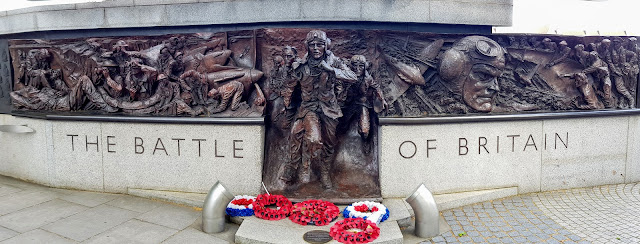
Walking along the Victoria Embankment, near Whitehall, you will discover the Battle of Britain Monument, which stretches along the pavement.

This granite and bronze monument was built so that visitors can interact with it. This impressive monument has scenes from different aspects of the Battle of Britain. From Airmen 'scrambling' to women working in munitions factories to the ground crews who kept the aeroplanes serviced... and more.

London The Unfinished City
"Never in the field of human conflict was so much owed by so many to so few."

I can happily look at this monument for hours, and still find something that I have never noticed before.

Saturday, April 08, 2023

Sir William Wallace Memorial

London The Unfinished City
Sir William Wallace Memorial.

The memorial, above, was installed in 1956, and adorns the wall of St Bartholomew's Hospital, close to where the execution took place.

Below the English text follows an inscription in Latin and Gaelic that translates as:

"I tell you the truth, son, freedom is the best condition, never live like a slave."

"Victory or Death."

The Smithfield area, originally known as Smoothfield, of London was once used by the Romans as a place to muster troops and to bury the dead, and was a large area of open ground outside of the Roman walls. 

Once the Romans had left Londinium the land was used for many different uses throughout the centuries, that included the grazing of livestock, summer fairs, jousting and executions.

Executions took on varying forms that included burning at the stake, for heretics, hanging, and the most vicious execution of all... hanged-drawn-and-quartered, usually reserved for treason. Executions would carry on at this spot until some time in the 1400s, when the gallows were moved to Tyburn. 

The execution area was known as the Elms, which was a medieval word for scaffold.

It is impossible to quantify the amount of people who were put to death here, throughout the centuries, but the most notable for me would be the execution of Sir William Wallace.

Wednesday, March 01, 2023

RAF Bomber Command Memorial

London The Unfinished City

It was on my first visit to the memorial that I began to write more about London and its history, which led me to create this blog. 

London The Unfinished City

The memorial, itself, is an amazing piece of work that inspired me to write a number of pieces about it. That is how much of an impact that it had on me.

London The Unfinished City

Should you find yourself in London's fourth largest Royal Park, then you should definitely take in this huge memorial.

Monday, November 21, 2022

Trafalgar Square: Fourth Plinth

London The Unfinished City
Nelson's Ship in a Bottle.

Ever since Trafalgar Square was opened, in 1844, one of its plinths, situated in the northwest of the square, has remained empty. The other three plinths have statues of King George IV, General Sir Charles James Napier and Major-General Sir Henry Havelock.

It was supposed to have a statue of King William IV affixed, but a lack of funds left the plinth unadorned.

In 1998, the Royal Society for the encouragement of Arts, Manufactures and Commerce commissioned three contemporary sculptures to be temporarily displayed on the plinth. 

Shortly afterwards the Secretary of State for Culture, Media and Sport, commissioned a report to seek public opinion on what should happen with the fourth plinth.

The report recommended a rolling programme of temporary artworks rather than a permanent figure. 

Ownership of Trafalgar Square was transferred from Westminster City Council to the Mayor of London, in 2003, which marked the beginning of the Mayor of London's Fourth Plinth Commission.

Friday, November 11, 2022

A Splash of Colour

London The Unfinished City
Lest We Forget.

I sit beside a fallen tree, looking across my field that has been transformed, these past years. My once lush, emerald pasture has been replaced with a patchwork of myriad browns. My once proud trees lie twisted and broken, like so much mangled machinery, spread without any thought or care. 

Diffused sunlight causes the timber frames and mangled steel of rotting machines, to appear to dance before me, like ghostly silhouettes on the uneven ground. 

Water, which fills the pits and troughs, reflects the dull, colourless sky, adding to my sombre mood. My heart feels heavy. Nothing moves. Nothing lives.

But, suddenly, there is clarity. The droplets from the fine rain, acting like a lens, focus my attention. Among the detritus, at the edge of the field, is there movement? Do my eyes deceive? I resist blinking, trying to focus on the apparition before me. Finally, I blink and the form takes shape. The shape of a man. A man who is staring at me,  as though he can see into my soul. 

My body aches as I rise to my feet. I feel the figure watching me, as I make my way into the field, if it can still be called that.

My progress is hindered by the thick mud, which sucks at my boots, threatening to pull me down into the bowels of the Earth. The figure before me turns, heading toward the centre of the quagmire, seeming to float across the surface. My breath becomes laboured, as my ageing body fights to keep me moving forward. As we get closer to the centre, the figure seems to undulate in-and-out of focus. A wave of nausea sweeps through me as the figure turns and holds my gaze. Tears fill his eyes as he dips his head. With a last great effort I step forward, throwing my arms around him, but he disappears and I topple into the mud. 

The sun, which has finally won its battle with the clouds, breaks through and warms the ground around me. And as I fight my way up and out of the decaying ground, I notice a splash of colour. As my eyes try to focus and my mind works to make sense of everything, exactly where the figure had stood, is a flower, swaying in the gentle breeze. 

The sun illuminates the thin wisp-like stalk, topped with blood-red petals. Somehow, against all the odds, surviving in the mud and detriment... a poppy.

Wednesday, November 02, 2022

National Covid Memorial Wall

London The Unfinished City
National Covid Memorial Wall.

The National Covid Memorial Wall stretches for a third of a mile along the Albert Embankment, from Westminster Bridge to Lambeth Bridge.  It was a risky idea as it could be interpreted as criminal damage, as no permission had been granted.

London The Unfinished City
National Covid Memorial Wall.

The first hearts began appearing in March 2021, when members of the 'Covid-19 Bereaved Families for Justice Campaign' arrived and began painting hearts on the wall.

London The Unfinished City
National Covid Memorial Wall.

At the time of writing there are almost 250,000 hearts painted or drawn onto the wall. The idea being that there be one heart for each person who had Covid listed as a cause of death on their death certificate.

London The Unfinished City
A staggering figure, that could have been much worse.

Tuesday, December 24, 2019

James Braidwood

London The Unfinished City
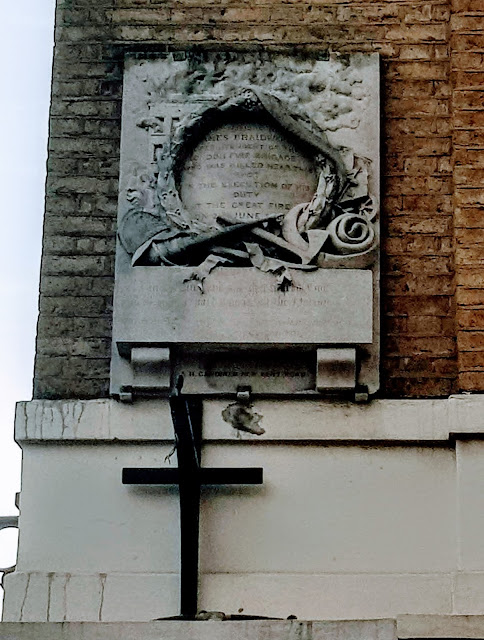
James Braidwood: Founder of the world's first municipal fire service.

I had seen this memorial on many an occasion, but could never quite work out the lettering, although the design obviously made reference to a fire. So, a little digging needed to be done.

The inscription reads;

To the memory of 
James Braidwood, 
superintendent of the 
London Fire Brigade, 
who was killed near this 
spot 
in the execution of his 
duty 
at the great fire 
on 22nd June 1861

A just man and one that feared God, of good report among all the nation.
Erected by the M. or Southwark Division of the Metropolitan Police

S. H. Gardiner, New Kent Road


Wednesday, December 13, 2017

Bomber Command Memorial

London The Unfinished City
"... who now stood thankful, in the early morning sun."
The Bomber Command Memorial, Green Park, is, by far, my favourite memorial, in the Unfinished City. There are countless others that I have visited, but there is something utterly unique about this memorial.

I don't know if it is the sheer scale of the memorial, or the detailing of the statues, or its setting at the corner of Green Park, that makes this my favourite, but there is something that keeps drawing me back to it, again and again.

In fact, I was so moved when I first saw it, that I ended up writing a poem the following day, entitled 'Morning Sun'.

Monday, December 04, 2017

Duke of York Column

London The Unfinished City
The Unfinished City's lost viewing platform.

I have walked by this memorial, to the Duke of York, countless times and assumed that it was a simple memorial atop a column. However, I was always intrigued by the doorway at the foot of the column, wondering why it was there and where it led. Was it to access an underground tunnel or was it simply a later addition, to act as a kind of cupboard? I needed to find out.

Saturday, October 08, 2016

Hardy Tree, Old St Pancras Churchyard


London The Unfinished City
Fraxinus Excelsior.

Saturday October 8, 2016.

For a change, instead of heading in to the Unfinished City to just have a wander, I had made a list of places to visit. This list would see me head from St Pancras down to Kensington, returning via Buckingham Palace before walking to Baker Street, where I would catch a train home.

St Pancras Old Church was a place that I had heard lots about and had always wanted to visit. I was especially looking forward to seeing The Hardy Tree, surrounded by headstones.


Sunday, March 06, 2016

Monument to the Great Fire of 1666

London The Unfinished City
A Monument and a Scientific Laboratory.
Sunday March 6, 2016.

The Monument, as it is known, once stood proud above the skyline of the Unfinished City, offering unparalleled views of the great city. 


Since its construction it has now been dwarfed by the newer buildings in the area, which has led me to wander past this icon, without even noticing it. Today was different, and I managed to grab a shot, whilst trying to avoid the hundreds of tourists and business types.

One of the reliefs on the Monument
One of the engravings at the base of the Monument.

However, the views are still pretty spectacular and, for a small price, are worth climbing the steps for. Plus, as an added bonus, you receive a certificate to say that you have climbed it.

Sunday, November 01, 2015

'Dockers' by Les Johnson

London The Unfinished City
Holland, Ringwood and Tibbs.

Sunday November 1, 2015.

It was a particularly foggy Sunday November morning, in the Unfinished City, as I strolled around the old Royal Docks. Still, this helped to take some dramatic and atmospheric shots, as the area was pretty much deserted. 

This image of The Dockers, with the cranes disappearing into the fog, became one of my favourite shots of the morning.

Saturday, January 31, 2015

Memorial to Heroic Self-sacrifice, City of London

London The Unfinished City
More than just a park.

Saturday January 31, 2015.


It was during a wet Saturday morning, in January, when I found this quiet little park. I had been enjoying a stroll from St Paul's Cathedral, through Paternoster Square and up to Greyfriars Church Garden, when I noticed a gate leading into a small park. So, I went in to see if there was anything of interest. And, boy, was there. 

The park appears, at first, to be simply a small patch of grass, surrounded by paving slabs and benches, with a few trees and bushes breaking up the space. As you move further into the park you notice a sundial and a small fountain. 

The memorial
A very sombre place.

However, it is not until you enter the park proper that you notice a small, covered area, with ornate tiles affixed to a wall. The legend, written on the timber, says, "Commemoration of heroic self-sacrifice."

The tiles all commemorate local heroes who lost their lives while saving others.

Saturday, March 08, 2014

William Huskisson

London The Unfinished City
The World's first person to be killed by a railway locomotive.
Saturday March 8, 2014.

It was during a walk from Battersea to Westminster that I spotted this statue of a man dressed in a toga. The dates on the statue, however, didn't explain why this figure should be dressed in Roman garb, so I decided to do some research. I can still not work out why he is depicted in this way.