Showing posts with label Wooden Roads. Show all posts

Sunday, December 29, 2024

Walking with Erin and Summer: Piccadilly Circus to Covent Garden... and beyond

River Thames with low cloud

Saturday December 28, 2024.

Erin and Summer, who had joined us on our last family walk, wanted to go to London to see Chinatown and have dinner out. So, after agreeing we set off as normal with a train to Baker Street and, to save time, a Bakerloo line train to Piccadilly Circus, from where our walk would begin.

World Time Linear Clock, Piccadilly Circus

Although they only wanted to visit Chinatown and eat out, I said that I would take them to some other places, as Summer explained that she didn't really get to see the sites. So, the first thing I pointed out was the World Time Linear Clock, at Piccadilly Circus station.

Chinatown, Wardour Street

Chinatown was busy, as it always is, as meandered our way through the throng of people queuing to dine, tourists snapping photos of the gates and those just going about their daily business. The smell of the various foods, from restaurants and bakeries, was intoxicating, making me feel hungrier than I actually was. Unfortunately, Erin and Summer had already planned where we having lunch, so I would have to wait.

Wonder Woman Statue

After walking through Chinatown we found ourselves on Leicester Court, where we saw the statue of Wonder Woman, before heading east, crossing Charing Cross Road onto Cranbourn Street and then Garrick Street. We walked up King Street and entered Covent Garden, where we watched a street performer juggling knives on a tightrope, before heading into the Apple Market building to peruse the stalls. 

Covent Garden Street Performer

At the northern end another entertainer was performing Shakespeare while balancing on a free-standing ladder. He followed this Shakespearean effort by juggling three clubs, while still atop the free-standing ladder. He was, quite possibly, one of the most entertaining performers that I had seen in a while. Erin and Summer enjoyed his performance, too, placing a £5 note in his hat at the end of his act.

Monday, January 15, 2024

Slabs, Markers & Covers

Although there is much to see when it comes to London's architecture, with her old buildings juxtaposed with new, it is always worth looking at what is below your feet.

Just as plaques of various styles adorn the walls around this great city, there are more to be found on the pavements, curbs and alleyways.

London The Unfinished City
Coal hole cover.

Not only are there numerous styles of Coal Hole Covers, to be found, but there are still places where you can find Wooden Paving on London's streets.

London The Unfinished City
Wooden paving.

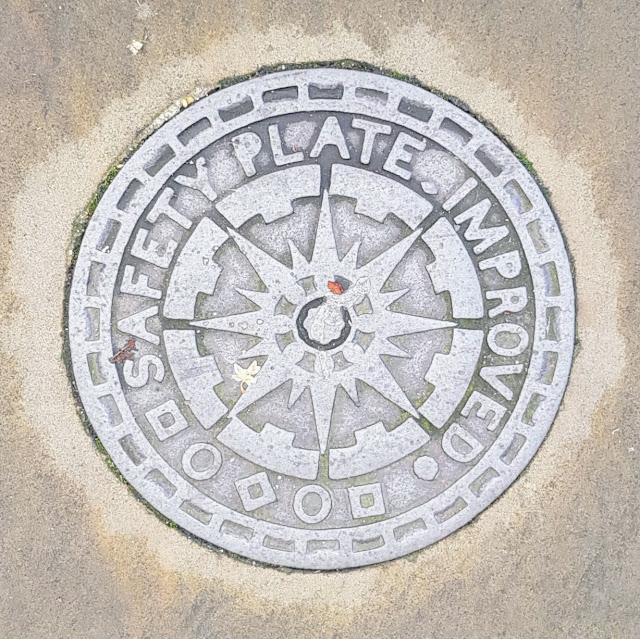
Sometimes the slabs are not concrete, wood or marble, but metal, often used as steps or utility covers.

London The Unfinished City
Metal steps plaque.

London The Unfinished City
Utility hole cover, Greenwich. 

Then there are the newer slabs, added to keep the history of an area alive.

London The Unfinished City
The Merchant Line, London Bridge City.

London The Unfinished City
Red Lion Court.

London The Unfinished City
St Dunstans Court.

Friday, September 23, 2022

Streets paved with gold. No, but paved with wood, sometimes.

London The Unfinished City
Wooden detail on the road.

"London's streets are paved with gold." - Uh, no they are not.

London's streets have never been paved with gold, obviously. They have, however, been paved in concrete, tarmac, cobbles, cork and wooden blocks, throughout the years. And, depending on the area of the city, a different type of wood was used: Australian Jarrah a hardwood was used in the 'posh' areas, while Swedish a yellow deal softwood was used on the main thoroughfares.

Although the idea of using wood had been around for years, it wasn't until 1839 that wooden blocks were first trialled on the streets of London, outside the Old Bailey.
 
London The Unfinished City
Chequer Street.

Then, in 1843, a meeting was brought to discuss the discontinuation of the use of wood in favour of granite cobbles (setts). Wood had proved to be problematic and it was found that the blocks would need to be covered in pitch and sanded. Also, accidents were occurring where roads went from one type of surface to another. The wooden blocks becoming slippery in wet weather.