Showing posts with label Stoke Newington. Show all posts

Monday, November 11, 2024

Abney Park Cemetery, Stoke Newington

Abney Park Cemetery

Abney Park Cemetery was the fourth of the eight private garden cemeteries, when it opened in 1840. It is situated in the grounds of Abney House which was once home to Isaac Watts.

For over 300,000 years people have gathered in this area, where Stone Age tools have been discovered along the banks of Hackney Brook.

It's modern roots go back to before the arrival of William the Conqueror, in 1066, when, as a small settlement, it was surrounded by land made up of fields.

In the 1600s wealthy families had large houses, with larger gardens, built here. These included Abney House and Fleetwood House. These houses were purchased by the Abney Park Cemetery Company, so that a garden cemetery could be built.

The cemetery was designed as an arboretum, botanical garden and park, as well as a place of remembrance. When it opened it had over 1,000 types of rose, from Hackney's Loddiges nursery, and 2,500 tree varieties.

By the 1960s the Cemetery Company, which had begun to lose income, leaving Abney Park to fall into neglect. Brambles, ivy and self-seeded trees allowed nature to take over.

Abney Park is now Grade II listed and is designated as a Local Nature Reserve.

Chapel

The chapel was the first non-denominational cemetery chapel in Europe.

Abney Park Mortuary Chapel was designed by William Hosking and built by John Jay. The open part is where hearses brought the coffins, while inside a staircase led up to a gallery. The spire was the tallest, in the area, and could be seen from quite a distance.

It was designed in a style that was not related to any specific branch of Christianity, so that anyone could have their funeral held here. The chapel, like the cemetery, was never consecrated, making it a popular burial ground for Dissenters, especially after Bunhill Fields closed to burials.

By the 1960s the chapel was in a sorry state of disrepair, but it wouldn't be until 2017 when the roof could be repaired, following a grant from Historic England. 

The National Lottery Heritage fund gave funding for the rest of the building to be restored, between 2021-23. The stained-glass window, installed in 2021, was designed by Piotr Frac, who worked with local schools and community groups. The window represents nature in the four seasons.

Salvation Army graves

In 1865 William and Catherine Booth founded the Salvation Army, so that they take God's salvation to the world.

When Catherine died, in 1890, she was buried at Abney Park. Other early leaders of the Salvation Army, including George Scott Railton and Elijah Cadman, were also buried here.

When General William Booth died, in 1912, he was buried beside his wife in one of the largest funerals London had ever seen. William and Catherine are laid to rest surrounded by the graves of many of their children.

Today, there are over 130 Salvationists buried at Abney Park.

War Memorial

This War Memorial was built in 1927, by the Commonwealth War Graves Commission to commemorate over 150 Commonwealth servicemen and women by name. Another 71 names were added following World War II.
Private H. F. Scott

There are 375 service personnel remembered at Abney Park, with over 140 in marked graves scattered throughout the park. Some of these have the distinctive Commonwealth War Graves Commission headstones.

Thursday, November 07, 2024

16 Alkham Road: Site of first bomb attack of World War I

16 Alkham Road

This typical house in Stoke Newington, Hackney, looks a lot like the rest of the houses in this terrace. However, unlike the majority of the other homes, this one has had the top floors extensively rebuilt.

The house also holds a rather unique place in London history, but we will have to travel back over 100 years to find out why.

Shortly after 23:00 on Monday May 31, 1915, the German Zeppelin LZ38 dropped its first bomb on London. This incendiary bomb crashed through the roof of 16 Alkham Road setting the upper floors alight.

The occupants, the Lovell family and two guests, all escaped without injury, with the fire being quickly extinguished by the fire brigade.

Zeppelin LZ33

Zeppelin LZ38 continued travelling over Hackney, Dalston, Shoreditch, Whitechapel, Tower Hamlets and Stepney, dropping high-explosive and incendiary bombs on the unsuspecting, and sleeping, people below.

On this first raid the LZ38 dropped a total of 91 incendiary devices, 28 explosive bombs and 2 grenades, resulting in 7 people being killed, 35 more injured and 41 fires started.

Between 1915 and 1918 there were over 20 air raids by Zeppelin and aircraft.

Following this raid restrictions were put in place across England, ensuring that only generalised locations of bombing raids were reported to the public.

Trivia: 

The bomb that hit 16 Alkham Road was the first time London had been attacked by a foreign military power in almost 1,000 years. The last time had been 1066, when William the Conqueror entered London.

Commemorative Plaque

Monday, November 04, 2024

Walking with Keilyn: Stoke Newington to Abney Park Cemetery... and beyond

Ghost Sign
'Ghost' signs.

Wednesday October 30, 2024.

Following my minor leg operation, last Friday (25th), this was my first chance to venture out for a walk. So, with Keilyn at my side, we headed out for a short walk to test my leg. However, this 'short walk' ended up being longer than I expected. Still it was good to be out and about again.

We grabbed a taxi to Watford Underground station and caught a train to Finchley Road, where we waited for an Aldgate train that would take us to Liverpool Street. 

At Liverpool Street we caught a London Overground train bound for Cheshunt, which we alighted from at Stoke Newington. 

Cedra Court
Some of these flats were owned by the Kray twins.

We headed along Cazenove Road to Cedra Court, where the Kray twins once owned properties, before heading down Geldeston Road in search of my grandfather's old family home. Unfortunately, the house had been demolished, with flats taking up the space. 

Royal Sovereign public house
The Royal Sovereign public house.

However, on the corner was the Royal Sovereign pub, which was used as a location in the Scott Adkins 2018 movie 'Accident Man'.

16 Alkham Road plaque
Site of the first attack on London by a foreign military power in nearly 1,000 years.

We then turned down Northwold Road, stopping at 16 Alkham Road, site of the first bomb to be dropped on London during World War I, before reaching the Yellow Warbler coffee shop, where hot drinks were purchased.

Abney Park Cemetery Egyptian revival entrance
The Egyptian revival entrance to Abney Park Cemetery.

With drinks in hand we crossed Stoke Newington High Street and entered Abney Park Cemetery via the Egyptian revival entrance.

Tuesday, December 24, 2019

James Braidwood

London The Unfinished City
James Braidwood: Founder of the world's first municipal fire service.

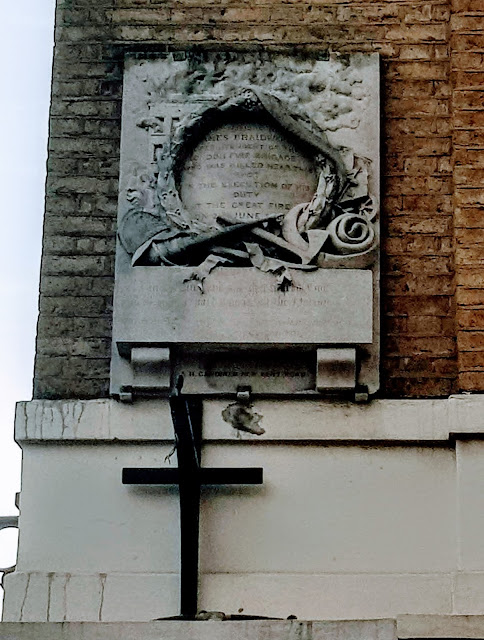
I had seen this memorial on many an occasion, but could never quite work out the lettering, although the design obviously made reference to a fire. So, a little digging needed to be done.

The inscription reads;

To the memory of 
James Braidwood, 
superintendent of the 
London Fire Brigade, 
who was killed near this 
spot 
in the execution of his 
duty 
at the great fire 
on 22nd June 1861

A just man and one that feared God, of good report among all the nation.
Erected by the M. or Southwark Division of the Metropolitan Police

S. H. Gardiner, New Kent Road