"Not all those who wander are lost..." Come with me as I explore London's history, hidden gems and unusual places.
Thursday, December 25, 2025
All Hallows by the Tower
Monday, September 29, 2025
"Why are there no roads within the City of London?"
The City of London was founded nearly 2,000 years ago, by the Romans, before they eventually left Londinium, leaving the City for nature to reclaim.
Over the centuries different tribes and groups moved to within the old City walls. Eventually these small villages coalesced into large hamlets and towns. And as they grew and expanded alleys, avenues, lanes, passages, pathways, streets, yards and walks were formed, creating thoroughfares. However, there were no roads.
This is because the Romans had streets, which comes from the Latin 'strata', making the word 'street' one of the oldest continually used words in the English language.
It wouldn't be until the late 1500s that the word 'road' would enter the English language. 'Road' is derived from the Old English word 'rad', which means 'a riding journey, usually with hostile intent'. Hence the word 'raid'.
As the City of London had been around for centuries, before this, all of its thoroughfares were already named.
In 1994 everything changed, for the City of London. Boundary changes were put in place which caused the City of London to 'absorb' part of Goswell Road from neighbouring Islington.
Ironically, Goswell Road was known as Goswell Street, up until 1864.
Goswell Road is over three quarters of a mile in length, but only about 100 yards of it falls within the City boundary. So, technically, there is still not a single entire road within the City of London.
Thursday, June 06, 2024
'Ring of Steel', City of London
![]() |
| A City of London police sentry box. |
Walking through and around the City of London you may notice that roads, entering the City, narrow and concrete islands have, usually empty, Police sentry boxes on them.
These sentry boxes are a remnant of far more dangerous times. They were put in place, along with narrower roads and CCTV cameras, as a response to the IRA threats to the City of London from the 1970s through to the 1990s. This initiative became known as the 'Ring of Steel'.
But, this wasn't the City of London's first form of protective security. For that we must go back to the founding of Londinium.
![]() |
| The City of London's original defensive ring. |
The Romans constructed a wall, many parts of which are still visible, to protect early Londinium from invasion from the Picts, who had invaded northern Britain and overrun Hadrian's Wall.
To further protect Londinium the Roman's increased fortifications along the wall, as well as increasing the wall's height.
Various Wards were also created within the City walls, ensuring that communities were linked and security could be maintained. These community links are still as important today for keeping the City of London safe.
Terrorism became an issue for the City of London, and London as a whole, when Irish Republicans began a bombing campaign between 1867 and 1885. This was followed by Militant Suffragette actions, along with Anarchist attacks.
The Irish Republican Army started a limited campaign between 1939 and 1940, which became known as the 'Sabotage Campaign',
The most deadly attacks began in 1973 and would continue until 1997, when the Provisional Irish Republican Army began a sustained campaign during what was called 'The Troubles'. This was further exacerbated by attacks related to Middle East politics and more Anarchist attacks.
![]() |
| The City of London's 'Ring of Steel'. |
It was during the 1990s that a new 'Ring of Steel' was put in place. This involved the narrowing of roads and the adding of small chicanes, which forced drivers to slow down. Concrete medians were also installed, each with a police sentry box manned by armed police. Some roads were closed to traffic altogether.
CCTV cameras recorded vehicles entering, and leaving, the City of London. One of the measures, now used throughout the world, was Automatic Number-Plate Recognition (ANPR) which was developed in the City of London. Today, the whole of London has traffic monitoring systems which are constantly viewed by police. This data is kept for five years.
Some dissident members of the Real Irish Republican Army and Islamic terrorists have continued to attack locations within the City of London, London and the UK, up to the present day.
![]() |
| Keilyn in a police sentry box. |
As new threats are detected new technology evolves. Cameras are moved, upgraded or more are installed. As the City of London changes, with roads rerouted, new businesses moving in or new infrastructure being constructed the 'Ring of Steel' adapts, doing its best to keep us safe.
Monday, May 08, 2023
Pudding Lane Steps
![]() |
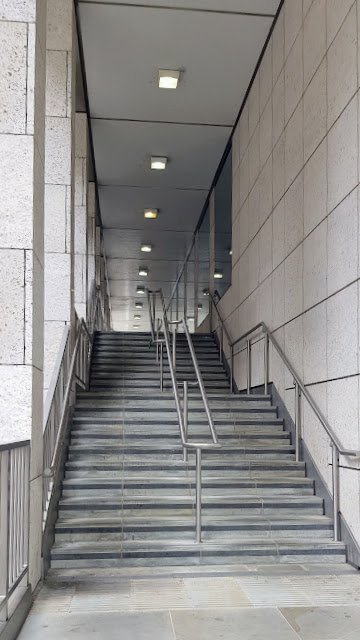
| These stairs lead to a viewing area looking out over the River Thames. |
Exploring London, as I do, I invariably discover new shortcuts, pieces of history or some hidden gem that I knew nothing about.
So it was on this particular Bank Holiday as I, Keilyn and my friend Gary made our way from Aldgate, via a meandering route, towards Baker Street, taking in the sites along the way.
As we approached The Monument I remembered that there was a stairway that would lead to a viewing area, above the north bank of the River Thames, so we set about finding it.
The stairway was easy to find, being situated on the corner of Monument Street and Pudding Lane, so up it we climbed, with Keilyn going ahead and looking for fossils in the stone walls of the office building.
At the top of the stairway, with the offices to our right, we could look down on Pudding Lane on our left, while ahead was an information board and an engraved slab.
![]() |
| Roman London information board. |
Saturday, August 04, 2018
London's Roman Fort, Walls & Bastions
![]() |
| Part of the Roman Fort Wall and Bastion 14, London Wall. |
I have always had a fascination with the Romans and, by extension, there creation of Londinium, so I have always looked forward to visiting as much of the remaining wall and fortifications, as I can.
![]() |
| Marker number 3 of 21. |
Saturday, June 06, 2015
Roman Bath
![]() |
| Roman? Tudor, more like! |
Saturday June 6, 2015.
This is one of the more unusual, hidden gems of the Unfinished City, that I had been eager to see for quite a while. The National Trust, who look after the Roman Bath, state that the you can visit at any time between 09:00 and dusk, to view the Roman Bath through a grill, but viewing of the interior must be made by contacting Westminster Council.