Showing posts with label Metropolitan Police. Show all posts

Monday, July 28, 2025

Model of Old London Bridge, Church of St Magnus-the-Martyr

Some of the figures in the model

Inside St Magnus-the-Martyr Church, on Lower Thames Street, is a remarkable model of the Medieval London Bridge.

This four-metre long model was built by David T Aggett, a member of the Metropolitan Police. He was also a keen model maker and this model of Old London Bridge took him almost three years to complete.

The model shows how Old London Bridge would have looked in 1400 and is built, predominantly, from cardboard boxes. 

He was also a liveryman of the Worshipful Company of Plumbers, so he donated the model to the Church, which is the church of the Worshipful Company of Plumbers

A Metropolitan Policeman

As a little joke he placed a Metropolitan Policeman on the bridge, which people can seek to find when admiring the model. 

Besides the Policeman there are countless other figures going about their daily routines, which can bring a smile to your face.

St Magnus-the-Martyr Church was once the entrance way to the old London Bridge, before the bridge was demolished and moved 30 metres to the west. So, it is fitting that the model resides here.

The Central Gatehouse

Monday, December 09, 2024

Myddelton Passage Etchings: A unique historical record

Myddelton Passage

On first turning on to Myddelton Passage it looks like a typical London road. Houses along one side stand opposite a brick wall, that, although old, looks rather plain.

It is not until you begin to walk along the path that you will notice etchings in the bricks. Random numbers, initials and letters can soon be seen. Although sporadic, at first, they begin to fill entire areas of the wall.

Myddelton Passage Etchings

Could they be some form of code or something else, entirely?

Thursday, June 06, 2024

'Ring of Steel', City of London

Police Sentry Box
A City of London police sentry box.

Walking through and around the City of London you may notice that roads, entering the City, narrow and concrete islands have, usually empty, Police sentry boxes on them. 

These sentry boxes are a remnant of far more dangerous times. They were put in place, along with narrower roads and CCTV cameras, as a response to the IRA threats to the City of London from the 1970s through to the 1990s. This initiative became known as the 'Ring of Steel'.

But, this wasn't the City of London's first form of protective security. For that we must go back to the founding of Londinium. 

Roman Wall
The City of London's original defensive ring.

The Romans constructed a wall, many parts of which are still visible, to protect early Londinium from invasion from the Picts, who had invaded northern Britain and overrun Hadrian's Wall. 

To further protect Londinium the Roman's increased fortifications along the wall, as well as increasing the wall's height.

Various Wards were also created within the City walls, ensuring that communities were linked and security could be maintained. These community links are still as important today for keeping the City of London safe.

Terrorism became an issue for the City of London, and London as a whole, when Irish Republicans began a bombing campaign between 1867 and 1885. This was followed by Militant Suffragette actions, along with Anarchist attacks.

The Irish Republican Army started a limited campaign between 1939 and 1940, which became known as the 'Sabotage Campaign',

The most deadly attacks began in 1973 and would continue until 1997, when the Provisional Irish Republican Army began a sustained campaign during what was called 'The Troubles'. This was further exacerbated by attacks related to Middle East politics and more Anarchist attacks.

Police Sentry Box and Police Car
The City of London's 'Ring of Steel'.

It was during the 1990s that a new 'Ring of Steel' was put in place. This involved the narrowing of roads and the adding of small chicanes, which forced drivers to slow down. Concrete medians were also installed, each with a police sentry box manned by armed police. Some roads were closed to traffic altogether.

CCTV cameras recorded vehicles entering, and leaving, the City of London. One of the measures, now used throughout the world, was Automatic Number-Plate Recognition (ANPR) which was developed in the City of London. Today, the whole of London has traffic monitoring systems which are constantly viewed by police. This data is kept for five years.

Some dissident members of the Real Irish Republican Army and Islamic terrorists have continued to attack locations within the City of London, London and the UK, up to the present day.

Police Sentry Box
Keilyn in a police sentry box.

As new threats are detected new technology evolves. Cameras are moved, upgraded or more are installed. As the City of London changes, with roads rerouted, new businesses moving in or new infrastructure being constructed the 'Ring of Steel' adapts, doing its best to keep us safe.

Thursday, June 08, 2023

Was this London's Smallest Police Station?

London The Unfinished City
It is NOT a Police Station.

Supposedly, on Trafalgar Square's south east corner, stands the UK's smallest Police Station. It is not! It never has been and it never will be.

The closest that it has been to being a Police Station was from 1928 until the 1970's, when it was used as a Police Observation Post.

So, let's clear this matter up.

According to many websites the Police Station was erected at the behest of Sir Lionel Edwards, who was in charge of the Office of Works.

However, no such person ever existed.

There was a Sir Lionel Earle, permanent secretary to the Office of Works, and a Mr G. Edwards OBE of the Metropolitan Police. These two men did correspond with each other and it is entirely plausible that the names were confused, at some point, and Sir Lionel Edwards came into being.

London The Unfinished City
"the Telephone Box inside the great granite base of the big lamp".

Now, the Police Station.

There had been correspondence between the Metropolitan Police and the Office of Works about having a Police Box erected in Trafalgar Square since the late 1910's.

A wooden telephone box was installed by the entrance to Trafalgar Square underground station in 1919, but the Police were after something bigger and more permanent. Their rationale was as Trafalgar Square was a place where protesters met, usually without any warning, they needed somewhere from which to keep an eye on the crowds and have the ability to call for reinforcements, if necessary. 

In 1921 the wooden box was still affixed to the London Underground entrance, but London Underground it removed as they had plans of their own.

At one point there was the suggestion put forward that an observation post could be installed on the roof of the National Gallery. This was turned down by the Metropolitan Police and was never mentioned again.

There was also the idea of erecting a wooden Police Public Call Box, but it would have been too conspicuous, so this idea was rejected, too.

Following the General Strike riots, of 1926, Sir Earle wrote to Mr Edwards with the suggestion that "...it might be possible to get the Telephone Box inside the great granite base of the big lamp at the end of the balustrade...".

Mr Edwards wrote back that he had had the same idea, but had dismissed it.

In July 1927 Sir John Anderson, the Permanent Under-Secretary of State at the Home Office, approved the observation box, which was estimated at costing £550.

London The Unfinished City
Nothing more than an Observation Post.

New granite was ordered and transported to London from Cornwall. 

In March 1928 the Observation Post was completed and the old wooden telephone box was removed.

During the 1930s the lamp, which had been run using gas, was converted to electricity. In addition the lamp was controlled in such a way that it blinked when the telephone rang, so that the officers could see it from across the square.

In the 1970's, with the introduction of radio communication, the observation post became redundant and has since had the telephone removed.

Sadly, it is now just used for storage., but Police Officers from around the world still come to see, and have their photo taken with, what they believe is London's smallest Police Station.

London's smallest Police Station was in Wellington's Arch from 1851 until at least 1968.

London's smallest Police Station, currently, is Pinner Police Station in the Borough of Harrow and within the Metropolitan Police's Greater London coverage.

Sunday, May 21, 2023

Police Public Call Post

London The Unfinished City
Walbrook.

Having spotted a few of these Police Public Call Posts, on my travels, I decided to find out how many are left and when they stopped being of use.

London The Unfinished City
Outside St Botolph’s Church, Aldgate.

Situated throughout London, the City of London and right across the British mainland, these Police Public Call Posts would have been a common sight, from the 1920s onwards.

Wednesday, January 19, 2022

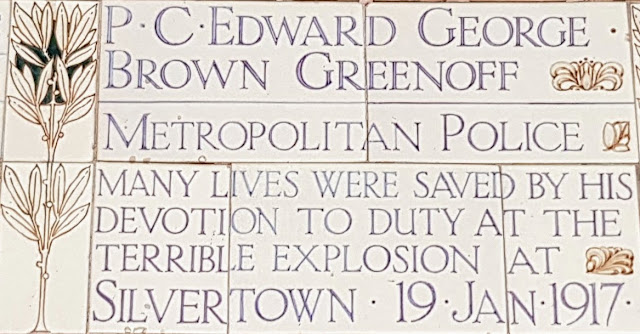
Police Constable Edward George Brown Greenoff


London The Unfinished City
P. C. Edward George Brown Greenoff (1886-1917).

On the evening of Friday January 19, 1917, a fire broke out at the Brunner Mond chemical factory off North Woolwich Road. The factory had been closed in 1912, only to be reopened in 1915 to purify Trinitrotoluene (TNT) for the war effort.

Within minutes of the outbreak of the fire an engine, from the new Brigade headquarters, was trying to dampen the blaze. 

Police Constable Edward Greenoff, of the Metropolitan Police's K Division, was on his beat when he noticed the fire. Realising what was in the building and the imminent danger of an explosion, P.C, Greenoff ran towards the fire to aid in the evacuation of the factory. If it had not been for this act of bravery the death toll would have been a lot higher. He then urged the people who had come to witness the fire to stay back and away from the flames. 

Then there came a rumbling sound and an explosion ripped the building apart. P.C. Greenoff was thrown forward by the force of the explosion and was knocked unconscious.

The building exploded with such force that girders, masonry and even a boiler, weighing several tons, were catapulted through the air. The shockwave, which was felt almost a mile away, ripped roofs from nearby buildings and flattened cottages within the area.

There were 73 fatalities and over 400 more were injured. 

P.C. Edward Greenoff was taken to Poplar Hospital where he died from his injuries on January 28th or 29th.

P.C. Edward George Brown Greenoff was buried in St Marylebone Cemetery, East Finchley.

This plaque is situated on the wall of the G. F. Watts Memorial to Heroic Self-Sacrifice, in Postman's Park.

Friday, September 30, 2016

Policeman's Hook

London The Unfinished City
A one-of-a-kind cloak hook.

Friday September 30, 2016.


It was a beautiful Summer's day, as I strolled down Long Acre on one of my strolls around the Unfinished City. As I reached the junction I was unsure of which direction to take, so I mentally flipped a coin and decided to head along Great Newport Street

As I crossed the road I noticed this peculiar looking hook, on a wall of one of the buildings. As I had never seen anything like it I decided to take a photo, so that I could do some research when I returned home. As it turns out, this is the only Metropolitan Police Hook in London.