Showing posts with label Suffragette. Show all posts

Thursday, June 06, 2024

'Ring of Steel', City of London

Police Sentry Box
A City of London police sentry box.

Walking through and around the City of London you may notice that roads, entering the City, narrow and concrete islands have, usually empty, Police sentry boxes on them. 

These sentry boxes are a remnant of far more dangerous times. They were put in place, along with narrower roads and CCTV cameras, as a response to the IRA threats to the City of London from the 1970s through to the 1990s. This initiative became known as the 'Ring of Steel'.

But, this wasn't the City of London's first form of protective security. For that we must go back to the founding of Londinium. 

Roman Wall
The City of London's original defensive ring.

The Romans constructed a wall, many parts of which are still visible, to protect early Londinium from invasion from the Picts, who had invaded northern Britain and overrun Hadrian's Wall. 

To further protect Londinium the Roman's increased fortifications along the wall, as well as increasing the wall's height.

Various Wards were also created within the City walls, ensuring that communities were linked and security could be maintained. These community links are still as important today for keeping the City of London safe.

Terrorism became an issue for the City of London, and London as a whole, when Irish Republicans began a bombing campaign between 1867 and 1885. This was followed by Militant Suffragette actions, along with Anarchist attacks.

The Irish Republican Army started a limited campaign between 1939 and 1940, which became known as the 'Sabotage Campaign',

The most deadly attacks began in 1973 and would continue until 1997, when the Provisional Irish Republican Army began a sustained campaign during what was called 'The Troubles'. This was further exacerbated by attacks related to Middle East politics and more Anarchist attacks.

Police Sentry Box and Police Car
The City of London's 'Ring of Steel'.

It was during the 1990s that a new 'Ring of Steel' was put in place. This involved the narrowing of roads and the adding of small chicanes, which forced drivers to slow down. Concrete medians were also installed, each with a police sentry box manned by armed police. Some roads were closed to traffic altogether.

CCTV cameras recorded vehicles entering, and leaving, the City of London. One of the measures, now used throughout the world, was Automatic Number-Plate Recognition (ANPR) which was developed in the City of London. Today, the whole of London has traffic monitoring systems which are constantly viewed by police. This data is kept for five years.

Some dissident members of the Real Irish Republican Army and Islamic terrorists have continued to attack locations within the City of London, London and the UK, up to the present day.

Police Sentry Box
Keilyn in a police sentry box.

As new threats are detected new technology evolves. Cameras are moved, upgraded or more are installed. As the City of London changes, with roads rerouted, new businesses moving in or new infrastructure being constructed the 'Ring of Steel' adapts, doing its best to keep us safe.

Thursday, February 22, 2024

How did London's Underground & Overground lines get their names?

"Names mean almost nothing." - Jean-Luc Picard

"Names mean almost everything."  - Jack Crusher

London The Unfinished City
Image Copyright TfL

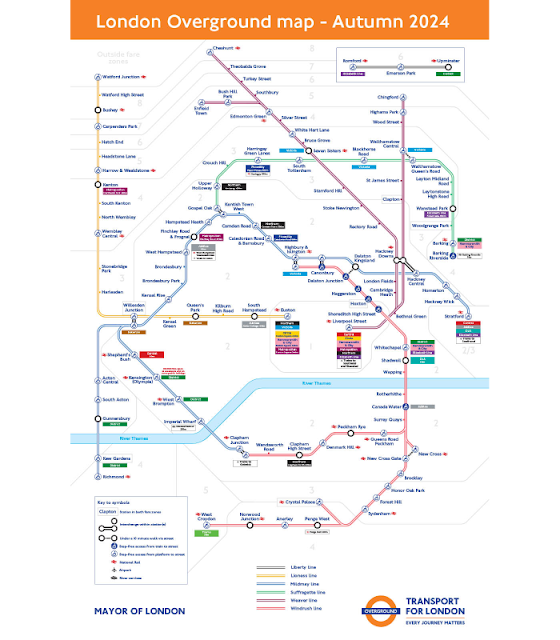
So, from Autumn 2024, the six London Overground lines are to be given distinct names and colours.

London Mayor, Sadiq Khan, has finally followed through with one of his 2021 Labour Mayoral manifesto pledges, which was to overhaul and rename the London Overground lines. The total cost of the project is around £6.3 million, which is an eye-watering amount of money, especially with current financial woes. 

But, hey, it will make things clearer and easier... won't it?

After hearing this news, I thought it would be fun to look at the etymology of the London Underground line names, before looking at the new ones.

Bakerloo - A portmanteau of the 'Baker Street and Waterloo Railway'.

Central - Originally called the Central London line it was shortened to Central line in 1937.

Circle - Quite simply the line is a loop. Easy. Except, as of 2009, it no longer runs in a complete circle.

District - Originally built by the Metropolitan District Railway, it became known as the District line so as not to be confused with the Metropolitan Railway.

Elizabeth - Originally this line was to be called Crosstrail, but, no. Once again a more regal name was chosen, and so was named in honour of HM Queen Elizabeth II.

Hammersmith & City - Quite simply it runs from Hammersmith and through the City. Boring.

Jubilee - Originally proposed as the Fleet line, various financial issues, construction delays and changes to its route saw it called the Jubilee line, in honour of Queen Elizabeth II's silver jubilee in 1977. Nice, but the line didn't open until 1979 and wasn't completed until 1999.

Metropolitan - The world's first underground railway was built by the Metropolitan Railway Company. I think the clue is in the name.

Northern - The City & South London Railway built the first proper underground line, built by boring a tunnel, rather than the cut-and-cover method. The Charing Cross, Euston & Hampstead Railway became owned by the Underground Electric Railways Company of London. In 1914 the Underground Electric Railways Company of London bought the City & South London Railway and, by adding extensions, allowed the lines to run on the same line. None of this explains why the name Northern was chosen though. 

Piccadilly - The Great Northern, Piccadilly & Brompton Railway ran from Finsbury Park under Piccadilly to Brompton. Quite simply, as the line reached the West End the name was shortened to simply Piccadilly.

Victoria - In 1955 plans were put forward for a new underground line between Victoria and Walthamstow. While planning the line various names were suggested. First there was the Walvic line (Walthamstow-Victoria) and the much better Viking line (Victoria-King's Cross). However, those that know best decided to be as boring as possible and call it the Victoria line. I much prefer Viking line.

Waterloo & City - The London and South Western Railway had their terminus at Waterloo Bridge, from where they ran trains to Southampton and back. However, for those people who needed to cross the river, this wasn't good enough. Thankfully, a new company named the Waterloo & City Railway Company obtained permission to build a new line from Waterloo Bridge to a new City station. The line was immediately called the Waterloo and City, although City station would be renamed Bank, the line kept its name.