
The East India Docks were constructed between 1803-1806 and were the third set of wet docks built on the River Thames, in the early 19th century. By the end of the 18th century East Indiamen ships had been sailing from Blackwall for almost 200 years.
The East India Company, founded in 1600, shipped valuable goods from the East to the River Thames. It was a rich, powerful and well organised body using the largest two ships that frequented the Port of London. The valuable cargoes were moved by barge to the city, then carried to the company's spacious warehouses on Billiter Street and Cutler Street.
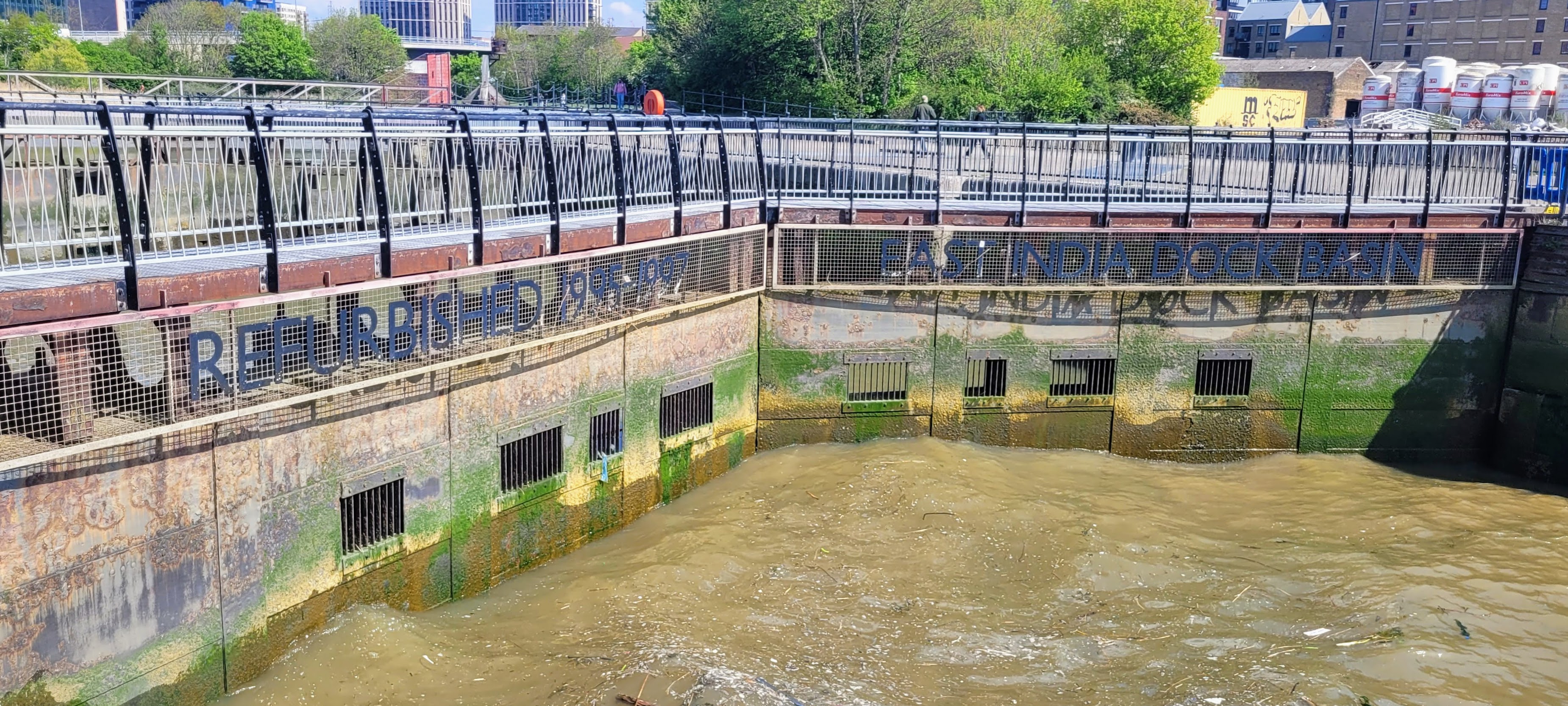
In January 1804 the lock was widened to 48 ft across to allow the largest East Indiamen, of up to 1,500 tonnes, to enter the docks.

In September 1804 Hugh McIntosh used a horse operated bucket dredger to excavate 8,000 tonnes of mud from the former ship repair yard, Brunswick Dock, to give a uniform depth of 22 ft. The south wall was built in brick, but the original timber walls of the Brunswick Dock were retained on the other three sides.
The Export Dock was also home to the emigrant's ships. In the 19th century companies including Green's, Wigram's and Dunbar's all used the docks as their embarkation point. By 1905 the Export Dock was principally used by sailing ships and steamers.
After suffering from bomb damage, during World War II, the Export Dock was sold in 1946 and filled in to make way for Brunswick Wharf Power Station. The power station was closed down in the 1980s and demolished. Now the site is home to Virginia Quay.


The Import Dock
The most important element of the East India Docks was the Import Dock. Covering almost 60 acres it provided room to unload the precious goods from the East Indiamen returning from their voyages.
Excavations began in 1803 using pumps, buckets, rods, pipes, and valves impounding 18 acres of water.
The work included a labour force of up to 400 men and 100 horses. Dredging 625,000 cubic yards of earth. Making nine million bricks from the excavated topsoil to form the dock walls and using 50 tonnes of old iron hoops to strengthen the walls.
The walls of the Import Dock were constructed with a curved profile which was ideally suited to the shape of the hulls of the East Indiamen.
During World War II the Import Dock played an important role in the construction of the Mulberry floating harbours for the D-Day landings in Normandy, in 1944. After World War II the Import Dock was filled in and a number of new developments, including the Financial Times Print Works (1987-88) and Telehouse Europe (1988-90), were built.

The Lock
The Entrance Lock, with a width of 48 ft, was the largest lock in the Port of London. It had a curved or rounded bottom, unlike the shallow inverts of the locks constructed at West India Docks.

