Showing posts with label Thames Iron Works. Show all posts

Monday, July 07, 2025

Thames Ironworks Football Club (1895-1900)

Thames Iron Works

The Thames Ironworks and Shipbuilding Company originated from the Ditchburn and Mare Shipbuilding Company, in 1837. They were a large shipyard and ironworks, situated on both sides of Bow Creek.

In March 1895, the Old Castle Swifts Football Club, the first professional football club in Essex, went bankrupt. They had been formed in 1892 by Donald Currie, a Scottish shipowner.

Following the collapse of the Old Castle Swifts Football Club, the Chairman of Thames Ironworks and Shipbuilding Company, Arnold Hills, saw an opportunity to start his own works team and provided the money to take over the tenancy of the now vacant football ground on Hermit Road, Canning Town. 

Meanwhile, the company's foreman, Dave Taylor, who was also a local football referee, placed an advert in the company's newspaper, 'The Thames Iron Works Gazette', asking for players to form a works football team. Fifty ironworkers answered the advert and so was born Thames Ironworks Football Club.

Each player paid half-a-crown for one year's membership, while Dave Taylor set about arranging fixtures for Thames Ironworks F.C. and their reserves.

Arnold Hills was a philanthropist, advocate for temperance and vegetarianism, and an outstanding sportsman. He also believed that a happy workforce was a more productive workforce. So, in addition to the football team, he introduced a cricket team, an operatic society and the Thames Ironworks band.

Arnold Hills was a former student and football Blue of Oxford University, so he chose dark blue as the colours of the team for their debut season.

The following season they changed to a sky blue top, white shorts and claret socks.

Monday, June 16, 2025

East India Docks, Blackwall

East India Docks Lock

The East India Docks were constructed between 1803-1806 and were the third set of wet docks built on the River Thames, in the early 19th century. By the end of the 18th century East Indiamen ships had been sailing from Blackwall for almost 200 years.

East India Docks Lock Entrance

The East India Company, founded in 1600, shipped valuable goods from the East to the River Thames. It was a rich, powerful and well organised body using the largest two ships that frequented the Port of London. The valuable cargoes were moved by barge to the city, then carried to the company's spacious warehouses on Billiter Street and Cutler Street.

In January 1804 the lock was widened to 48 ft across to allow the largest East Indiamen, of up to 1,500 tonnes, to enter the docks.

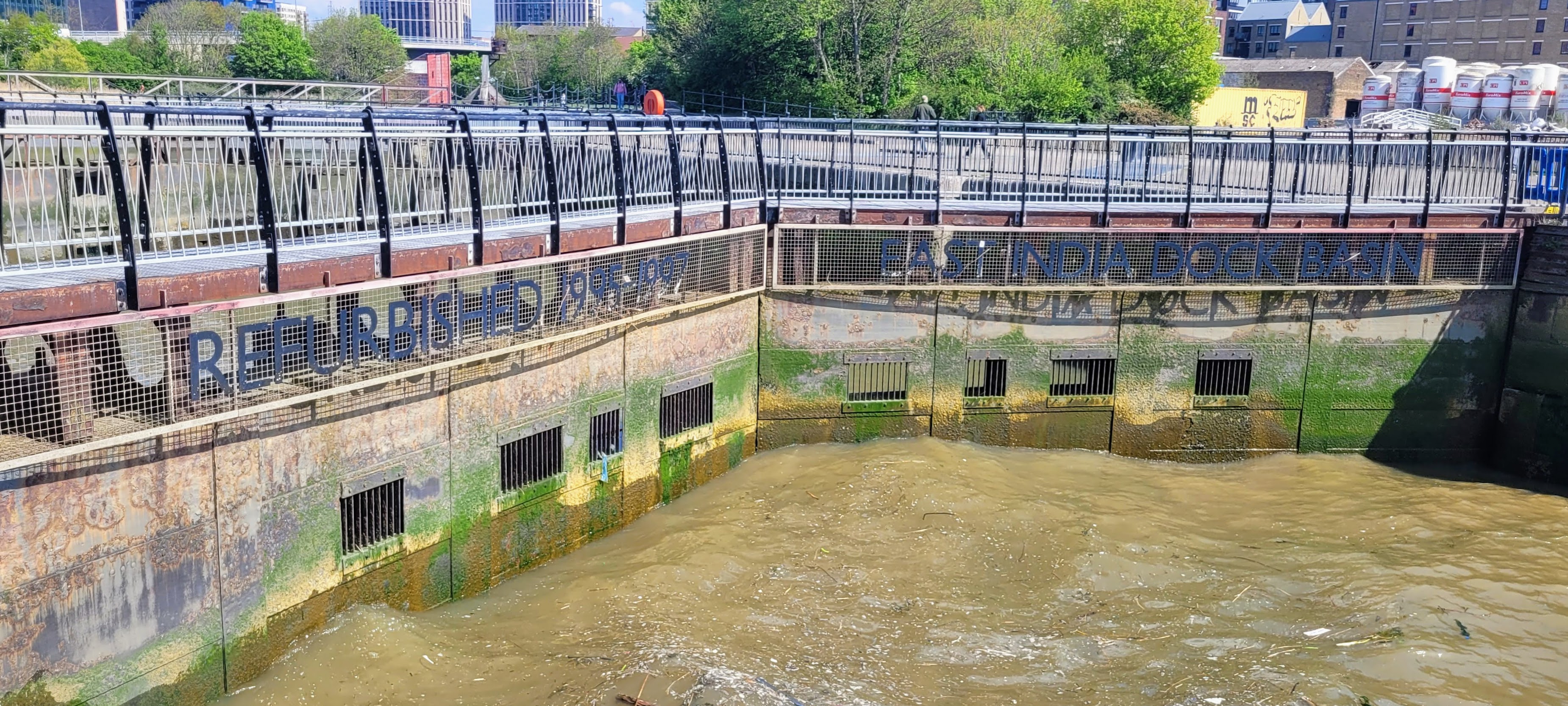
East India Docks Basin

The Export Dock

In September 1804 Hugh McIntosh used a horse operated bucket dredger to excavate 8,000 tonnes of mud from the former ship repair yard, Brunswick Dock, to give a uniform depth of 22 ft. The south wall was built in brick, but the original timber walls of the Brunswick Dock were retained on the other three sides.

The Export Dock was also home to the emigrant's ships. In the 19th century companies including Green's, Wigram's and Dunbar's all used the docks as their embarkation point. By 1905 the Export Dock was principally used by sailing ships and steamers.

After suffering from bomb damage, during World War II, the Export Dock was sold in 1946 and filled in to make way for Brunswick Wharf Power Station. The power station was closed down in the 1980s and demolished. Now the site is home to Virginia Quay.

East India Docks Lock Entrance

The Import Dock

The most important element of the East India Docks was the Import Dock. Covering almost 60 acres it provided room to unload the precious goods from the East Indiamen returning from their voyages.

Excavations began in 1803 using pumps, buckets, rods, pipes, and valves impounding 18 acres of water.

The work included a labour force of up to 400 men and 100 horses. Dredging 625,000 cubic yards of earth. Making nine million bricks from the excavated topsoil to form the dock walls and using 50 tonnes of old iron hoops to strengthen the walls.

The walls of the Import Dock were constructed with a curved profile which was ideally suited to the shape of the hulls of the East Indiamen.

During World War II the Import Dock played an important role in the construction of the Mulberry floating harbours for the D-Day landings in Normandy, in 1944. After World War II the Import Dock was filled in and a number of new developments, including the Financial Times Print Works (1987-88) and Telehouse Europe (1988-90), were built.

East India Docks Lock

The Lock

The Entrance Lock, with a width of 48 ft, was the largest lock in the Port of London. It had a curved or rounded bottom, unlike the shallow inverts of the locks constructed at West India Docks.

Thursday, March 13, 2025

'SS Robin', Historic Vessel

SS Robin at the Royal Docks
Awaiting a permanent home.

The 'SS Robin' is the world's only surviving complete Victorian steamship.

Along with her sister ship, 'SS Rook', 'SS Robin' was built at Orchard House Yard, in 1889, launching in September 1890. 

Orchard House Yards, and much of the banks of the River Thames, were considered the world centre for shipbuilding, at the time, with the proud tradition going back many hundreds of years. This made London a global trading empire, whilst also supplying the bulk of ships for the Royal and Merchant Navies.

One of the largest yards in the country, The Thames Iron Works, would build some of the biggest ships, either side of the River Lea, at Bow Creek.

By 1890, however, the northeast coast of England and shipbuilders in Scotland had become the leading shipbuilders, with their lower overheads, resulting in The Thames Iron Works closing in 1912.

Robin and Rook.

Robert Thomson, a ship broker and owner, ordered both ships constructed on slipways and built by Ditchburn & Mare, in 1845. Ditchburn & Mare was later owned by The Thames Iron Works and Ship Building Company, who then leased the yard to shipwright William Jolly, a Thames barge builder. 

He started construction before selling the business shortly after to Mackenzie, McAlpine and Company. Both builders were inexperienced, ill equipped and struggled to complete the orders to a standard high enough to satisfy Lloyd’s. 

Robert Thompson took over the work himself, eventually, paying a naval architect superintendent to complete the ships on his behalf. The ships were complete to Lloyd’s highest class of 100A1. 

'Robin' and 'Rook' were to be the last ships built at the yard, which closed immediately after.

Following their launch they went to the East India Docks, which were nearby, for final fitting out. 'Robin' was later towed to Dundee where her boiler, triple expansion engine and ancillary machinery were installed, by Gourlay Brothers & Company Limited. 

Although rigged as an auxiliary three-masted schooner she was designed to carry sails, should they be needed. 

SS Robin at the Royal Docks
SS Robin and Lightship 93, at the Royal Docks.

Maiden Voyage.

Having been sold into the service of Arthur C. Ponsonby & Company of Newport, South Wales, her first voyage was from Liverpool to Bayonne, France, in 1890. Her crew consisted of twelve men.

Her next voyage began in Swansea, in 1891, and saw her visit Rouen, the Mersey, Plymouth, Deauville, Guernsey, London, Rochester, Newport, Bristol, Swansea, Cherbourg, and back again to the Thames. This would be her trading route for the following years, carrying bulk cargoes of china clay, coal, grain, iron ore, railway rail and scrap steel, as well as general cargoes of baled and casked goods.