Showing posts with label World War II. Show all posts

Monday, September 08, 2025

"The Man who saved London from drowning, during The Blitz"

Thomas Peirson Frank Portrait
Thomas Peirson Frank. (Elliott & Fry, Public domain)

During World War II, especially during The Blitz, London was heavily bombed. 

Bombers flew along the River Thames, dropping bombs on the dockyards and industrial sites, before moving towards the City itself, using Tower Bridge as a point of reference.

Because London is a low-lying city the River Thames embankments were targeted, too, in the hopes of flooding some of the area.

However, they didn't know about Thomas Peirson Frank.

Thomas Peirson Frank was born into a farming family in Yorkshire, in 1881. He was educated at Pickering Grammar School and Huddersfield Technical College, before gaining three years of practical experience training under Huddersfield borough engineer, K.P. Campbell.

Over the next few years he gained further experience in general construction, the laying of sewers and water mains, maintenance of roads and tramways and much more.

In 1908, he became the city engineer for Ripon. During the four years that he worked here he was responsible for extending the sewage disposal works and also the construction of two river dams.

He then spent between three or four years in various roles in Cardiff, Liverpool, Plymouth and Stockton-on-Tees. In Cardiff he acted as a surveyor and performed a similar role in Liverpool. While in Plymouth he was responsible for construction work, which included roads and sewers for a housing scheme. In Stockton-on-Tees he was the borough engineer. During his time in Liverpool he also lectured at Liverpool University.

Monday, June 16, 2025

East India Docks, Blackwall

East India Docks Lock

The East India Docks were constructed between 1803-1806 and were the third set of wet docks built on the River Thames, in the early 19th century. By the end of the 18th century East Indiamen ships had been sailing from Blackwall for almost 200 years.

East India Docks Lock Entrance

The East India Company, founded in 1600, shipped valuable goods from the East to the River Thames. It was a rich, powerful and well organised body using the largest two ships that frequented the Port of London. The valuable cargoes were moved by barge to the city, then carried to the company's spacious warehouses on Billiter Street and Cutler Street.

In January 1804 the lock was widened to 48 ft across to allow the largest East Indiamen, of up to 1,500 tonnes, to enter the docks.

East India Docks Basin

The Export Dock

In September 1804 Hugh McIntosh used a horse operated bucket dredger to excavate 8,000 tonnes of mud from the former ship repair yard, Brunswick Dock, to give a uniform depth of 22 ft. The south wall was built in brick, but the original timber walls of the Brunswick Dock were retained on the other three sides.

The Export Dock was also home to the emigrant's ships. In the 19th century companies including Green's, Wigram's and Dunbar's all used the docks as their embarkation point. By 1905 the Export Dock was principally used by sailing ships and steamers.

After suffering from bomb damage, during World War II, the Export Dock was sold in 1946 and filled in to make way for Brunswick Wharf Power Station. The power station was closed down in the 1980s and demolished. Now the site is home to Virginia Quay.

East India Docks Lock Entrance

The Import Dock

The most important element of the East India Docks was the Import Dock. Covering almost 60 acres it provided room to unload the precious goods from the East Indiamen returning from their voyages.

Excavations began in 1803 using pumps, buckets, rods, pipes, and valves impounding 18 acres of water.

The work included a labour force of up to 400 men and 100 horses. Dredging 625,000 cubic yards of earth. Making nine million bricks from the excavated topsoil to form the dock walls and using 50 tonnes of old iron hoops to strengthen the walls.

The walls of the Import Dock were constructed with a curved profile which was ideally suited to the shape of the hulls of the East Indiamen.

During World War II the Import Dock played an important role in the construction of the Mulberry floating harbours for the D-Day landings in Normandy, in 1944. After World War II the Import Dock was filled in and a number of new developments, including the Financial Times Print Works (1987-88) and Telehouse Europe (1988-90), were built.

East India Docks Lock

The Lock

The Entrance Lock, with a width of 48 ft, was the largest lock in the Port of London. It had a curved or rounded bottom, unlike the shallow inverts of the locks constructed at West India Docks.

Thursday, January 23, 2025

Special Operations Executive Agents Memorial & Violette Szabo

Special Operations Executive Agents Memorial

This bronze bust of Violette Szabo, on the Albert Embankment, just yards from the Headquarters of the British Special Intelligence Service (MI6), commemorates the secret agents who led covert operations against the Nazis.

This monument was commissioned by the Public Memorials Appeal.

S. O. E.

The Special Operations Executive was secretly formed for the purpose of recruiting agents, men and women of many nationalities, who would volunteer to continue the fight for freedom, by performing acts of sabotage in countries occupied by the enemy during the Second World War.

This monument is in honour of all the courageous S.O.E. Agents: those who did survive and those who did not survive their perilous missions. Their services were beyond the call of duty. In the pages of history their names are carved with pride.

The Heroes of Telemark.

In 1943 Norwegian resistance commandos sponsored by the S.O.E. raided the enemy occupied Norsk Hydro Plant in the Telemark region of Norway.

This successful raid sabotaged the machinery that was producing heavy water, which is used in the manufacture of the Atomic Bomb.

Thanks to those Norwegian Commandos the enemy's attempt to develop the Atomic Bomb was thwarted.

The Maquis French resistance fighters.

470 S.O.E. agents were sent on sabotage missions to occupied France where they fought with networks of French resistance fighters who played an important part in the liberation of France in 1944.

Special Operations Executive Memorial

Violette Szabo.

Violette Bushell was born in Paris, France, in 1921, before her family moved to England. At the outbreak of World War II, she joined the Women's Land Army and the Auxiliary Territorial Service, where she met Étienne Szabo, a Free French corps soldier. They were married and she bore him a daughter, Tanis, in 1942. That same year Étienne was killed in action at the battle of El-Alamein. 

It was this event that led her to join the Special Operations Executive intelligence agency, which, at the time, had its headquarters on Baker Street.

Special Operations Executive Baker Street

Thursday, December 05, 2024

Fireplace and Alcoves, Vincent Street

Fireplace

Standing alone in the heart of Westminster, surrounded by ivy, a fireplace can be seen on the street. This is a relic from one of many houses that once lined this end of Vincent Street, but were destroyed during World War II.

The building that now stands next to this site is Dean Abbott House, which is a sheltered accommodation and retirement housing complex, with security gates and fencing that stop you from seeing more of the relics of the area.

Alcoves

However, during my visit to the fireplace, I got talking to tone of the residents, Tom, who was returning from the shops. He explained about the fireplace and the houses that had once stood here, before mentioning that there was more to see, if I was interested.

A moment later Tom led me through the security gate and showed me the other alcoves, still in situ. Although not as impressive as the fireplace, it was still interesting to see these remnants from the past.

Thursday, November 28, 2024

Smithfield Market: V-2 Rocket attack memorial

Smithfield Market V-2 Rocket attack memorial

On Thursday March 8, 1945, at 11:30, a V-2 Rocket struck the Harts Corner part of Smithfield Market, on the corner of Charterhouse Street and Farringdon Road.

The rocket went through the Victorian market and penetrated the railway tunnels below, causing the market buildings to fall into the resulting crater, along with many of the workers and visitors to the market.

The market had been extra busy, that morning, as many women and children had been queueing in the hopes of obtaining a rabbit, from a consignment that had just gone on sale.

In total 110 people died, while countless others were seriously injured.

This attack happened just weeks before the last V-2 fell on London.

Harts Corner was originally a market for fruit and vegetables, then fish and then a part of the meat market. It had been designed by Sir Horace Jones, but was impossible to salvage after the rocket struck.

Thursday, November 21, 2024

Grove Road Bridge: Site of the first V-1 attack in London

Grove Road Bridge

This bridge is typical of many railway bridges in London, or the rest of the country for that matter. However, this bridge has a special place in London history and to find out more we must travel back to 1944.

On Tuesday June 13, 1944, at around 04:30, the first V-1 flying bomb, also known as 'buzz bomb' or 'doodlebug', to hit London, detonated on this railway bridge, which carries the London North Eastern Railway from Liverpool Street.

The blast severely damaged the bridge and demolished twelve houses and over fifty others were damaged, with much of the damage occurring on Antill Road, Belhaven Street and Burnside Street.

Six people lost their lives, while another forty-two were injured.

Grove Road Bridge

The bridge, being a vital transport route, was repaired and operational by 19:45 on June 14. This repaired bridge would stay in place until the entire bridge was replaced in 1948.

Thursday, November 14, 2024

ARP Stretcher Railings

ARP Stretchers as Railings

Wandering London's streets, as I often do, I am still surprised by the extraordinary things hidden in plain sight.

Take the railings, in the photo above. At first glance they appear to be your standard railings, which are quite often found south of the river, in places like Bermondsey, Brixton, Camberwell, Deptford, Southwark, etc..  There even some north of the River Thames, in Poplar.

However, these are no ordinary railings. They are almost 80 years old and once served a very different purpose.

ARP Stretchers as Railings

During World War II many of the metal fences and railings, around various houses and buildings, were removed, so that the metal could be used for the war effort.

Sunday, September 01, 2024

Walking alone: Elephant & Castle to Borough... and beyond

Cubana Restaurant

Friday August 23, 2024.

As I still had some time away from work I decided to take another walk through London. I was going to be joined by my youngest, but Keilyn and her sister Erin had both gone away for the week, so I was left to explore on my own.

A simple journey saw me catch a Metropolitan line train to Baker street where I changed to a Bakerloo line train, that whisked me off to Elephant & Castle, which is as good as a starting point as any.

Bakerloo line train

At Lambeth North the carriage emptied and I found myself in an deserted carriage, which was cool.

After exiting the station I turned right, as I had no route to follow, and began walking along St George's Road towards Geraldine Mary Harmsworth Park, before turning right, again, on to Lambeth Road.

St George's Circus Obelisk

Approaching St George's Circus I took some photographs of the obelisk, at the centre of the roundabout, before turning my attention to the Bakerloo line London Road Underground Train Depot, situated on the corner opposite.

I continued along Borough Road and onto Borough High Street, from where I turned right onto Trinity Street. Realising that I was going to end up going around in circles, I turned left onto Globe Street, which led me to Pilgrimage Street.

I found that I was in a small residential area with not much to offer, so I turned right onto Manciple Street, before turning left onto Hankey Place. And I was glad that I did.

ARP Stretchers

This small street with its houses and flats had secrets to show. Along the low walls many of what I thought were iron railings were, in fact, ARP stretchers, left over from World War II. I had heard about these but had never seen them in person, so I was thrilled.

I exited Hankey Place and turned left onto Long Lane. before heading up Tennis Street to Angel Place. Now, Angel Place is a small alley that links Tennis Street with Borough High Street, but, again, this hides a secret. 

Marshalsea Prison South Wall

The tall brick wall, to one side, was once the south boundary wall of Marshalsea Prison, which stood near here until it closed in 1842. Behind it is St George's Churchyard Gardens, where I sat in the shade for a few minutes, before continuing on my walk.

The Southwark Tavern

Suitably rested I continued along Angel Place to Borough High Street. As it was approaching noon I thought I would find a watering hole and stop for a beverage. So, I continued up Borough High Street and crossed Southwark Street and found myself outside 'The Southwark Tavern'. And in I went.

Sunday, May 26, 2024

Dunkirk Little Ships at St Katharine Docks and Marina

Dunkirk Little Ships at St Katharine Docks
Dunkirk Little Ships at St Katharine Docks and Marina.

Saturday May 25, 2024.

With the anniversary of the start of 'Operation Dynamo', this weekend, some of the 'Little Ships of Dunkirk' had made their way to St Katharine Docks and Marina, allowing visitors to get up close to these historic vessels.

Dunkirk Little Ships at St Katharine Docks
Some of the historic Dunkirk Little Ships.

It was a beautiful summer morning as we walked around the Docks and Marina, inspecting these small boats that, 84 years ago, had made their way from Ramsgate to Dunkirk to help in the evacuation of more than 338,000 British and French soldiers. 

Dunkirk 1940 Plaque
A 'Dunkirk 1940' commemorative plaque.

Each boat was in pristine condition and each had its own story to tell, with information boards and owners and crew ready and willing to share the stories of the vessels.

Dunkirk Little Ships at St Katharine Docks
Dunkirk Little Ship 'Lady Lou'.

'Lady Lou' is one of four surviving pre-war Ramparts and was built in 1936.

Monday, January 08, 2024

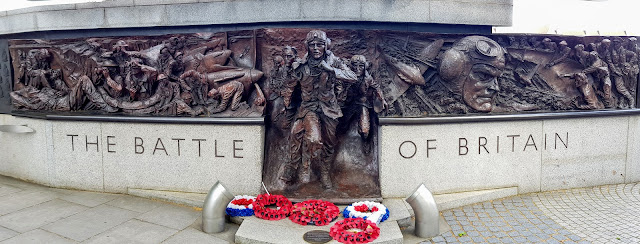
Battle of Britain Monument

London The Unfinished City
"Scramble!"

Walking along the Victoria Embankment, near Whitehall, you will discover the Battle of Britain Monument, which stretches along the pavement.

This granite and bronze monument was built so that visitors can interact with it. This impressive monument has scenes from different aspects of the Battle of Britain. From Airmen 'scrambling' to women working in munitions factories to the ground crews who kept the aeroplanes serviced... and more.

London The Unfinished City
"Never in the field of human conflict was so much owed by so many to so few."

I can happily look at this monument for hours, and still find something that I have never noticed before.

Wednesday, March 01, 2023

RAF Bomber Command Memorial

London The Unfinished City

It was on my first visit to the memorial that I began to write more about London and its history, which led me to create this blog. 

London The Unfinished City

The memorial, itself, is an amazing piece of work that inspired me to write a number of pieces about it. That is how much of an impact that it had on me.

London The Unfinished City

Should you find yourself in London's fourth largest Royal Park, then you should definitely take in this huge memorial.

Friday, November 11, 2022

A Splash of Colour

London The Unfinished City
Lest We Forget.

I sit beside a fallen tree, looking across my field that has been transformed, these past years. My once lush, emerald pasture has been replaced with a patchwork of myriad browns. My once proud trees lie twisted and broken, like so much mangled machinery, spread without any thought or care. 

Diffused sunlight causes the timber frames and mangled steel of rotting machines, to appear to dance before me, like ghostly silhouettes on the uneven ground. 

Water, which fills the pits and troughs, reflects the dull, colourless sky, adding to my sombre mood. My heart feels heavy. Nothing moves. Nothing lives.

But, suddenly, there is clarity. The droplets from the fine rain, acting like a lens, focus my attention. Among the detritus, at the edge of the field, is there movement? Do my eyes deceive? I resist blinking, trying to focus on the apparition before me. Finally, I blink and the form takes shape. The shape of a man. A man who is staring at me,  as though he can see into my soul. 

My body aches as I rise to my feet. I feel the figure watching me, as I make my way into the field, if it can still be called that.

My progress is hindered by the thick mud, which sucks at my boots, threatening to pull me down into the bowels of the Earth. The figure before me turns, heading toward the centre of the quagmire, seeming to float across the surface. My breath becomes laboured, as my ageing body fights to keep me moving forward. As we get closer to the centre, the figure seems to undulate in-and-out of focus. A wave of nausea sweeps through me as the figure turns and holds my gaze. Tears fill his eyes as he dips his head. With a last great effort I step forward, throwing my arms around him, but he disappears and I topple into the mud. 

The sun, which has finally won its battle with the clouds, breaks through and warms the ground around me. And as I fight my way up and out of the decaying ground, I notice a splash of colour. As my eyes try to focus and my mind works to make sense of everything, exactly where the figure had stood, is a flower, swaying in the gentle breeze. 

The sun illuminates the thin wisp-like stalk, topped with blood-red petals. Somehow, against all the odds, surviving in the mud and detriment... a poppy.

Wednesday, August 07, 2019

'HMS Belfast'... revisited.

London The Unfinished City
Erin and Keilyn standing by 'B' Turret. 
The guns of 'A' and 'B' turrets are both elevated and targeted on the M1 Gateway Services, some 12.5 miles away.
This is well within reach of these 6-inch guns.

Way back on August 4, 2010, I took my eldest daughter, Alysha, aboard HMS Belfast. She was 14 at the time. We had a great time exploring the ship and taking in the views.

This past Sunday, August 4, 2019, I took my two youngest daughters, Erin (7) and Keilyn (6), aboard. We climbed up ladders, clambered through watertight doors and edged our way along narrow gangways, taking in all nine decks.
(I am unsure as to why August 4th has played a part in both visits).

We began our exploration on the Quarterdeck, before heading inside and into the Laundry. Then off to the Sound Reproduction Room, Chapel and Mail Room, before heading down the first of many ladders to the Boiler and Engine Rooms.

A set of ladders brought us back up to the quarterdeck, where we saw the Messdeck, Bakery and Food Stores. We then carried on passed the  Galley, NAAFI, Provision Stores, the Dentist, Dispensary and Sick Bay. This brought  us to the Arctic Messdeck and the Brig.

We then doubled back and headed down more ladders to the Forward Steering Position. Then up some ladders only to go down some more, a few moments later, as we entered the Shell Room and Magazine for 'B' Turret.

Friday, March 22, 2019

St Dunstan-in-the-East Church & Garden

London The Unfinished City
A panoramic of the Nave.

Friday March 22, 2019.

It was a cool spring Friday morning, as I took to the streets of the Unfinished City, in search of new areas to discover. Pretty soon I found myself on Lower Thames Street, heading eastward.

Since it had been pouring with rain on my last visit to St Dunstan-in-the-East Church Garden, I decided to pop in for a look around. It was perfect timing, because as I arrived a tour guide and his Spanish entourage were leaving, heading off in the direction of the Tower of London, leaving me alone among the ruins.

London The Unfinished City


Obviously, as it was still early spring, many of the flowers had yet to bloom, which gave the ruined church an even more sombre mood, especially with the overcast skies.

Considering where the ruins are located it was remarkably peaceful, even with the traffic zooming past.


Saturday, June 06, 2015

'HMS Belfast'

London The Unfinished City
Gateway Services: Targeted.
Saturday June 6, 2015.

It was while walking around the 
Unfinished City, and its environs, that I managed to grab yet another image of this iconic piece of Royal Navy history. Thankfully, the sun was just right and the crowds were few, which allowed me to get this shot, with the Tower of London in the background, rather than the standard shot of H.M.S. Belfast with Tower Bridge. I have clambered under, and over, her decks on a number of occasions, but on this visit it was purely for the photograph.


Wednesday, May 02, 2012

Battle of Britain Monument

London The Unfinished City
A Monument to "The Few".

Wednesday May 2, 2012.

I have always been fascinated by the various statues, monuments and memorials dotted around London, including the temporary pieces that appear every now-and-again.

I also have a fascination with the Battle of Britain, so, when I found out about this monument, I had to visit it.

Friday, August 05, 2011

Imperial War Museum

London The Unfinished City
From Bethlem to Bedlam.

Friday August 5, 2011.


The Imperial War Museum (London branch) is one of my favourite museums. I cannot count the number of times that I have visited, but it would be in the high twenties. It holds a world-leading collection of artefacts from the earliest conflicts and wars through to those from current theatres of operation. 

Following a multi-million pound restoration, which saw the majority of the building redeveloped, including the entrance atrium, space has been created to show more objects from the collection, while creating additional exhibition areas.