Showing posts with label Charles Dickens. Show all posts

Thursday, September 25, 2025

Aldgate Pump

Aldgate Pump


At the corner of Leadenhall Street and Fenchurch Street, where the two streets join to form Aldgate High Street, you will find a stone obelisk with a lantern mounted to its top.

It is no ordinary obelisk, but is in fact the Aldgate Pump, a historic landmark point that marks the beginning of the East End and was mentioned by Charles Dickens, as well as being sung about in traditional rhymes and songs.

It was originally situated further west, on the site of what was to become Fenchurch Street station.

The Aldgate Pump in the 1870s

The freshwater well was fed from one of London's many underground rivers, beginning its journey in Hampstead, to the north, and had been used since the 13th century. The water was said to be "bright, sparkling and cool and of a pleasant flavour".

However, it was later discovered that the water was contaminated. The decaying organic matter and calcium from the bones of dead Londoners, in the nearby cemeteries, had begun to leach into the underground rivers and streams.

So, in 1876, when the Aldgate Pump was moved to its new location, it was connected to the mains water supply.

Brass Wolf's Head

This current pump is made of Portland stone, and dates from the 18th century, while the brass wolf's head spout is 19th century. The lantern, at the top of the obelisk, is a handmade replica of the original, which was lost in 1900.

In 2019 the City of London Corporation, with the assistance of the Heritage of London Trust, repaired and restored the pump. Some of the money came from Miss Anthea Gray, who had left a generous gift in her Will, to the Heritage of London Trust.

Thursday, July 17, 2025

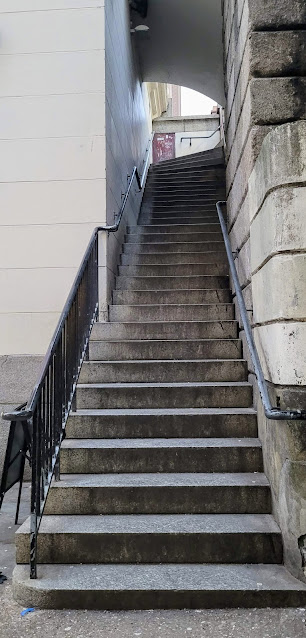
'Nancy's Steps', Old London Bridge

Steps of old London Bridge
'Nancy's Steps'.

These steps, on the southwest side of London Bridge, the arch and a few remaining pedestrian alcoves are pretty much all that is left, in England, of John Rennie's London Bridge. 

Victoria Park London Bridge Alcove
Old London Bridge pedestrian alcove, Victoria Park.

One alcove sits in the quadrangle of Guy's Hospital, while another can be found in Victoria Park.

The rest of the bridge was sold to Robert McCulloch, who had it dismantled and shipped to America, where it was rebuilt in Lake Havasu City, Arizona.

One of the surviving pieces of John Rennie's London Bridge
A surviving arch of John Rennie's London Bridge.

These steps are often called 'Nancy's Steps', in reference to the character of Nancy, from the novel 'Oliver Twist', by Charles Dickens.

In the novel Bill Sikes murders Nancy in a room, while Bill's dog, Bull's-Eye, watches on. 

However, in the 1968 movie, 'Oliver!', Nancy is murdered on the steps of London Bridge by Bill Sikes.

Surely Some Mistake
Shorely Shome Mishtake.

This makes the Blue Plaque, affixed to the wall of the surviving arch of John Rennie's London Bridge, incorrect.

You can read more about London Bridge by clicking on the link below.


Monday, November 25, 2024

Marshalsea Prison South Wall

Marshalsea Prison South Wall

Angel Place is an alley that leads from Borough High Street to Tennis Street, passing St George's Churchyard Gardens.

The wall that separates the gardens from the alley is all that remains of the south wall of Marshalsea Prison, a notorious debtor's prison that stood, in one state or another, on this site.

Marshalsea Prison Flagstone

Brief History

The first Marshalsea Prison, 1373-1811, was located at what is now 161 Borough High Street and housed men accused of crimes at sea, political prisoners and debtors.

Tuesday, January 09, 2018

'Ye Olde Cheshire Cheese'

London The Unfinished City
Is that the River Fleet, I hear?

One of my favourite pubs, in the City of London, is Ye Olde Cheshire Cheese. I first discovered it a number of years back, when I ducked into an alleyway to avoid some freezing rain, on a cold January day. Seeing the light of the pub I wandered in.

London The Unfinished City
Heading into the cellar.

On entering I found it to be quite dark, with wood panelling and little in the way of natural light. Spread across a number of floors, with various bars, it has a feeling of being lost in time.

London The Unfinished City
Throughout the reigns of...

Once my eyes adjusted to the diffused light, the building almost came alive with its history.

London The Unfinished City
A cosy little space in the cellar.

Buying a pint of bitter I took a seat in one of the near empty spaces and savoured the atmosphere of this historic place.

Thursday, November 30, 2017

'The Dickens Inn'

London The Unfinished City
Dickensian.

It was while strolling around St Katharine Dock and Marina that I spotted this beautiful old converted warehouse. Intrigued by its name, and style, I decided to find out more about this fascinating building.

'The Grapes'

London The Unfinished City
Grape Expectations.

The first time I discovered The Grapes, it was too early in the day to pay it a visit, so I made a plan to return to it. Sure enough, two months later, I did return and I was not disappointed.

London The Unfinished City
The Grapes; A narrow pub on Narrow Street

It is a narrow space, but quite long, stretching back to a terrace, that overlooks the river. There is a spacious dining room, upstairs, where a mouth-watering selection of food can be savoured. I opted to eat downstairs, choosing from the pub grub menu; Cumberland sausage, creamy mash with a caramelised onion gravy, washed down with a pint of St. Edmunds. Beautiful.

Sunday, November 12, 2017

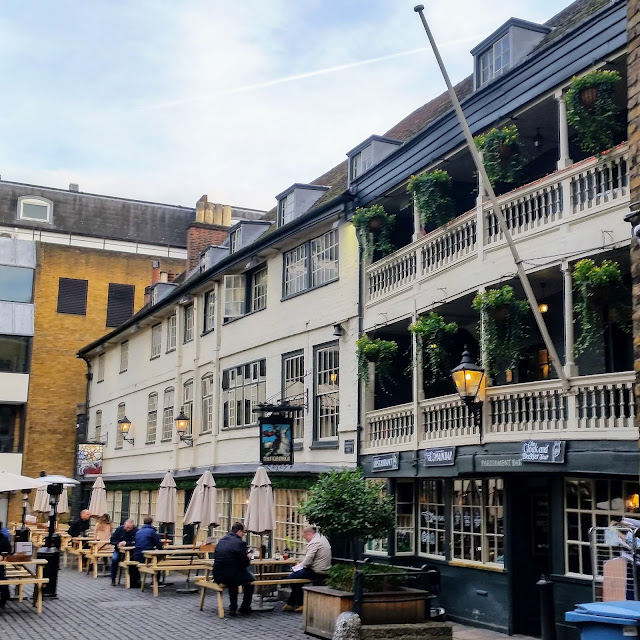
'The George Inn'

London The Unfinished City
The Unfinished City's last 'galleried' coaching inn.

The George Inn
is one of those places that has existed, in some form or another, in the great Unfinished City for centuries. Unlike some other places of this age, though, The George Inn still retains all of the character that you would associate with something of this bygone era. From walking through the bars, that were frequented by Charles Dickens and William Shakespeare, to walking along the gallery, with its uneven and creaky floorboards, you get a real sense of history.