Showing posts with label Drinking Fountain. Show all posts

Thursday, December 04, 2025

Tanner Street Drinking Fountain, Bermondsey

Tanner Street Drinking Fountain

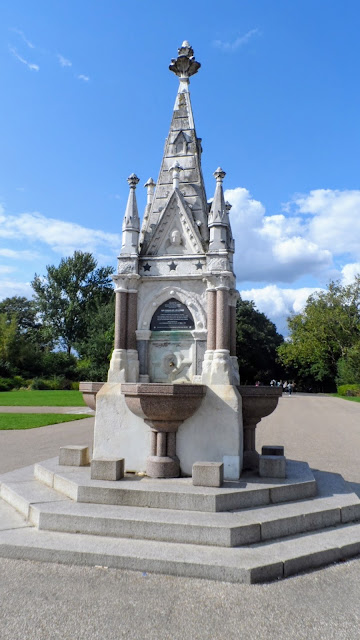
In the corner of Tanner Street Park, behind low iron railings, there is a drinking fountain with a remarkable history. This is the Tanner Street Drinking Fountain.

This drinking fountain began its life as a turret at the top of tower of St Olaf's Church, Tooley Street.

Henry Flitcroft designed the church, which was constructed with Portland stone, in 1737. By the early 20th century the church had fallen into disrepair and so, in 1918, permission was granted to demolish part of the church. However, a stipulation was attached:

"...that provision should be made for the preservation of the tower thereof and for the maintenance of a portion of the site of the old church and of the old churchyard as a public open space and for the perpetuation of the name of St Olave in connection with such site."

Tanner Street Drinking Fountain

Subsequently, the riverside area around Hay's Wharf was being developed and, as such, a request was submitted to demolish the tower.

A fierce Parliamentary debate ensued. Eventually permission was granted to demolish the tower, on the condition that Bermondsey Borough Council use some of the proceeds from the sale of the church land, in Tooley Street, to establish a recreation ground in nearby Tanner Street. Also, as an acknowledgement of the original church, the turret/cupola should be retained as a drinking fountain.

Eventually the drinking fountain fell into disrepair and, during the upgrading of Tanner Street Park, was restored in 2018, by Southwark Council.

Monday, October 13, 2025

London's Drinking Fountains

Drinking Fountain on Allsop Place

In a bustling metropolis like London, it's easy to overlook the small, yet significant, historical markers scattered throughout the city. Among these are the numerous drinking fountains and animal water troughs, silent sentinels that tell a story of Victorian philanthropy, public health, and a bygone era before bottled water became ubiquitous.

Imagine London in the mid-19th century. The River Thames, while a vital artery for trade, was also a significant source of drinking water for many, often contaminated and leading to devastating outbreaks of cholera and other diseases. Access to clean, safe drinking water was a luxury, not a right, and for the working classes, it was a daily struggle. This pressing public health crisis spurred a wave of social reform, and a key initiative was the provision of free, clean drinking water for all. 

The Metropolitan Drinking Fountain and Cattle Trough Association, founded in 1859, became the driving force behind this movement. Their mission was simple: "to promote the erection of drinking fountains in the streets of London, and also of cattle troughs for the use of animals."

Cornhill Fountain

These fountains and troughs were more than just practical necessities; they were symbols of Victorian compassion and a commitment to public welfare. Funded by generous donations from individuals, charitable organizations, and even royalty, they sprung up in parks, market squares, and busy thoroughfares across the city.

Monday, June 17, 2024

Southwark Park

Caryatids of the Old Rotherhithe Town Hall
The Caryatids of the Old Rotherhithe Town Hall.

Opening to the public on June 19, 1869, Southwark Park covers 26 hectares and is Grade II listed. It stretches from Jamaica Road, to the north, to Hawkstone Road in the southeast.

Southwark Park, has two entrances on Jamaica Road, Christchurch Gate, named after a nearby church, and Paradise Gate. Christchurch Gate was designated an entrance in 1903, but following damage in World War II it was replaced with a new gate, modelled on the original, thanks to the Heritage Lottery Fund restoration in 2001-2002.

Southwark Park Bandstand
Southwark Park Bandstand.

Entering through Christchurch Gate the path divides, with one that leads you on a tree-lined avenue around the park, while the other leads you to the Bandstand. This Bandstand was acquired, in 1884, from the Great Exhibition in South Kensington and placed in the park. During the summer months free concerts are held here.

Caryatids
Caryatids. One representing Oak and the other Laurel.

Continuing south from the Bandstand you suddenly come across some stone pillars, hidden among the trees. These are Caryatids that originally flanked the the main entrance of the old Rotherhithe Town Hall. They were placed here in 2011. Continuing on there are tennis courts to the west, while a bowls club, hidden behind manicured hedges, takes up a small area at the centre of the park. 

Jabez West Drinking Fountain
Memorial to a working-class man.

Then there is the polished grey granite Jabez West Drinking Fountain, which is a memorial to a working-class man. 

Gateway from Carriage Drive
A simple gate.

Jamaica Gate stands at the west end of Carriage Drive, which now divides the park into separate spaces.

Monday, June 03, 2024

Jabez West Drinking Fountain

Jabez West Drinking Fountain
Memorial to a working-class man.

In Southwark Park there is a drinking fountain that was installed in 1885, shortly after the park opened to the public in 1869. 

It is fairly unique as it is a memorial to a working-class man.

Jabez West was born in Princes Risborough, on June 6, 1810, to Anne and William West. His father was a blacksmith. 

He moved to Bermondsey some time in the 1830s and married Sarah Johnson on October 21, 1838. They went on to have seven children.

His wife, Sarah, died in 1873 and, in 1876, he married Hannah Aiton.

Jabez died on May 13, 1884.

Jabez West Information Baord
The information board in Southwark Park.

Although he originally worked in the leather trade he is best known in the area for his devotion to political reform and the temperance movement.

He also campaigned for the creation of Southwark Park.

Following his death the Metropolitan Board of Works took the unusual step of agreeing to this memorial for a working-class man. Made from polished grey granite the fountain was paid for by public subscription at a cost of £120.

Monday, April 15, 2024

Ready Money Drinking Fountain

Ready Money Drinking Fountain
The Ready Money drinking fountain, also known as the Parsee Fountain.

If you walk along the main Broad Walk, of Regent's Park, you will come across this beautiful drinking fountain, which is situated close to the highest point of the park.

Sir Cowasjee Jehangir, whose nickname was 'Ready Money', a wealthy Parsee from Bombay (now Mumbai), was a well respected philanthropist, funding asylums, colleges and hospitals, in India. He gave the fountain to the British nation as a 'thank you' for the protection his countrymen received by the British, in India.

It was built in 1869 and cost £1,400. It is made from 10 tonnes of Sicilian white marble and 4 tonnes of Scottish pink and grey granite. It was designed by Robert Kierle and constructed by the sculptor Henry Ross.

There are carved busts, in the gables, of Queen Victoria, Prince Albert and Cowasji Jehangir, with the the fourth gable containing a clock.

Below each of the four basins are small apertures which allowed dogs to drink at the fountain, too.

It became Grade II listed in 1970 and was fully restored, thanks to funding from the Heritage Lottery Fund, between 1999-2000.

Between 2016-2017 further restoration work was carried out.