Showing posts with label Victorian. Show all posts

Thursday, November 06, 2025

London's Postboxes

A replica 'Penfold' type postbox beside Tower Bridge
A replica 'Penfold' type postbox, beside Tower Bridge.

Normally overlooked because of how common they are on the streets of the United Kingdom, the humble postbox can tell you a lot about an area. Each postbox also has a Royal cypher, which helps denote its age. Although, occasionally, postboxes are created without a cypher. These are called 'anonymous' postboxes.

So, let us look at the evolution of the British Postbox.

Like so many other iconic things the Postbox was created in the Victorian era, with the first postbox being installed on Guernsey, in the Channel Islands, in 1852.

In 1853, the first postbox, on the mainland, was installed in Carlisle.

London's first postboxes were installed in 1855.

During the 19th century there was no standard to postboxes, with those in the east and west being markedly different from those in the north and Ireland. The aperture, for the letter, was often vertical, rather than the now standard horizontal, and they were all of different shapes and sizes. One is believed to have been 2.4 metres (7.8 feet), tall. The only constant was that they were made off cast-iron.

It wasn't until 1857 that the Post Office launched a competition to standardise the shape and size of the postbox. Unbelievably, one of the original designs was designed with no aperture for the letters. This was remedied and the 'London Ornate Box' came into use, between 1857-1859. It was green with gold trim and had an enamel compass on its top. In fact, all postboxes were green, si that they blended with the landscape. It wasn't until 1884 that they would be painted the now familiar red.

A 'Wall Box' postbox
A 'Wall Box' postbox.

In 1857 the 'Wall Box' was introduced as an economy measure, where space was a premium. These were usually in rural areas.

The 'First National Standard' postbox was unveiled in 1859. It was cylindrical, with a horizontal aperture beneath a hexagonal hood and was made from cast-iron.

A replica 'Penfold' type postbox
A replica 'Penfold' type postbox, outside the General Post Office building.

The architect John Wornham Penfold designed a hexagonal model, in 1866, which would adopt his name and become known as the 'Penfold' postbox. These were cast-iron and stayed in use from 1866 till 1879. There were thirteen variations of this postbox, that were produced. Many of these postboxes, that you see today, are replicas of the originals and were introduced to historic places, such as Tower Bridge.

A Victorian "anonymous" postbox, as it has no cypher
A Victorian 'anonymous' postbox, as it has no cypher.

In 1879, the 'Victorian Type A' and its smaller 'Victorian Type B' were introduced. It is this cylindrical design, with its circular convex top, that is still the most common style of postbox.

In 1896, the first 'Lamp Box' was installed, on an experimental basis. Much like the 'Wall Box', these were used where pavements were small, such as in rural areas.

In 1899, the first 'Type C' oval-shaped postboxes were introduced in London. These large, double-aperture pillar boxes were designed to increase capacity and pre-sort mail into 'London' and 'Country' destinations.

A postbox with King Edward VII cypher
A postbox with a King Edward VII cypher.

In 1930, some 'Victorian Type B' postboxes were painted blue, to signify the 'Air Mail' service being offered. An 'Air Mail' sign was affixed to the top and the door showed both collection times and air mail charges.

Monday, October 13, 2025

London's Drinking Fountains

Drinking Fountain on Allsop Place

In a bustling metropolis like London, it's easy to overlook the small, yet significant, historical markers scattered throughout the city. Among these are the numerous drinking fountains and animal water troughs, silent sentinels that tell a story of Victorian philanthropy, public health, and a bygone era before bottled water became ubiquitous.

Imagine London in the mid-19th century. The River Thames, while a vital artery for trade, was also a significant source of drinking water for many, often contaminated and leading to devastating outbreaks of cholera and other diseases. Access to clean, safe drinking water was a luxury, not a right, and for the working classes, it was a daily struggle. This pressing public health crisis spurred a wave of social reform, and a key initiative was the provision of free, clean drinking water for all. 

The Metropolitan Drinking Fountain and Cattle Trough Association, founded in 1859, became the driving force behind this movement. Their mission was simple: "to promote the erection of drinking fountains in the streets of London, and also of cattle troughs for the use of animals."

Cornhill Fountain

These fountains and troughs were more than just practical necessities; they were symbols of Victorian compassion and a commitment to public welfare. Funded by generous donations from individuals, charitable organizations, and even royalty, they sprung up in parks, market squares, and busy thoroughfares across the city.

Monday, January 27, 2025

Victorian Turkish Bath House, Bishopsgate

Victorian Bath House Bishopsgate

It is quite a juxtaposition to walk through the City of London, with its glass office blocks, concrete buildings and shops, to then find yourself facing at a Turkish style Victorian Bath House.

These were once very common, in the late 1800s, but, as far as I can find, this is the last of its kind, in London.

So why is it here and when and why was it built?

During the early to mid 1800s London's population tripled to over 3 million residents, bringing with it many problems, including housing issues, which led to health and hygiene problems.

To try and solve this the Baths and Washhouses Act of 1846 was introduced, which encouraged local authorities to provide adequate public washing and bathing facilities.

While many washhouses were large buildings that could be used by many people, the more affluent residents wanted something more to their taste.

Victorian Bath House Bishopsgate

Enter David Urquhart. As a diplomat Mr Urquhart had visited Moorish Spain, Greece and Turkey and suggested the use of 'Turkish Baths', a phrase that he coined, in 1850. He claimed that these baths could cure alcoholism, baldness, cholera, constipation and dementia, all of which was unfounded.

Urquhart oversaw the building of many of these Turkish Baths and, in 1860, Roger Evans, a colleague of Urquhart's, opened the first of these Turkish Baths at 5 Bell Street, near Marble Arch.

Tuesday, April 11, 2023

Victoria Park

London The Unfinished City
Bonner Gate.

One of the parks and, to be honest, areas of London that I have rarely walked around is Victoria Park and, by extension, the East End. I have always had a fascination with the East end, but seldom visit it, considering its history.

So I took the opportunity of having some time away from work to explore the park, which covers some 86 hectares.

Having walked from the Queen Elizabeth Olympic Park I entered Victoria Park, via St Mark's Gate, and immediately turned right, having spotted two brick alcoves that were once part of London Bridge and, a little further up the path, the War Memorial.

London The Unfinished City
One of the two alcoves from the old London Bridge.

I then made my way along one of the tree-lined avenues. To my left were large open spaces with people training, sitting and enjoying the sun, walking dogs or, like me, just enjoying the warm weather. To my right cricket and football pitches stretched towards the edges of the park.

This brought me to the Model Boating Lake, splashpool, skatepark and the children's main playground and cafe. To my right, hidden behind some trees there was an Old English Garden, unfortunately not in full bloom, so not as impressive at it usually looks, but still nice to see. 

As I continued the East Fishing Lake came into view, on my right, along with the Burdett-Coutts Drinking Fountain and bandstand, while to my left the open green spaces continued.

Crossing Grove Road, via Diamond Jubilee Gate, I entered the West Park and found myself by the West Boating Lake, with its abundance of wildlife. Herons, ducks, cormorants and geese of various species. The trees surrounding the lake were filled with the sound of Parakeets, screeching to one another.

London The Unfinished City
The West Boating Lake.

Following the path to the right, around the lake, to my right the green spaces continued along with another children's play area. As I moved out of the trees I spotted a Chinese Pagoda to my left across a bridge. 

London The Unfinished City
Pagoda Island.

Tuesday, September 22, 2020

Victorian Vespasienne, Holborn


London The Unfinished City
A Victorian Vespasienne (Pissoir)

Thursday September 10, 2020

One of the advantages of wandering, sometimes aimlessly, around the great city of London, is that you get to make some unique discoveries.

This is what happened as I made a meandering way from Euston station to Southwark. Taking a left here and a right there, I soon found myself near Lincoln's Inn Fields. As I continued, in a southeasterly direction, I found myself in a narrow alley, named Star Yard, at which point I noticed this cast-iron toilet block.

Thursday, March 26, 2015

Tower Bridge Exhibition

London The Unfinished City
Built to last.
Saturday March 26, 2015.

For a birthday treat, I went to the Tower Bridge Exhibition, as I was eager to see the newly installed glass floors. I had last walked across the pedestrian walkways in 1982, when I was 10.

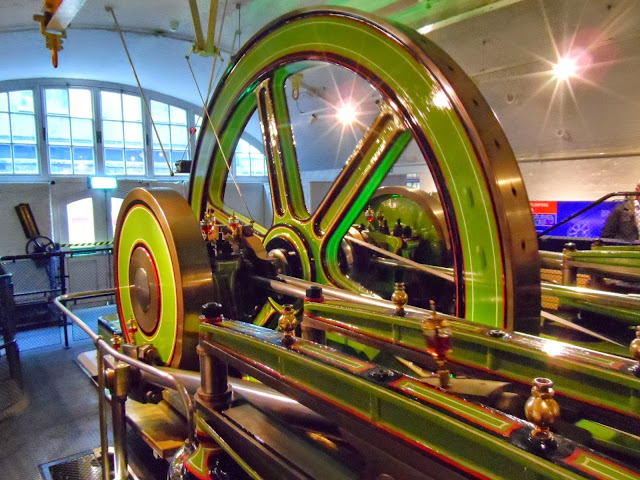
The sheer scale of the bridge, and its inner workings, are amazing to behold, considering what tools they had to use, back in the 1880s.