"Not all those who wander are lost..." Come with me as I explore London's history, hidden gems and unusual places.
Sunday, May 04, 2025
Walking with Erin: Baker Street to Soho Square... and beyond
Thursday, February 22, 2024
How did London's Underground & Overground lines get their names?
"Names mean almost nothing." - Jean-Luc Picard
"Names mean almost everything." - Jack Crusher
![]() |
| Image Copyright TfL |
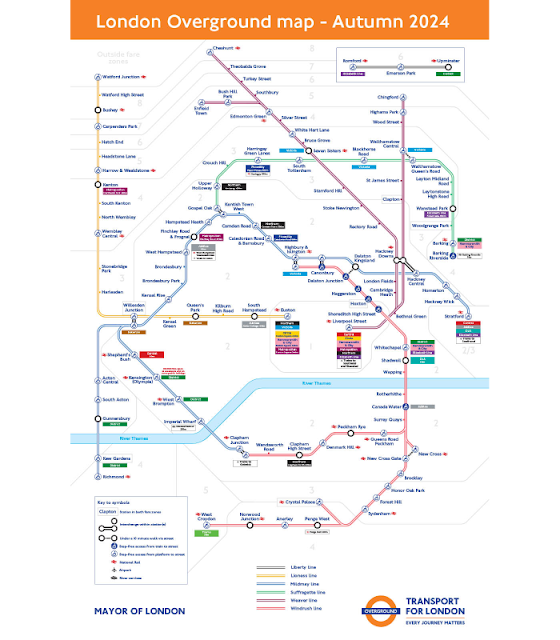
So, from Autumn 2024, the six London Overground lines are to be given distinct names and colours.
London Mayor, Sadiq Khan, has finally followed through with one of his 2021 Labour Mayoral manifesto pledges, which was to overhaul and rename the London Overground lines. The total cost of the project is around £6.3 million, which is an eye-watering amount of money, especially with current financial woes.
But, hey, it will make things clearer and easier... won't it?
After hearing this news, I thought it would be fun to look at the etymology of the London Underground line names, before looking at the new ones.
Bakerloo - A portmanteau of the 'Baker Street and Waterloo Railway'.
Central - Originally called the Central London line it was shortened to Central line in 1937.
Circle - Quite simply the line is a loop. Easy. Except, as of 2009, it no longer runs in a complete circle.
District - Originally built by the Metropolitan District Railway, it became known as the District line so as not to be confused with the Metropolitan Railway.
Elizabeth - Originally this line was to be called Crosstrail, but, no. Once again a more regal name was chosen, and so was named in honour of HM Queen Elizabeth II.
Hammersmith & City - Quite simply it runs from Hammersmith and through the City. Boring.
Jubilee - Originally proposed as the Fleet line, various financial issues, construction delays and changes to its route saw it called the Jubilee line, in honour of Queen Elizabeth II's silver jubilee in 1977. Nice, but the line didn't open until 1979 and wasn't completed until 1999.
Metropolitan - The world's first underground railway was built by the Metropolitan Railway Company. I think the clue is in the name.
Northern - The City & South London Railway built the first proper underground line, built by boring a tunnel, rather than the cut-and-cover method. The Charing Cross, Euston & Hampstead Railway became owned by the Underground Electric Railways Company of London. In 1914 the Underground Electric Railways Company of London bought the City & South London Railway and, by adding extensions, allowed the lines to run on the same line. None of this explains why the name Northern was chosen though.
Piccadilly - The Great Northern, Piccadilly & Brompton Railway ran from Finsbury Park under Piccadilly to Brompton. Quite simply, as the line reached the West End the name was shortened to simply Piccadilly.
Victoria - In 1955 plans were put forward for a new underground line between Victoria and Walthamstow. While planning the line various names were suggested. First there was the Walvic line (Walthamstow-Victoria) and the much better Viking line (Victoria-King's Cross). However, those that know best decided to be as boring as possible and call it the Victoria line. I much prefer Viking line.
Waterloo & City - The London and South Western Railway had their terminus at Waterloo Bridge, from where they ran trains to Southampton and back. However, for those people who needed to cross the river, this wasn't good enough. Thankfully, a new company named the Waterloo & City Railway Company obtained permission to build a new line from Waterloo Bridge to a new City station. The line was immediately called the Waterloo and City, although City station would be renamed Bank, the line kept its name.
Wednesday, February 21, 2024
Walking with Erin: The Wallace Collection to Carnaby Street... and beyond
![]() |
| The Great Gallery. |
Tuesday February 20, 2024.
With half term upon us I had already planned to take a walk with Keilyn, later in the week. Erin, not one for long walks wanted a day out , too, so we decided to visit the Wallace Collection.
We caught a Metropolitan line train to Baker Street and began our day.
We headed down Chiltern Street, on to Dorset Street and then on to Manchester Street, spying Hertford House on our left, all the while I was taking photos of Coal Hole Plates, as I think they are nice pieces of history.
![]() |
| A Coal Hole Plate. |
As tickets are not required, unless seeing one of their temporary exhibitions, we headed through the doors into the entrance hall. Ahead of us carpeted marble stairs lead to the first floor, while rooms were to our left and right. We decided to start on the ground floor and work our way up the house.
We headed through the shop to the Housekeeper's Room, where paintings by Turner, Bonington and Canaletto.
![]() |
| 'Fishing Boats' by Bonington. |
We then headed through to the first of four rooms dedicated to Arms and Armour. Weapons from India, Persia, Japan and Europe, among others, were displayed, along with armour from various countries.
![]() |
| Arms and Armour. |
Following these rooms we headed to the Smoking Room, which was filled with jewellery, porcelain and the like, before heading to the 16th Century Gallery, the Front State Room, the Back State Room, the Dining Room and then the Billiard Room.
![]() |
| The Smoking Room. |
We then ascended the stairs and entered the Boudoir, the West Room and the three West Galleries.
![]() |
| The Staircase. |
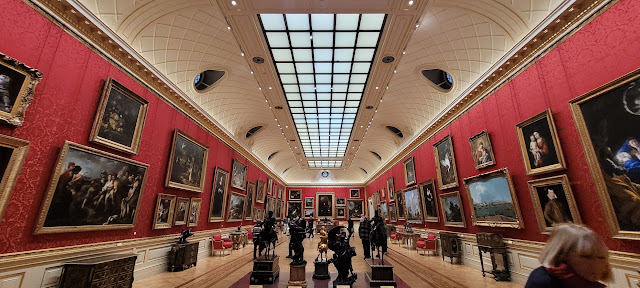
The highlight, for me, was the Great Gallery, which is an amazing and spacious room. Furniture and paintings, along with ornaments were spread around this cavernous room, while seating allowed you to sit and take in the room.
![]() |
| The Great Gallery. |
We then made our way though to the three East Galleries and then the East Drawing Room. Each room was splendid and it felt like stepping back in time. The Small Drawing Room led us to the Large Drawing Room, the Oval Drawing Room and the Study.
![]() |
| Erin in the Oval Drawing Room. |