Showing posts with label TFL. Show all posts

Thursday, January 01, 2026

London Transport Trivia

Frank Pick Roundel

Below you will find many fascinating, interesting and unbelievable facts
 about London's Transport system.

If you know of any trivia that I have missed, or if you spot an error, please, get in touch.

Obviously, with upgrades, new stations, extensions and the ever-changing city, these figures are likely to change, but were correct at the time of writing.

A
  • Acton has the most stations, of any town, with seven: Acton Central (Mildmay), Acton Main Line (Elizabeth), Acton Town (District & Piccadilly), East Acton (Central), North Acton (Central), South Acton (Mildmay), West Acton (Central)
  • Acton Town is the first station, alphabetically
  • Acton Town was originally called Mill Hill Park
  • Albert Gunter 'jumped' his No. 78 bus over Tower Bridge as it was opening, to avoid a catastrophe, in December 1952.
  • Alcohol was banned on the network in June 2008
  • Aldgate station is built on a plague pit where over 1,000 bodies were buried, in 1665
  • Alperton was originally called Perivale-Alperton
  • Amersham is the highest station above sea level, at 150 metres (492 feet)
  • Angel station has the longest escalators on the network, and in the UK, with a vertical rise of 27 metres (90 feet) and a length of 61 metres (200 feet)
  • Archway was originally called Highgate, then Archway (Highgate), then Highgate (Archway)
  • Arnos Grove station was inspired by the Stockholm Public Library
  • Arsenal was originally called Gillespie Road, then Arsenal (Highbury Hill)
B
  • Baker Street has the most platforms, with 10
  • Bakerloo line has 25 stations
  • Bakerloo line is 23.2 km (14.4 miles) long
  • Bakerloo line opened on March 10, 1906
  • Balham is the only station on the network that contains none of the letters from the word ‘underground’
  • Bank station has two moving walkways
  • Bank was originally called City
  • Barbican was originally called Aldersgate Street, then Aldersgate, then Aldersgate & Barbican
  • Bayswater became Bayswater (Queen's Road) & Westbourne Grove, then Bayswater (Queen's Road), with the suffix gradually dropped 
  • Becontree was originally called Gale Street
  • Boston Manor was originally called Boston Road
  • Brent Cross was originally called Brent
  • British Museum (disused) sits between Tottenham Court Road and Holborn, but it hasn’t been used since 1932
  • Bromley-by-Bow was originally called Bromley
  • Burnt Oak became Burnt Oak (for Watling), with the suffix gradually dropped
  • Bus route 24 is London's oldest, still running bus route, between Pimlico and Hampstead Heath
C
  • Cable Car has 2 stations
  • Cable Car is 3,600 ft (1.100 m) long
  • Cable Car opened on July 4, 2012
  • Canons Park was originally called Canons Park (Edgware)
  • Central line has 49 stations
  • Central line has the longest single journey, from West Ruislip to Epping, at 54.5 km (34 miles)
  • Central line is the longest underground line at 74 km (46 miles) long
  • Central line opened on July 30, 1900
  • Chalfont & Latimer to Chesham is the longest distance between stations, at 6.3 km (3.9 miles)
  • Chalfont & Latimer was originally called Chalfont Road
  • Chancery Lane became Chancery Lane (Grays Inn), with the suffix gradually dropped
  • Chancery Lane has the shortest escalator, which has only 50 steps
  • Charing Cross (Bakerloo line) was originally called Trafalgar Square
  • Charing Cross has the most exits to street level, with 13
  • Charing Cross was created in 1979, when Trafalgar Square and Strand stations were merged
  • Charles Holden took inspiration from the Moscow Metro for his design of Gants Hill station
  • Chesham is the furthest station from central London, at 40 km (25 miles)
  • Chesham is the most northerly station on the network
  • Chesham is the most westerly station on the network
  • Chiswick Park was originally called Acton Green, then Chiswick Park & Acton Green
  • Chorleywood was originally called Chorley Wood, then Chorley Wood & Chenies, before becoming Chorleywood
  • Circle line has 36 stations
  • Circle line is 27 km (17 miles) long
  • Circle line opened in 1863, but wasn't completed until 1884. It became the Circle line in 1936
  • Circle line stopped being a true circle in 2009
  • Clapham North was originally called Clapham Road
  • Cockney rhyming slang for the Tube is ‘The Oxo’, as in 'Oxo cube'
  • Covent Garden to Leicester Square is the shortest journey on the network, with the platforms just 260 metres (853 feet) apart
  • Croxley was originally called Croxley Green
D
  • Dagenham East was originally called Dagenham
  • Dagenham Heathway was originally called Heathway
  • Debden was originally called Chigwell Road, then Chigwell Lane
  • District line has the most stations, with 60
  • District line is 64 km (40 miles) long
  • District line opened on December 24, 1868
  • District line rail maps were originally published, in the 19th century, with the maxim 'Time is Money' on the cover.
  • Docklands Light Railway has 45 stations
  • Docklands light Railway is 38 km (24 miles) long
  • Docklands Light Railway opened on August 31, 1987
  • Down Street station (disused) was used as a bunker, by Winston Churchill, during World War II

Thursday, July 11, 2024

'Staff Letters' Postboxes

Staff Letters Box
A 'Staff Letters' box on the Piccadilly line - photo © Keilyn J. A. Morrissey.

Normally I only spot interesting things when walking the streets of London. 

On this occasion I was travelling on the Piccadilly line when I noticed these boxes, as we stopped at various stations. As the boxes were never opposite where we were sat, it took a while to work out what was written on them. 

Fortunately, as we pulled into one station, the box was almost directly outside the carriage, so Keilyn jumped off the train, took the photo and jumped back on, all with a big grin on her face.

It took a bit of research, when we got home, but theses boxes are exactly what they say they are... Letter boxes for staff.

Thursday, February 22, 2024

How did London's Underground & Overground lines get their names?

"Names mean almost nothing." - Jean-Luc Picard

"Names mean almost everything."  - Jack Crusher

London The Unfinished City
Image Copyright TfL

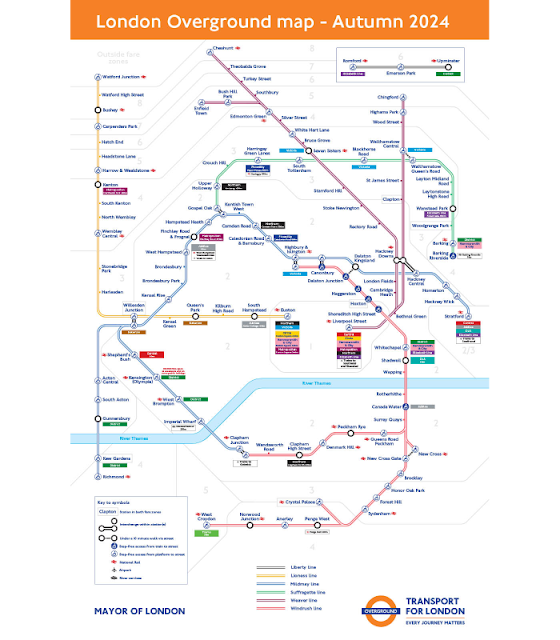
So, from Autumn 2024, the six London Overground lines are to be given distinct names and colours.

London Mayor, Sadiq Khan, has finally followed through with one of his 2021 Labour Mayoral manifesto pledges, which was to overhaul and rename the London Overground lines. The total cost of the project is around £6.3 million, which is an eye-watering amount of money, especially with current financial woes. 

But, hey, it will make things clearer and easier... won't it?

After hearing this news, I thought it would be fun to look at the etymology of the London Underground line names, before looking at the new ones.

Bakerloo - A portmanteau of the 'Baker Street and Waterloo Railway'.

Central - Originally called the Central London line it was shortened to Central line in 1937.

Circle - Quite simply the line is a loop. Easy. Except, as of 2009, it no longer runs in a complete circle.

District - Originally built by the Metropolitan District Railway, it became known as the District line so as not to be confused with the Metropolitan Railway.

Elizabeth - Originally this line was to be called Crosstrail, but, no. Once again a more regal name was chosen, and so was named in honour of HM Queen Elizabeth II.

Hammersmith & City - Quite simply it runs from Hammersmith and through the City. Boring.

Jubilee - Originally proposed as the Fleet line, various financial issues, construction delays and changes to its route saw it called the Jubilee line, in honour of Queen Elizabeth II's silver jubilee in 1977. Nice, but the line didn't open until 1979 and wasn't completed until 1999.

Metropolitan - The world's first underground railway was built by the Metropolitan Railway Company. I think the clue is in the name.

Northern - The City & South London Railway built the first proper underground line, built by boring a tunnel, rather than the cut-and-cover method. The Charing Cross, Euston & Hampstead Railway became owned by the Underground Electric Railways Company of London. In 1914 the Underground Electric Railways Company of London bought the City & South London Railway and, by adding extensions, allowed the lines to run on the same line. None of this explains why the name Northern was chosen though. 

Piccadilly - The Great Northern, Piccadilly & Brompton Railway ran from Finsbury Park under Piccadilly to Brompton. Quite simply, as the line reached the West End the name was shortened to simply Piccadilly.

Victoria - In 1955 plans were put forward for a new underground line between Victoria and Walthamstow. While planning the line various names were suggested. First there was the Walvic line (Walthamstow-Victoria) and the much better Viking line (Victoria-King's Cross). However, those that know best decided to be as boring as possible and call it the Victoria line. I much prefer Viking line.

Waterloo & City - The London and South Western Railway had their terminus at Waterloo Bridge, from where they ran trains to Southampton and back. However, for those people who needed to cross the river, this wasn't good enough. Thankfully, a new company named the Waterloo & City Railway Company obtained permission to build a new line from Waterloo Bridge to a new City station. The line was immediately called the Waterloo and City, although City station would be renamed Bank, the line kept its name.

Wednesday, January 24, 2024

Station Area ID Codes (SIDs)

London The Unfinished City

When travelling to London I use the London Underground, or, depending on my destination, the Overground. Because of this I have visited many stations, with their countless escalators, lifts, staircases, corridors and ticket halls, which make each station unique in its own way.

Another thing that they all share are small blue number plates, affixed to walls and doors throughout the station complex. Some corridors can have multiple SIDs, depending on their length.

London The Unfinished City

Each plate as a single digit number above a three digit number. The top number is easy to work out as this denotes the level beneath ground, but the longer number is a lot trickier to understand.

Saturday, October 28, 2023

London's Transport Network Information

London The Unfinished City
History of the Roundel.

London has to be one of the most interconnected cities in the world. From its 86,000 buses to its 4,100 underground trains, you can reach every part of the capital... and beyond.

Then there is the River Boat service and the Tram network. And that is before you get on to the Elizabeth line, the interlinked London Overground lines and National Rail lines

The London Underground system is composed, currently, of 11 distinct lines, serving 272 stations over 400 kilometres (250 miles). The station of Ongar is 'point zero' for measurements along the network.

Below you will find some information for each of the lines. 

('Speed' is an average for the entire line).

Bakerloo

First service: March 10, 1906

Length: 23.2 km (14.4 mi)

Stations: 25

Speed: 27 km/h (16 mph)

Central

First service: July 30, 1900

Length: 74 km (46 mi)

Stations: 49

Speed: 37 km/h (23 mph)

Circle

First service: 1863

Length: 27 km (17 mi)

Stations: 36

Speed: 24 km/h (15 mph)

District

First service: December 24, 1868

Length: 64 km (40 mi)

Stations: 60

Speed: 30 km/h (18 mph)

Hammersmith & City

First service: January 10, 1863

Length: 25.5 km (15.8 mi)

Stations: 29

Speed: 25 km/h (15 mph)

Jubilee

First service: May 1, 1979

Length: 36.2 km (22.5 mi)

Stations: 27

Speed: 40 km/h (25 mph)

Suggested names: Fleet line

Metropolitan

First service: January 10, 1863

Length: 67 km (42 mi)

Stations: 34

Speed: 45 km/h (28 mph)

Tuesday, June 06, 2023

World Time Linear Clock

London The Unfinished City
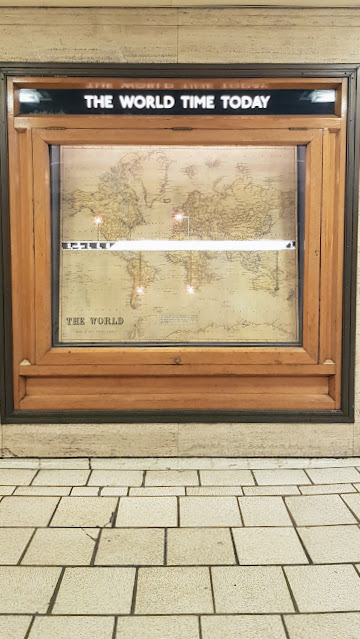
The World Time Today.

If you were to enter London's West End via Piccadilly Circus, then don't rush straight out of the station. Take a moment to marvel at the 1920s architecture and then go in search of a truly unique timepiece.

Built into the wall is the World Time Linear Clock which was the brainchild of Architect Charles Holden and John Mowlem & Company.

It was installed during the expansion of Piccadilly Circus station, during the the early 1920s.

London The Unfinished City
The scrolling band rotates as the Earth spins.

The time is displayed by a west scrolling band, with Roman numerals, that moves at the same speed as the Earth rotates, around the equator.

It shows both GMT and BST and gives a rough indication as to the time around the world. It is not entirely accurate as world time zones only broadly follow longitude. But, it is still a fascinating piece of machinery.

London The Unfinished City
How to use.

Lightbulbs highlight a small number of cities that include London, Cape Town, Sydney, New York, Victoria (Canada) and Buenos Aires.

I was surprised, on my visit, how no one noticed this piece of horology that once informed the traveller, that needed to know, the time around the world. 

Now, people are too inpatient and in a constant rush, which is a shame.

London The Unfinished City
World Time Linear Clock, Piccadilly Circus station.

Wednesday, November 30, 2022

RATs on the London Underground

London The Unfinished City
A C69/77 stock train converted to be a Rail Adhesion Train (RAT) on the Metropolitan line.

Every now and again I see these Rail Adhesion Trains, usually in the Autumn/Winter months and usually at Watford Metropolitan line station, but I never understood what they did.

Coming back from London, last Sunday evening, a Rail Adhesion Train was in the sidings, so I took a photograph and decided to do so some research to find out what this train actually does.

Wednesday, November 23, 2022

Woolwich Free Ferry

London The Unfinished City
Looking from the south terminal to the north.

Although you can traverse the River Thames by foot, either by bridge, tunnel or cable car, you can also choose to go by train, by road or boat.

The Woolwich Free Ferry, however, is only suitable if travelling from South Woolwich to North Woolwich, but it is still a fun way of travelling and offers some great views along the Thames. Plus, it is completely free to use.

Sunday, June 12, 2022

Metropolitan line


London The Unfinished City
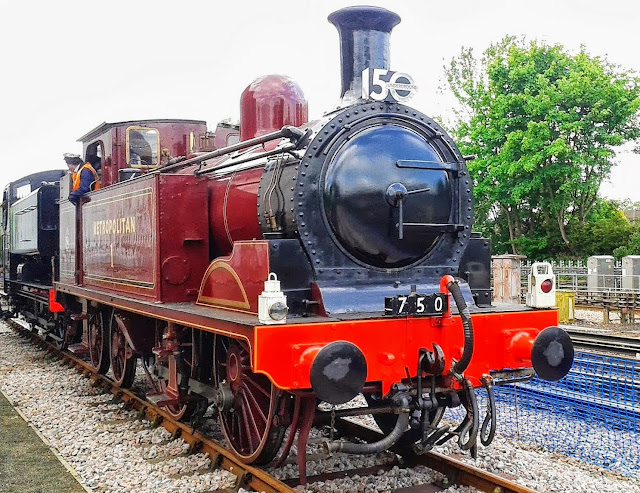
Metropolitan 1 steam locomotive, celebrating 150 years of the Met line, in 2018.

Living in Watford, which is the largest town in Hertfordshire, I have access to excellent transport links to London, as well as other areas of the country. Just 16 miles from Central London I have a choice of National Rail, London Overground services or Transport for London's Metropolitan line service. It is the latter that I invariably use.

London The Unfinished City
Trains at Watford Metropolitan station awaiting the morning rush hour.

The Metropolitan line station is just a 15 minute walk from my home and will get me to central London in just 40 minutes. I can also change to a different line like the Jubilee, while enroute, and end up in east London in a little over an hour.

London The Unfinished City
Watford Metropolitan station decorated in celebration of 150 years.

As this is the line that I most commonly use, and it being the first of its kind in the world, I thought I would do a blog about its history.

Saturday, July 03, 2021

Westminster Station


London The Unfinished City
Walls like catacombs.

Sunday, June 27, 2021

Most of the Unfinished City's underground stations have unique features or something that stands them apart from the others. The surface stations are different as they were all built to the same standard, although some, which were added later, were designed to stand out.

London The Unfinished City
Supports, staircases & escalators.


My favourite underground station, from the extension of the Jubilee line, is Westminster, which has a uniqueness to it that I have not seen at any other subsurface station. From the giant box that you descend into, to the staircases, escalators and elevators all supported from giant steel pillars, it is like descending into the bowels of the Earth.

London The Unfinished City
Structural supports.


The lighting is just right to show off the skill and workmanship that went in to constructing this behemoth of a station and, considering the depth to which you descend, this station only has four platforms: Circle & District line eastbound, Circle & District line westbound, Jubilee line eastbound & Jubilee line westbound.

London The Unfinished City
'Station Box'

Sunday, February 24, 2019

A Blast from the Past

London The Unfinished City
 A 1938 art-deco Bakerloo line train.

Sunday February 24, 2019.

A rare sight on the Metropolitan Line, this afternoon, a beautifully restored 1938 art-deco train, that was used on the Bakerloo, Northern and Piccadilly lines.

It had begun its journey from Ealing Broadway and headed to Hammersmith, High Street Kensington and then a full circuit of the Circle Line before arriving at Moorgate.

It then ran from Moorgate, along the Metropolitan Line, to Amersham, before returning to Ealing Broadway, via Rayners Lane.

We waited for it at Rickmansworth where we were in the perfect place to see it.

Friday, August 05, 2016

Roundel

London The Unfinished City
The more things change, the more they stay the same.

I live in Watford, which is the largest town in Hertfordshire, and is the fourth most connected town in the country. 

So, being roughly 18 miles from the centre of London, getting into the Unfinished City is remarkably simple, and cheap.

I can guarantee, though, that 98% of my journeys, into the Unfinished City, are made via the London Underground. The other 2% I make via the overground networks, which include the London Overground and National Rail.

London The Unfinished City
Love the Tube: 160 Years of Service.

The Metropolitan Line station is just a short walk away and can take me straight through to Baker Street or Aldgate. Or I can change at Finchley Road, among others, to change onto a different line, depending on where I am headed,

One of the things that is instantly recognisable around the world, is the Roundel: The symbol used by Transport for London on all of their stations, bus stops, promotional material, etc..

London The Unfinished City
Bank station Roundel.

What many don't realise is how the Roundel developed over time.

Saturday, October 13, 2012

London Cable Car

London The Unfinished City
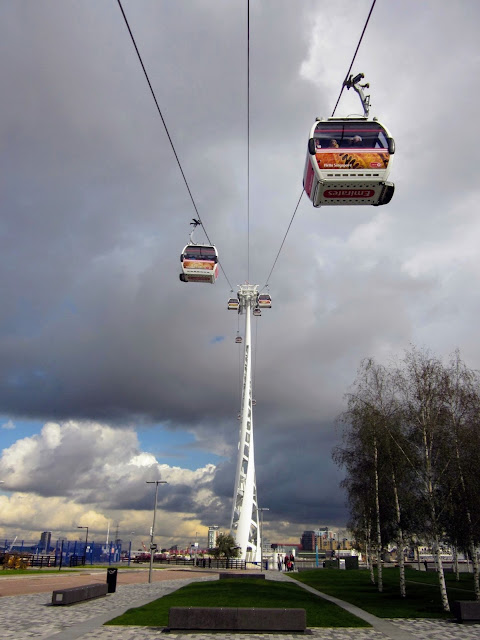
Reaching for the Sky.

Saturday October 13, 2012.


I absolutely love travelling across the River Thames, via the London Dangleway, even though it is simpler, and cheaper, to stay on the Jubilee Line and travel below the River Thames.

London The Unfinished City
Sunset from the Dangleway.

The reason for this is the novelty, which still hasn't worn off after countless flights, and the views which are unique. On a clear day you can see The Thames Barrier, Canary Wharf, The Shard, the Olympic Park, the Old Royal Naval College and, if you get your timing right, some spectacular sunsets.

London The Unfinished City
Descending into the London Fog.