Showing posts with label London Overground. Show all posts

Monday, May 13, 2024

Brunel Museum

Brunel Museum Tunnel Shaft
The Mural on the side of the Grand Entrance Hall.

The Brunel Museum is located within the Brunel Engine House building, Rotherhithe. This small but very informative museum allows you to descend into the Rotherhithe Thames Tunnel Shaft and visit the Engine House, where you will learn exactly what went in to building the world's first tunnel beneath a navigational waterway.

Marc Isambard Brunel designed Engine House as part of the Thames Tunnel project. Steam-powered pumps, used to extract water from the tunnel, were originally housed here, although it was used as a boiler house, between 1825-43. 

Brunel Museum Priming Pump
A Priming Pump from 1929.

In 1961 the Brunel Engine House opened and offered visitors the chance to see the interior of the building, as well as the Rennie flat V steam engine.

In 1974 the Engine House and Chimney were Grade II Listed. 

Between 1975-79 restoration work to stop structural decay was undertaken and completed.

Brunel Museum Engine House
The Chimney and Engine House.

In 2006 the Brunel Engine House changed its name to the Brunel Museum allowing the museum to incorporate other projects by the Brunel's. A new mural was created on the side of the Tunnel Shaft and benches were created in the style of Brunel bridges, in the garden area.

Brunel Museum Royal Albert Bridge
The Royal Albert Bridge, Saltash, as a bench at the museum.

Refurbishments, in 2007, included the moving of the Rennie flat V steam engine to the Chatham Historic Dockyard, thus creating a larger exhibition space and improved toilet facilities, within the Engine House. 

Brunel Museum Memorabilia
Memorabilia for the Thames Tunnel.


Thursday, February 22, 2024

How did London's Underground & Overground lines get their names?

"Names mean almost nothing." - Jean-Luc Picard

"Names mean almost everything."  - Jack Crusher

London The Unfinished City
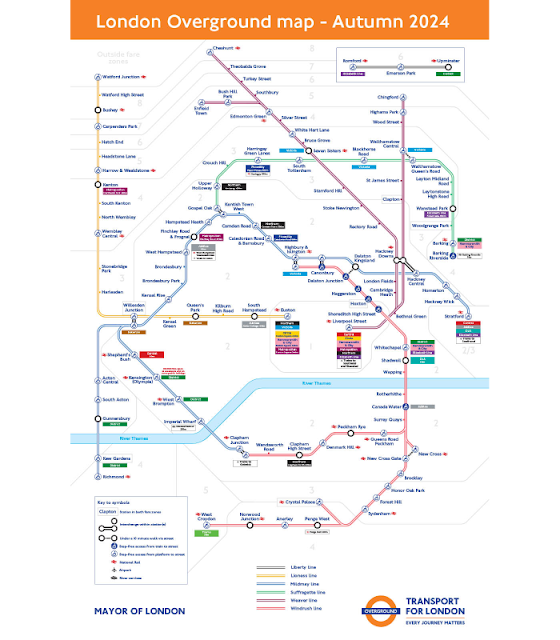
Image Copyright TfL

So, from Autumn 2024, the six London Overground lines are to be given distinct names and colours.

London Mayor, Sadiq Khan, has finally followed through with one of his 2021 Labour Mayoral manifesto pledges, which was to overhaul and rename the London Overground lines. The total cost of the project is around £6.3 million, which is an eye-watering amount of money, especially with current financial woes. 

But, hey, it will make things clearer and easier... won't it?

After hearing this news, I thought it would be fun to look at the etymology of the London Underground line names, before looking at the new ones.

Bakerloo - A portmanteau of the 'Baker Street and Waterloo Railway'.

Central - Originally called the Central London line it was shortened to Central line in 1937.

Circle - Quite simply the line is a loop. Easy. Except, as of 2009, it no longer runs in a complete circle.

District - Originally built by the Metropolitan District Railway, it became known as the District line so as not to be confused with the Metropolitan Railway.

Elizabeth - Originally this line was to be called Crosstrail, but, no. Once again a more regal name was chosen, and so was named in honour of HM Queen Elizabeth II.

Hammersmith & City - Quite simply it runs from Hammersmith and through the City. Boring.

Jubilee - Originally proposed as the Fleet line, various financial issues, construction delays and changes to its route saw it called the Jubilee line, in honour of Queen Elizabeth II's silver jubilee in 1977. Nice, but the line didn't open until 1979 and wasn't completed until 1999.

Metropolitan - The world's first underground railway was built by the Metropolitan Railway Company. I think the clue is in the name.

Northern - The City & South London Railway built the first proper underground line, built by boring a tunnel, rather than the cut-and-cover method. The Charing Cross, Euston & Hampstead Railway became owned by the Underground Electric Railways Company of London. In 1914 the Underground Electric Railways Company of London bought the City & South London Railway and, by adding extensions, allowed the lines to run on the same line. None of this explains why the name Northern was chosen though. 

Piccadilly - The Great Northern, Piccadilly & Brompton Railway ran from Finsbury Park under Piccadilly to Brompton. Quite simply, as the line reached the West End the name was shortened to simply Piccadilly.

Victoria - In 1955 plans were put forward for a new underground line between Victoria and Walthamstow. While planning the line various names were suggested. First there was the Walvic line (Walthamstow-Victoria) and the much better Viking line (Victoria-King's Cross). However, those that know best decided to be as boring as possible and call it the Victoria line. I much prefer Viking line.

Waterloo & City - The London and South Western Railway had their terminus at Waterloo Bridge, from where they ran trains to Southampton and back. However, for those people who needed to cross the river, this wasn't good enough. Thankfully, a new company named the Waterloo & City Railway Company obtained permission to build a new line from Waterloo Bridge to a new City station. The line was immediately called the Waterloo and City, although City station would be renamed Bank, the line kept its name.