![]() |
| The plaque at Rotherhithe station. |
![]() |
| Keilyn at the bottom of the tunnel shaft. Notice the soot mark, from steam trains, still on the wall. |
"Not all those who wander are lost..." Come with me as I explore London's history, hidden gems and unusual places.
![]() |
| The plaque at Rotherhithe station. |
![]() |
| Keilyn at the bottom of the tunnel shaft. Notice the soot mark, from steam trains, still on the wall. |
The statue consists of 16 pieces of granite and is 2.1m in height, width and depth and cost £100,000.
It was unveiled on Friday September 10, 2021.
A worn brass plaque reads:
Wednesday August 14, 2024.
As we had some time away from work and the girls were away from school for the holidays, we decided to spend some time visiting some sites in London.
We booked a taxi and headed to Watford Junction, where we caught an Avanti West Coast to Euston and, from there, a Northern line train to Archway.
After topping up on a few snacks fro the day we caught a 210 bus to Compton Avenue, where we alighted and walked the short distance to Kenwood House.
Kenwood House is a former stately home, which was originally built circa 1616. It was remodelled by the architect Robert Adam in the 18th century and was home to the Earls of Mansfield until the 20th century.
Besides being a stately home, Kenwood House is home to historic paintings by the likes of John Crome, Anthony van Dyck, Claude de Jongh, JMW Turner, Thomas Gainsborough, Rembrandt and many more.
During our visit there was an exhibition by Stephen Farthing entitled 'Strike a Pose: Stephen Farthing and the Swagger Portrait'. These are portraits of Lord Howe, reimagined by Stephen Farthing, and were pretty spectacular.
You can see more photos from Kenwood House by clicking the link below.
After visiting the house we sat in the grounds and ate our lunch, before we took a stroll through the grounds, eventually finding ourselves heading south through Hampstead Heath.
The weather was perfect for a wander through the Heath, with many people jogging, walking dogs, having a picnic or, like this, just taking in the surroundings.
"Names mean almost nothing." - Jean-Luc Picard
"Names mean almost everything." - Jack Crusher
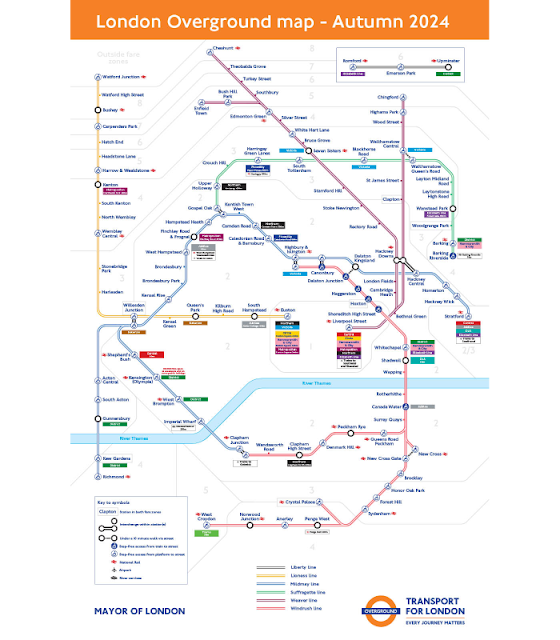
![]() |
| Image Copyright TfL |
So, from Autumn 2024, the six London Overground lines are to be given distinct names and colours.
London Mayor, Sadiq Khan, has finally followed through with one of his 2021 Labour Mayoral manifesto pledges, which was to overhaul and rename the London Overground lines. The total cost of the project is around £6.3 million, which is an eye-watering amount of money, especially with current financial woes.
But, hey, it will make things clearer and easier... won't it?
After hearing this news, I thought it would be fun to look at the etymology of the London Underground line names, before looking at the new ones.
Bakerloo - A portmanteau of the 'Baker Street and Waterloo Railway'.
Central - Originally called the Central London line it was shortened to Central line in 1937.
Circle - Quite simply the line is a loop. Easy. Except, as of 2009, it no longer runs in a complete circle.
District - Originally built by the Metropolitan District Railway, it became known as the District line so as not to be confused with the Metropolitan Railway.
Elizabeth - Originally this line was to be called Crosstrail, but, no. Once again a more regal name was chosen, and so was named in honour of HM Queen Elizabeth II.
Hammersmith & City - Quite simply it runs from Hammersmith and through the City. Boring.
Jubilee - Originally proposed as the Fleet line, various financial issues, construction delays and changes to its route saw it called the Jubilee line, in honour of Queen Elizabeth II's silver jubilee in 1977. Nice, but the line didn't open until 1979 and wasn't completed until 1999.
Metropolitan - The world's first underground railway was built by the Metropolitan Railway Company. I think the clue is in the name.
Northern - The City & South London Railway built the first proper underground line, built by boring a tunnel, rather than the cut-and-cover method. The Charing Cross, Euston & Hampstead Railway became owned by the Underground Electric Railways Company of London. In 1914 the Underground Electric Railways Company of London bought the City & South London Railway and, by adding extensions, allowed the lines to run on the same line. None of this explains why the name Northern was chosen though.
Piccadilly - The Great Northern, Piccadilly & Brompton Railway ran from Finsbury Park under Piccadilly to Brompton. Quite simply, as the line reached the West End the name was shortened to simply Piccadilly.
Victoria - In 1955 plans were put forward for a new underground line between Victoria and Walthamstow. While planning the line various names were suggested. First there was the Walvic line (Walthamstow-Victoria) and the much better Viking line (Victoria-King's Cross). However, those that know best decided to be as boring as possible and call it the Victoria line. I much prefer Viking line.
Waterloo & City - The London and South Western Railway had their terminus at Waterloo Bridge, from where they ran trains to Southampton and back. However, for those people who needed to cross the river, this wasn't good enough. Thankfully, a new company named the Waterloo & City Railway Company obtained permission to build a new line from Waterloo Bridge to a new City station. The line was immediately called the Waterloo and City, although City station would be renamed Bank, the line kept its name.
| The National Windrush Monument. |
Anyone travelling through Waterloo station, since late June of this year, will almost definitely have seen the 3.5 metre (11.5 feet) tall bronze National Windrush Monument.
The Monument depicts a family (father, mother, daughter) dressed in their 'Sunday Best', while standing atop seven suitcases, which contain all of their worldly belongings from their Caribbean home.
The monument is dedicated to all those who emigrated from the Caribbean to Britain between the arrival of the ship HMT Empire Windrush on 22 June 1948 and the Immigration Act 1971.