Showing posts with label London Transport. Show all posts

Thursday, January 01, 2026

London Transport Trivia

Frank Pick Roundel

Below you will find many fascinating, interesting and unbelievable facts
 about London's Transport system.

If you know of any trivia that I have missed, or if you spot an error, please, get in touch.

Obviously, with upgrades, new stations, extensions and the ever-changing city, these figures are likely to change, but were correct at the time of writing.

A
  • Acton has the most stations, of any town, with seven: Acton Central (Mildmay), Acton Main Line (Elizabeth), Acton Town (District & Piccadilly), East Acton (Central), North Acton (Central), South Acton (Mildmay), West Acton (Central)
  • Acton Town is the first station, alphabetically
  • Acton Town was originally called Mill Hill Park
  • Albert Gunter 'jumped' his No. 78 bus over Tower Bridge as it was opening, to avoid a catastrophe, in December 1952.
  • Alcohol was banned on the network in June 2008
  • Aldgate station is built on a plague pit where over 1,000 bodies were buried, in 1665
  • Alperton was originally called Perivale-Alperton
  • Amersham is the highest station above sea level, at 150 metres (492 feet)
  • Angel station has the longest escalators on the network, and in the UK, with a vertical rise of 27 metres (90 feet) and a length of 61 metres (200 feet)
  • Archway was originally called Highgate, then Archway (Highgate), then Highgate (Archway)
  • Arnos Grove station was inspired by the Stockholm Public Library
  • Arsenal was originally called Gillespie Road, then Arsenal (Highbury Hill)
B
  • Baker Street has the most platforms, with 10
  • Bakerloo line has 25 stations
  • Bakerloo line is 23.2 km (14.4 miles) long
  • Bakerloo line opened on March 10, 1906
  • Balham is the only station on the network that contains none of the letters from the word ‘underground’
  • Bank station has two moving walkways
  • Bank was originally called City
  • Barbican was originally called Aldersgate Street, then Aldersgate, then Aldersgate & Barbican
  • Bayswater became Bayswater (Queen's Road) & Westbourne Grove, then Bayswater (Queen's Road), with the suffix gradually dropped 
  • Becontree was originally called Gale Street
  • Boston Manor was originally called Boston Road
  • Brent Cross was originally called Brent
  • British Museum (disused) sits between Tottenham Court Road and Holborn, but it hasn’t been used since 1932
  • Bromley-by-Bow was originally called Bromley
  • Burnt Oak became Burnt Oak (for Watling), with the suffix gradually dropped
  • Bus route 24 is London's oldest, still running bus route, between Pimlico and Hampstead Heath
C
  • Cable Car has 2 stations
  • Cable Car is 3,600 ft (1.100 m) long
  • Cable Car opened on July 4, 2012
  • Canons Park was originally called Canons Park (Edgware)
  • Central line has 49 stations
  • Central line has the longest single journey, from West Ruislip to Epping, at 54.5 km (34 miles)
  • Central line is the longest underground line at 74 km (46 miles) long
  • Central line opened on July 30, 1900
  • Chalfont & Latimer to Chesham is the longest distance between stations, at 6.3 km (3.9 miles)
  • Chalfont & Latimer was originally called Chalfont Road
  • Chancery Lane became Chancery Lane (Grays Inn), with the suffix gradually dropped
  • Chancery Lane has the shortest escalator, which has only 50 steps
  • Charing Cross (Bakerloo line) was originally called Trafalgar Square
  • Charing Cross has the most exits to street level, with 13
  • Charing Cross was created in 1979, when Trafalgar Square and Strand stations were merged
  • Charles Holden took inspiration from the Moscow Metro for his design of Gants Hill station
  • Chesham is the furthest station from central London, at 40 km (25 miles)
  • Chesham is the most northerly station on the network
  • Chesham is the most westerly station on the network
  • Chiswick Park was originally called Acton Green, then Chiswick Park & Acton Green
  • Chorleywood was originally called Chorley Wood, then Chorley Wood & Chenies, before becoming Chorleywood
  • Circle line has 36 stations
  • Circle line is 27 km (17 miles) long
  • Circle line opened in 1863, but wasn't completed until 1884. It became the Circle line in 1936
  • Circle line stopped being a true circle in 2009
  • Clapham North was originally called Clapham Road
  • Cockney rhyming slang for the Tube is ‘The Oxo’, as in 'Oxo cube'
  • Covent Garden to Leicester Square is the shortest journey on the network, with the platforms just 260 metres (853 feet) apart
  • Croxley was originally called Croxley Green
D
  • Dagenham East was originally called Dagenham
  • Dagenham Heathway was originally called Heathway
  • Debden was originally called Chigwell Road, then Chigwell Lane
  • District line has the most stations, with 60
  • District line is 64 km (40 miles) long
  • District line opened on December 24, 1868
  • District line rail maps were originally published, in the 19th century, with the maxim 'Time is Money' on the cover.
  • Docklands Light Railway has 45 stations
  • Docklands light Railway is 38 km (24 miles) long
  • Docklands Light Railway opened on August 31, 1987
  • Down Street station (disused) was used as a bunker, by Winston Churchill, during World War II

Sunday, August 28, 2022

London Transport Museum: Hidden London Exhibition


London The unfinished City
Hidden London.

Friday August 26, 2022.

Since I still had some time off, before heading back to work, I decided to take Erin and Keilyn to London. Keeping our exact destination a secret from them we travelled, via London Underground, to Piccadilly Circus, where we stopped for some lunch, which we ate in the grounds of St Anne's church, Soho.

Suitably filled we continued along Shaftesbury Avenue to Charing Cross Road, where we turned left heading for Old Compton Street. Or, in fact, a grate in a traffic island through which you can peer down into a utility tunnel and make out a worn sign saying 'Little Compton Street'.

London The unfinished City
Little Compton Street sign, below street level.

We then headed down Earlham Street to Seven Dials, before heading along Mercer Street to Long Acre. From here we headed along Drury Lane and various other roads, which lead us to Covent Garden. A little perusal around the various market stalls before heading to our true destination... London Transport Museum.

London The unfinished City
Looking across at the entrance to the Hidden London Exhibition.

With our timed entry tickets we didn't have to queue and were ushered in within minutes of arrival. Taking the lift to level 2, we began our journey though London's transport history. But, that is a story for another time. This story is all about the Hidden London Exhibition, within the London Transport Museum.

London The unfinished City
Hidden London Exhibition

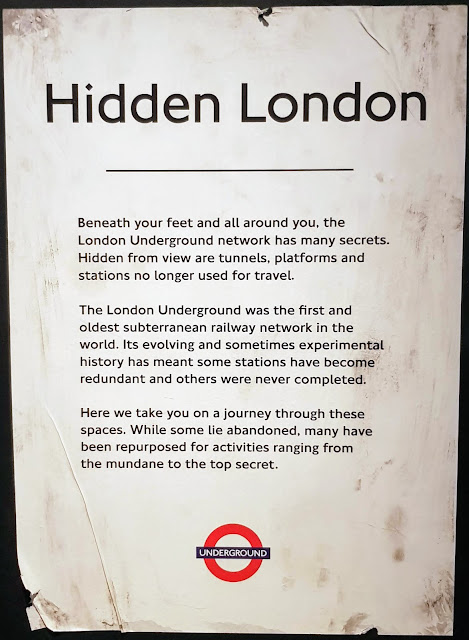
The Exhibition began by entering a 'disused' underground station and the paraphernalia that you find within the entrance, before leading you through the history of the closed stations. Why they were closed, how they were repurposed and, sometimes, their top secret use throughout the years. 

London The unfinished City
Aldwych station.

Sunday, September 12, 2021

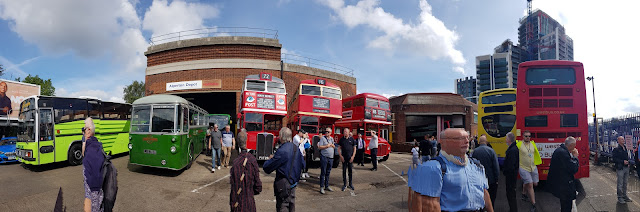
Alperton Bus Garage Farewell Open Day


London The Unfinished City
Alperton Garage Farewell Open Day
Saturday September 11, 2021

After 82 years of operation the Alperton Bus Garage ceased being operational on Friday September 10, 2021. The following day they opened up their doors and invited the public in to enjoy the various buses and chat with staff, for the final time.

London The Unfinished City
Keilyn takes Erin for a ride.

Myself, Erin, Keilyn and my uncle Martin arrived at the depot a few minutes before the gates opened. Joining the queue we didn't have to wait long. A £2.50 entrance fee for adults (accompanied children were free), which would go to local charities was a small price to pay.

London The Unfinished City
Centrewest (Preserved) BL81 (1977).

Sunday, February 24, 2019

A Blast from the Past

London The Unfinished City
 A 1938 art-deco Bakerloo line train.

Sunday February 24, 2019.

A rare sight on the Metropolitan Line, this afternoon, a beautifully restored 1938 art-deco train, that was used on the Bakerloo, Northern and Piccadilly lines.

It had begun its journey from Ealing Broadway and headed to Hammersmith, High Street Kensington and then a full circuit of the Circle Line before arriving at Moorgate.

It then ran from Moorgate, along the Metropolitan Line, to Amersham, before returning to Ealing Broadway, via Rayners Lane.

We waited for it at Rickmansworth where we were in the perfect place to see it.

Monday, November 13, 2017

London Transport Museum

London The Unfinished City
'Old Bill' saw action in The Great War.

The London Transport Museum
is one of those museums that, at first thought, makes you think of musty old buses and trams. Maybe some stuffy uniforms and not much more. And you would be right, but, at the same time, wrong.

Yes, there are plenty of buses, trams and trains, but they are in no way musty. All of the exhibits are displayed in such a way as to show the evolution of transport in London. The majority of the exhibits are available for the public to climb aboard, while the remaining ones are too fragile. 

There is everything from Sedan chairs to an original Omnibus. Trams and Taxis. Steam Locomotives to the latest in Underground carriages. 

The museum also shows the history of how timetables, signage and posters changed throughout the years, and how transport embraced new technology. It is definitely one of the more hands-on museums that is perfect for the entire family.

Friday, August 05, 2016

Roundel

London The Unfinished City
The more things change, the more they stay the same.

I live in Watford, which is the largest town in Hertfordshire, and is the fourth most connected town in the country. 

So, being roughly 18 miles from the centre of London, getting into the Unfinished City is remarkably simple, and cheap.

I can guarantee, though, that 98% of my journeys, into the Unfinished City, are made via the London Underground. The other 2% I make via the overground networks, which include the London Overground and National Rail.

London The Unfinished City
Love the Tube: 160 Years of Service.

The Metropolitan Line station is just a short walk away and can take me straight through to Baker Street or Aldgate. Or I can change at Finchley Road, among others, to change onto a different line, depending on where I am headed,

One of the things that is instantly recognisable around the world, is the Roundel: The symbol used by Transport for London on all of their stations, bus stops, promotional material, etc..

London The Unfinished City
Bank station Roundel.

What many don't realise is how the Roundel developed over time.