Showing posts with label Plaque. Show all posts

Monday, December 08, 2025

The Great Fire of 1666: What was lost and what survived?

This marks, almost, the exact location where the fire began
This plaque marks the spot from where the fire began.

Everyone knows the story of the Great Fire of 1666, from where it began to where it was extinguished. Children even sing a nursery rhyme about it.

History records the devastation, loss of life and the rebuilding, but many notable historic places survived the devastation and because of this are often overlooked.

The statue of the Golden Boy of Pye Corner
The Golden Boy of Pye Corner.
Brief History.

The fire started on Sunday September 2, 1666 and burned for four days.

The Great Fire of 1666, began at the shop of Thomas Farriner, in Pudding Lane, and was finally brought under control in the west, at Pie Corner (now the junction of Cock Lane and Giltspur Street), near Smithfield.

A small gilded statue of a boy, called the 'Golden Boy of Pye Corner', marks the spot where the fire reached.

Although the fire was said to be extinguished some isolated fires continued to break out.

The fire's advance was finally stopped for two main reasons: 
  1. The strong easterly wind, which had driven the fire, finally subsided.
  2. King Charles II had ordered the widespread use of gunpowder to blow up rows of houses, creating wide, empty gaps that the flames could not jump. These firebreaks, combined with the wind dying down, proved the ultimate stopping factor at places like Pie Corner.
How many people died?

The official number of people recorded to have died in the Great Fire of 1666 is only six to eight named people. However, the actual death toll is believed to have been much higher, potentially in the hundreds or even thousands. 

The Bills of Mortality at the time largely failed to account for the deaths of the poor, middle-class citizens, or the homeless, as a substantial portion of the population was displaced and not properly documented.

It is important to remember that the fire was a firestorm, with temperatures reaching 1,700°C, which is enough to completely cremate bodies, leaving no recognisable remains to be counted.

Plus, the official count only includes direct deaths from the fire itself. Many more people likely died in the cold winter months that followed due to disease, exposure and starvation in the makeshift camps set up outside the city walls.

A map showing the reach of the Great Fire of 1666
The scale of destruction within the City of London.

What was lost?

Over 13,000 homes were either destroyed by the fire, or pulled down or blown up to create firebreaks.

Old St Paul's Cathedral was completely gutted and later demolished to make way for Sir Christopher Wren's masterpiece.

The Royal Exchange, on Threadneedle Street, was completely destroyed.

Some 87 medieval churches were lost in the Great Fire.

Monday, July 14, 2025

MillenniuM Pathway, Archbishop's Park

MillenniuM Pathway plaque

Archbishop's Park, Lambeth, is a wonderful park that sits just to the east of Lambeth Palace Gardens. In fact it was once part of Lambeth Palace Gardens, before Archbishop Archibald Campbell Tait opened over 9 acres of land for use by the poor of the area.

Besides the usual sports fields and courts, there is a wonderful play area, a stunning bench, a community orchard, gardens and much more.

A path that flows through the park has stepping stone plaques, embedded in the tarmac, which chart the history of the area, along with some of the area's more famous names. 

It was unveiled in June 2000 with local residents choosing the subjects of the plaques.

Plaques Timeline

1000 - Lambeth is mainly marshland and open countryside punctuated by Roman roads and a few small settlements

1041 - The Anglo Saxon chronicle records 'This year died Hardicanute at Lambeth, as he stood drinking'.

1087 - Domesday Book lists Lambeth, or Lanchei, as belonging to Countess Goda, sister of Edward the Confessor.

1197 - The Manor of Lambeth is acquired by  the Archbishop of Canterbury. The building of Lambeth Palace begins during this period.

1339 - Edward III gives Kennington to the Black Prince, who builds a palace.

1534 - Sir Thomas More refuses to swear allegiance to the King at Lambeth Palace.

1605 - Guy Fawkes and his fellow conspirators store their gunpowder in a house in  Lambeth.

1634 - Tradescant opens his museum of curiosities to the public.

1661 - John writes of his 'Pretty Contrived

1731 - Birth of Henry Cavendish who weighed the world at Clapham.

1740 - Death of Margaret Finch Queen of the Norwood Gypsies aged 109.

1760 - Dr Johnson stays with the Thrales at Streatham Place.

1770 - Campaign tp abolish slavery is spearheaded by the Clapham Sect.

1771 - Opening of Astley's Amphitheatre in Westminster Bridge Road. The first indoor circus.

1793 - William Blake writes of 'Songs of Experience' while living in Hercules Road.

1802 - A hermit called 'Matthews the Hairyman' lives in a cave in the remote Norwood hills.

1820 - Henry Potter breeds leeches at Streatham to supply the London hospitals.

1826 - Doulton and Watts begin making pottery from premises in Lambeth High Street.

1848 - Mass meeting of Chartists on Kennington Common to present a petition to Parliament

1853 - The Crystal Palace moves from Hyde Park to the Norwood Ridge and the surrounding area develops rapidly.

1880 - Clapham Rovers win the  FA Cup.

1898 - Charlie Chaplin leaves Kennington Road School to join a Clog Dancing Troupe, aged nine.

1902 - WG Grace plays at Streatham Cricket Club, known as one of the most attractive grounds in the country.

MillenniuM Pathway 1936 plaque

1936 - Lupino Lane sings 'The Lambeth Walk' in the show 'Me and My Girl', and it becomes an international dance craze.

1938 - Alfie Howard, Lambeth's Town Crier, attends his first function. He's still working at the age of 87 as this path is made.

1945 - Lambeth Baths receives a direct hit from a V2 rocket. Thirty seven people are killed in Lambeth's worst incident of World War II.

1948 - The Empire Windrush docks in Southampton, the post-war immigration from the West Indies begins and Brixton's black community flourishes.

1951 - The Festival of Britain and the redevelopment of the South Bank.

1981 - The Brixton Riots act as a catalyst for change and regeneration in the inner city.

1990 - Brixton produces its first Prime Minister, John Major.

2000 - Ken Livingstone, Lambeth born and bred, becomes London's first elected Mayor. The London Eye transforms the London skyline.

Monday, September 12, 2022

'The Blacksmiths Arms'


London The Unfinished City
The Blacksmiths Arms, Rotherhithe.

Saturday September 10, 2022.

Wandering, as I do, around the streets of London I invariably stumble across a fair few pubs. Many of these I pass by, unless something about it catches my eye. This is what happened when I was walking through Rotherhithe and came across The Blacksmiths Arms.

Beautifully decked out with colourful hanging baskets and potted flowers, I decided to venture inside. Besides, I was thirsty.

And what a wonderful pub it is. Walking inside is like stepping back in time as it still maintains some original fittings and looks every bit the 200+ year old pub.

With its horseshoe bar, dining room at the back, comfortable armchairs and sofas and bar stools, it is a really relaxing place to take a break. There are, also, tables and chairs out front, where you can sit in the fresh air.

There is also a function room that can be hired out for private events.

London The Unfinished City
Isle of Thanet plaque.

The walls are full of photographs, paintings and various pieces of history, concerning the pub and the surrounding area, so there is a lot to peruse as you wait for a meal or sip your drink.

One photo showed Queen Elizabeth the Queen Mother, sipping a drink at the bar, so I had to do the same.

London The Unfinished City
Me standing where Queen Elizabeth The Queen Mother once stood.

The staff were friendly and there were a great selection of ales, lagers and spirits that would appeal to everyone.

This is definitely a place that I would revisit, should I find myself walking through Rotherhithe, again.

Wednesday, January 19, 2022

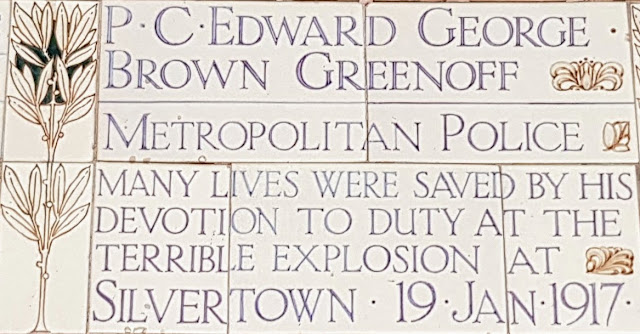
Police Constable Edward George Brown Greenoff


London The Unfinished City
P. C. Edward George Brown Greenoff (1886-1917).

On the evening of Friday January 19, 1917, a fire broke out at the Brunner Mond chemical factory off North Woolwich Road. The factory had been closed in 1912, only to be reopened in 1915 to purify Trinitrotoluene (TNT) for the war effort.

Within minutes of the outbreak of the fire an engine, from the new Brigade headquarters, was trying to dampen the blaze. 

Police Constable Edward Greenoff, of the Metropolitan Police's K Division, was on his beat when he noticed the fire. Realising what was in the building and the imminent danger of an explosion, P.C, Greenoff ran towards the fire to aid in the evacuation of the factory. If it had not been for this act of bravery the death toll would have been a lot higher. He then urged the people who had come to witness the fire to stay back and away from the flames. 

Then there came a rumbling sound and an explosion ripped the building apart. P.C. Greenoff was thrown forward by the force of the explosion and was knocked unconscious.

The building exploded with such force that girders, masonry and even a boiler, weighing several tons, were catapulted through the air. The shockwave, which was felt almost a mile away, ripped roofs from nearby buildings and flattened cottages within the area.

There were 73 fatalities and over 400 more were injured. 

P.C. Edward Greenoff was taken to Poplar Hospital where he died from his injuries on January 28th or 29th.

P.C. Edward George Brown Greenoff was buried in St Marylebone Cemetery, East Finchley.

This plaque is situated on the wall of the G. F. Watts Memorial to Heroic Self-Sacrifice, in Postman's Park.

Thursday, February 25, 2021

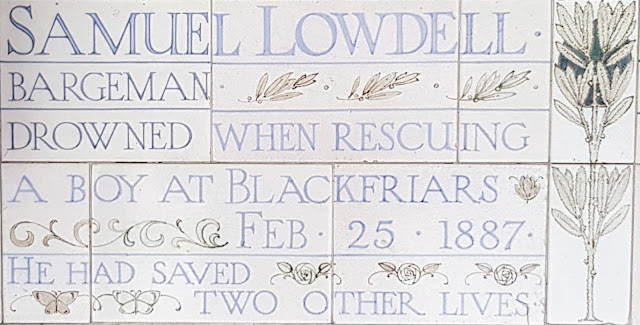
Samuel Lowdell


London The unfinished City
Samuel Lowdell (1864-1887).

Samuel Lowdell, of Bow Common, was a bargeman that worked on the barge 'William and Mary', on the River Thames. During his short life Samuel had previously saved two other people from the dangerous waters of Old Man Thames.

On the night of February 25, 1887, Samuel was working on the barge, near Blackfriars, when a shout went up that someone had fallen into the River. A boy, named Buck, had fallen in and, without any hesitation, Samuel dived into the frigid, murky waters to save him.

Unfortunately, on this occasion, after saving the boy, Samuel became stuck beneath a smaller boat, which was moored next to his barge. Despite frantic efforts to free him, Samuel never resurfaced and was presumed drowned. Buck was pulled from the water by another boat.

Samuel's body would not be recovered from the River Thames until March 23, 1887.

On April 3, 1887, Samuel Lowdell was buried in a common grave at Manor Park Cemetery.

This plaque is situated on the wall of the G. F. Watts Memorial to Heroic Self-Sacrifice, in Postman's Park. 

Memorial to Heroic Self-Sacrifice

Tuesday, December 24, 2019

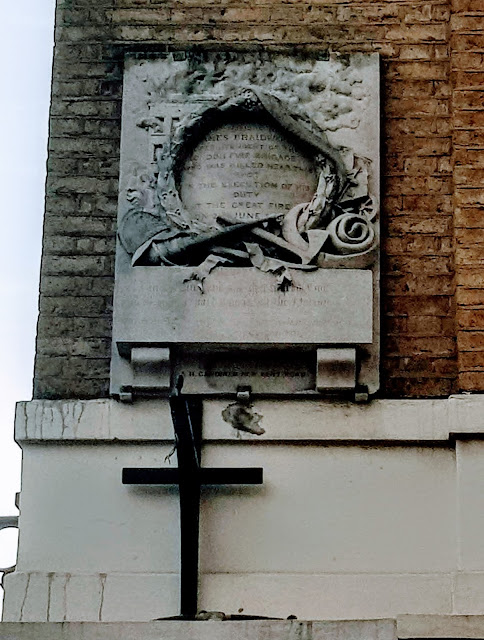
James Braidwood

London The Unfinished City
James Braidwood: Founder of the world's first municipal fire service.

I had seen this memorial on many an occasion, but could never quite work out the lettering, although the design obviously made reference to a fire. So, a little digging needed to be done.

The inscription reads;

To the memory of 
James Braidwood, 
superintendent of the 
London Fire Brigade, 
who was killed near this 
spot 
in the execution of his 
duty 
at the great fire 
on 22nd June 1861

A just man and one that feared God, of good report among all the nation.
Erected by the M. or Southwark Division of the Metropolitan Police

S. H. Gardiner, New Kent Road


Friday, October 28, 2016

Texas Legation

London The Unfinished City
Legation for the Republic of Texas.

Friday October 28, 2016.


It was a late October evening when, after a visit to The Prince Charles Cinema, I decided to go in search of the long-forgotten offices for the Republic of Texas. 

I knew where it had been situated, but, at this time of evening, I was unsure if I would be able to find the plaque.