![]() |
| The Blackfriar public house. |
![]() |
| The wedge shaped Blackfriar pub. |
![]() |
| Some of the bronze relief around the top of the bar. |
![]() |
| Scenes from the life of a monk. |
![]() |
| A day in the life of a monk. |
![]() |
| Stained Glass Window. |
"Not all those who wander are lost..." Come with me as I explore London's history, hidden gems and unusual places.
![]() |
| The Blackfriar public house. |
![]() |
| The wedge shaped Blackfriar pub. |
![]() |
| Some of the bronze relief around the top of the bar. |
![]() |
| Scenes from the life of a monk. |
![]() |
| A day in the life of a monk. |
![]() |
| Stained Glass Window. |
![]() |
| It is NOT a Police Station. |
Supposedly, on Trafalgar Square's south east corner, stands the UK's smallest Police Station. It is not! It never has been and it never will be.
The closest that it has been to being a Police Station was from 1928 until the 1970's, when it was used as a Police Observation Post.
So, let's clear this matter up.
According to many websites the Police Station was erected at the behest of Sir Lionel Edwards, who was in charge of the Office of Works.
However, no such person ever existed.
There was a Sir Lionel Earle, permanent secretary to the Office of Works, and a Mr G. Edwards OBE of the Metropolitan Police. These two men did correspond with each other and it is entirely plausible that the names were confused, at some point, and Sir Lionel Edwards came into being.
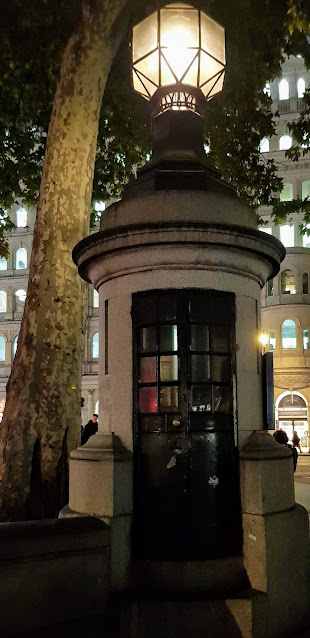
![]() |
| "the Telephone Box inside the great granite base of the big lamp". |
There had been correspondence between the Metropolitan Police and the Office of Works about having a Police Box erected in Trafalgar Square since the late 1910's.
A wooden telephone box was installed by the entrance to Trafalgar Square underground station in 1919, but the Police were after something bigger and more permanent. Their rationale was as Trafalgar Square was a place where protesters met, usually without any warning, they needed somewhere from which to keep an eye on the crowds and have the ability to call for reinforcements, if necessary.
In 1921 the wooden box was still affixed to the London Underground entrance, but London Underground it removed as they had plans of their own.
At one point there was the suggestion put forward that an observation post could be installed on the roof of the National Gallery. This was turned down by the Metropolitan Police and was never mentioned again.
There was also the idea of erecting a wooden Police Public Call Box, but it would have been too conspicuous, so this idea was rejected, too.
Following the General Strike riots, of 1926, Sir Earle wrote to Mr Edwards with the suggestion that "...it might be possible to get the Telephone Box inside the great granite base of the big lamp at the end of the balustrade...".
Mr Edwards wrote back that he had had the same idea, but had dismissed it.
In July 1927 Sir John Anderson, the Permanent Under-Secretary of State at the Home Office, approved the observation box, which was estimated at costing £550.
![]() |
| Nothing more than an Observation Post. |
New granite was ordered and transported to London from Cornwall.
In March 1928 the Observation Post was completed and the old wooden telephone box was removed.
During the 1930s the lamp, which had been run using gas, was converted to electricity. In addition the lamp was controlled in such a way that it blinked when the telephone rang, so that the officers could see it from across the square.
In the 1970's, with the introduction of radio communication, the observation post became redundant and has since had the telephone removed.
Sadly, it is now just used for storage., but Police Officers from around the world still come to see, and have their photo taken with, what they believe is London's smallest Police Station.
London's smallest Police Station was in Wellington's Arch from 1851 until at least 1968.
London's smallest Police Station, currently, is Pinner Police Station in the Borough of Harrow and within the Metropolitan Police's Greater London coverage.
![]() |
| The World Time Today. |
If you were to enter London's West End via Piccadilly Circus, then don't rush straight out of the station. Take a moment to marvel at the 1920s architecture and then go in search of a truly unique timepiece.
Built into the wall is the World Time Linear Clock which was the brainchild of Architect Charles Holden and John Mowlem & Company.
It was installed during the expansion of Piccadilly Circus station, during the the early 1920s.
![]() |
| The scrolling band rotates as the Earth spins. |
The time is displayed by a west scrolling band, with Roman numerals, that moves at the same speed as the Earth rotates, around the equator.
It shows both GMT and BST and gives a rough indication as to the time around the world. It is not entirely accurate as world time zones only broadly follow longitude. But, it is still a fascinating piece of machinery.
![]() |
| How to use. |
Lightbulbs highlight a small number of cities that include London, Cape Town, Sydney, New York, Victoria (Canada) and Buenos Aires.
I was surprised, on my visit, how no one noticed this piece of horology that once informed the traveller, that needed to know, the time around the world.
Now, people are too inpatient and in a constant rush, which is a shame.
![]() |
| World Time Linear Clock, Piccadilly Circus station. |
![]() |
| Empire, Leicester Square. |
Leicester Square has been a busy hub for tourists and those visiting the area to watch films and shows for many years. The square is used for exhibitions and events throughout the year and is always bustling with a palpable energy.
![]() |
| William Shakespeare fountain. |
With the Empire Leicester Square and the Odeon Leicester Square, on two sides which are used for film premieres, and more restaurants than you can count and pubs on the other, it is a magnet for anyone heading to the West End.
![]() |
| Lumiere Festival, 2016. |
To the north is Chinatown, the east Covent Garden, south lies Trafalgar Square and Piccadilly Circus is to the west, making Leicester Square a true hub in the West End.
![]() |
| Enough said. |
It is possibly because of how busy the area gets that I prefer walking around other areas of London.
![]() |
| m&m's World. |
However, every once in a while, I do head here, especially if there is something worth seeing.
![]() |
| Transformers: Rise of the Beasts. |
Over the years I have seen many changes to the square and its surroundings. Statues have come and gone. Fountains and water features have been rebuilt and installed. Paving and seating has been improved. Theatres, cinemas, shops and restaurants have come and gone, too.
![]() |
| Celebrity handprints, 2010. |
But the atmosphere has always remained.
![]() |
| Temple Church. |
Saturday May 27, 2023.
The Temple Church is famous throughout the world as the church of the Knights Templar and was a place that I long wished to visit.
It was by pure chance that while wandering along Fleet Street I noticed that the gates to Temple Church were open, with an A-board advertising that the church was open for viewing. So, through the gate I headed.
The narrow passageway soon opened up and, in front and to my left, the Round of Temple Church came into view.
![]() |
| Approaching Temple Church from the north with the Great Norman Doorway. |
I made my way around to the south of the building, which is the best place from which to view the church and is where the entrance is situated.
![]() |
| The Temple Church from Church Court. |
After admiring the architecture and the surrounding buildings, which are filled with law firms and the like, I entered the church.
Now, I have been inside many churches, cathedrals and abbeys all of varying size and stature, but Temple Church is on another level, in my opinion.