Showing posts with label Sir John Betjeman. Show all posts

Thursday, March 12, 2026

Euston Arch

Euston Arch
Euston Arch (Image Public Domain)

Robert Stephenson planned the terminus for the London to Birmingham Railway to be constructed at Euston, replacing the old terminus at Chalk Farm. 

When the station opened, in July 1837, it had two platforms with each being 420 ft (128 m) long. A double train shed, designed by Charles Fox, that was 200 ft (60 m) long, with 40 ft (12 m) spans. Six trains ran each day from Euston to Watford and Boxmoor. 

On September 17, 1838, the final 112 miles (180 km) to Birmingham were completed. However, steam trains did not have the power to make the steep incline up to Camden Town and so required help. This took the form of the trains out of Euston being attached to a 3 inch, 1430 ft (4370 m) long rope, affixed to two 60 horsepower stationary steam engines. Euston-bound trains had their engines detached at Camden Town, with the carriages continuing the journey under the charge of the brakemen.

Monday, March 31, 2025

St Vedast-alias-Foster Public Garden and its Treasures, City of London

St Vedast-alias-Foster Public Garden

In the shadow of St Paul's Cathedral and hidden along a small passageway, from Foster Lane, is this wonderful public garden, that holds some intriguing and historic items.

The garden is built on what was once a graveyard belonging to St Vedast-alias-Foster, a church that was founded in around 1170. 

The church has been restored many times and rebuilt at least twice, the last by Sir Christopher Wren following the Great Fire of 1666.

The church was completely gutted during The Blitz, with its restoration being undertaken by Canon Charles Bernard Mortlock, Poet Laureate John Betjeman, Noel Mander a master organ builder and architect Stephen Dykes Bower.

An adjacent plot to the north, formerly the location of the Fountain Pub, was purchased and used for the construction of a new Rectory. On land between this new Rectory and what is now the parish hall of St Vedast a small secluded courtyard was built.

The entrance to St Vedast-alias-Foster Public Garden

Passing through these blue doors and up the three small stone steps you will find yourself in a small courtyard, with a tree as a centrepiece, various plants and plaques. The white walls in contrast with the brick walls and the covered walkway gives this small courtyard an almost Mediterranean feel. 

But there are secrets to be discovered here: Roman tiles, sculptures and a 3,000 year old brick, from Iraq.

Roman pavement tiles

On the south wall you will find the remains of a Roman pavement, discovered 18 feet below the floor of the church of St Matthew, Friday Street, which was demolished in 1886.

Relief sculpture of Canon Charles Bernard Mortlock

There is a small sculpture of Canon Charles Bernard Mortlock, entitled 'Head', by Jacob Epstein.

Thursday, January 30, 2025

'John Betjeman' by Martin Jennings

John Betjeman Statue St Pancras

To mark the opening of St Pancras International as the terminus for the High-Speed rail link, between London and Europe, a statue of Sir John Betjeman was unveiled.

John Betjeman had been an advocate of Victorian architecture and, in the 1960s, had campaigned to have St Pancras station, and the adjacent hotel, saved from demolition.

John Betjeman Statue

Sir John Betjeman CBE (1906-1984).

Born in London he lived in Gospel Oak until the family moved to Highgate, in 1909. T.S. Eliot was one of John's early tutors, at Highgate School. Following this he was sent to boarding school at Dragon School preparatory school, Oxford, and then Marlborough College, Wiltshire. He left Marlborough College in 1925.

His next education came when he entered Magdalen College at the University of Oxford, where one of his tutors was C.S. Lewis. Neither men seemed to get on, with C.S. Lewis stating that "Betjeman would not achieve honours in any class." Betjeman was expelled from Oxford, in 1928, after failing the Pass school and only achieving a satisfactory result in one of three required papers, Shakespeare and other English authors.

Between 1930-1935 Betjeman worked for the Architectural Review as an assistant editor.

Monday, December 02, 2024

Walking with Erin and Keilyn: Euston to Canopy Market... and beyond

St Pancras International Christmas Tree

Sunday December 1, 2024.

It was an overcast morning as Erin, Keilyn and I prepared for our trip to London. Our plan was to visit St Pancras International, as my girls wanted to see the giant Emerald City Christmas tree, from the movie 'Wicked', which they went to see last week.

As we were about to leave rain, which had been threatening, decided to pour from the sky, so a taxi was ordered.

Lioness line Watford High Street

We decided that, for a change, we would take the Lioness line to Euston, as Keilyn and I had been waiting for the new signage to be unveiled.

Once aboard we sat down and watched as the rain began to diminish the closer we got to our destination. And, sure enough, as we exited Euston station the rain had all but stopped, making our short walk to St Pancras International a drier affair.

St Pancras International Wicked Christmas Tree

Once inside we headed through the crowds towards the giant Emerald City tree, taking lots of photos, before we took the escalator up to the next level, so that we could get a different view of it. 

Sir John Betjeman statue

We then went for a wander to see the statue of Sir John Betjeman and the Meeting Place statue, which towers over the upper concourse.

St Pancras International Wicked Christmas Tree

We then used the lift and went for a proper look at the tree, which has a model of Oz inside it. 

Lego Glinda and Elphaba

More photos were taken before we headed towards the eastern exit, where we discovered life-size models of Glinda and Elphaba, which were made of Lego.

Granary Square Christmas Tree

On leaving St Pancras International we crossed Regent's Canal and reached Granary Square, heading off towards Canopy Market, in search of some lunch. After a brief look at what was on offer, Erin decided on a Cheese Burger, made with dry age beef, with cheddar cheese and ketchup. Erin decided against having the pickles and mustard. 

Canopy Market Coffee Car

With Erin waiting in line for her food to be prepared, Keilyn and I went and ordered a coffee and hot chocolate.

Petit Prince Burger

When Erin had received her food, we found a table, where Erin and Keilyn sat, while I went to get food for Keilyn and myself. Keilyn decided to have Duck Fat Chips (freshly cut potatoes, double fried with a drizzle of duck fat), while I had the Petit Prince Burger (Brioche bun, butter infused grilled duck, stilton, gherkins, fried onion and burger sauce).

Monday, July 01, 2024

Tower House, Holland Park

Tower House
The Tower House, built by William Burges.

Wandering through the Holland Park district of the Royal Borough of Kensington and Chelsea, you will find this Victorian era house, with a cylindrical tower and conical roof. It is distinct from the others houses on this street and really catches the eye.

William Burges purchased the leasehold to the land in 1875, from the Earl of Ilchester, and began designing the Tower House as his own private residence. By 1878 the exterior and much of the interior were completed, but decoration, furniture and furnishings were still being designed up until his death in 1881.

It is a red brick building with dressing of Bath stone and Cumbrian green roof slates and was Grade I listed in 1949. 

It has a basement with a kitchen and other utility rooms, while the ground floor has the hall, dining room, drawing room and library. The first floor has the main bedroom, guest room, bathroom and an armoury. The staircase is built into the cylindrical tower.

Tower House
A late Victorian townhouse, with a tower.

Following his death, Richard Popplewell Pullan, Burges's brother-in-law, inherited the lease. Pullan would go on to complete some of Burges's projects. The author, Colonel T.H. Minshall then purchased the lease, before selling it on to Colonel E.R.B. Graham, in 1933.

Sunday, June 11, 2023

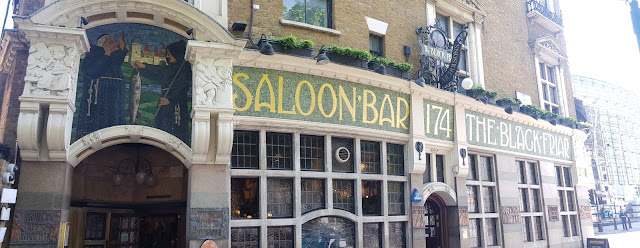
'The Blackfriar', City of London

London The Unfinished City
The Blackfriar public house.

On the odd occasion that I fancy a drink, when walking around London, I never stop at one of those pubs that has no character, preferring to find a pub with a bit of history.

So it was while walking westward along the River Thames that I spotted this odd shaped building, across the road from Blackfriars station. 

London The Unfinished City
The wedge shaped Blackfriar pub.

As I approached I realised that it was a pub and, so, headed in. And what a place it is.

London The Unfinished City
Some of the bronze relief around the top of the bar.

The pub is remarkably deceptive as, when viewed from the outside, it looks long and narrow, but, once inside, the pub opens up with a substantial bar area, for a pub this small, that contains booths, tables and areas to just stand. 

London The Unfinished City
Scenes from the life of a monk.

A dining area, set under the adjoining railway arch, which I didn't visit on this occasion, is furnished with sculptures.

London The Unfinished City
A day in the life of a monk.

Around the tops of the walls bronze reliefs showed Dominican Friars going about their daily tasks, while a stained-glass window allowed a rainbow of light to filter into the room.

London The Unfinished City
Stained Glass Window.

There was obviously some serious history to this pub, so I bought a pint of ale and sat outside at one of the tables. 

Tuesday, April 04, 2023

Oldest House in the City of London

London The Unfinished City
41-42 Cloth Fair

Wandering, as I do, along the labyrinthine streets of London I always discover something to which I was unaware. This is exactly what happened whilst I walked from Farringdon towards Barbican.

Having headed south from Farringdon station and along the Grand Avenue, that divides Smithfield Market, I headed onto West Smithfield and turned onto a narrow road named Cloth Fair. 

As I approached the courtyard of the Priory Church of St Bartholomew the Great I noticed a timber framed building to my left. It was unlike any other building on the street, so I took some photos.

Saturday, September 10, 2016

Wilton's Music Hall

London The Unfinished City
Last of the Grand Music Halls.
Saturday September 10, 2016.

It was a damp afternoon as I wandered around the Tower Hamlets area of the Unfinished City, looking for interesting architecture and hidden gems, and boy did I find one. It was just as the rain started to pour, that I stumbled upon this true piece of East End history. And, to my great relief, it was open. So, inside I went. 

A multi-million renovation had just been completed on the building, which had been suffering from damp, rot, a leaky roof, subsidence and more irksome things.