Monday, March 04, 2024

'HMS Alice Liddell' by Shezad Dawood

HMS Alice Liddell
'HMS Alice Liddell' by Shezad Dawood.

I was taken by complete surprise when, walking through St Pancras International railway station, I noticed a giant spaceship hanging from the ceiling, above the eastern entrance on Pancras Road.

St Pancras Wires
The steampunk-gothic spaceship HMS Alice Liddell.

It is very 'steampunk' in its design and, after having a better look, I noticed that it had buildings on it. It also appeared to change colour, depending on the angle it was viewed from and the light hitting it. So, I took the lift to the next floor, to get a better view and understanding of the piece.

HMS Alice Liddell by Shezad Dawood
Depending on the light the spaceship takes on a different colour.

Sure enough the spaceship did have buildings on its top; a scale model of St Pancras International. I realised that this model is a kind of hybrid steampunk-gothic mix and that I was going to have to do some research on this intriguing piece of art.

Thursday, February 29, 2024

"Cannon to right of them..."

City of London bollard
A City of London bollard.

Walking around the streets of London you will always see metal posts, or bollards, separating the pavement from the road. Many of these, especially the newer ones, are metal or toughened plastic. 

In the city of London these bollards become more ornate, but some of them have a history, are quite old and are not even English.

City of London bollard
More street bollards in the City of London.

During the Battle of Trafalgar, on October 21, 1805, the British plundered all of the French ships, using what they could, before sinking the enemy ships. The French cannon could not be converted for use by the British fleet, so, instead of leaving them to be reused, they were brought back to England and used as bollards, throughout the East End and south London.

Cannons used as bollards
French cannon, used as street bollards, removed during pavement works.

Before they were set in stone each cannon had a ball welded into the barrel, so as to stop it being removed and used against the country.

Cannon in Rotherhithe
Cannon outside the old Royal Navy Victualling Yard, Rotherhithe.

Monday, February 26, 2024

Millwall Slipway

London The Unfinished City
Hydraulic ram.

Historic places can be easily missed, even when walking the streets and roads of London.

It was while wandering along Westferry Road, on the Isle of Dogs, that I found what looked like a car park and an ordinary entranceway to the River Thames.

London The Unfinished City
At first glance it looks like a simple slipway.

What made me stop were the bollards at the top of the ramp. These weren't your typical car park bollards, but ones that I have seen countless times near docks and mooring sites. So, I decided to take a closer look.

Heading down the slipway I saw some obviously old machinery, to my left. On closer inspection I discovered that this was a hydraulic ram, once used for closing the long disappeared lock gates.

London The Unfinished City
Hydraulic ram.

The ramp itself was modern, although, as I approached the foreshore, a portion of the old ramp could be seen almost completely covered by sand, rubble and pieces of clay pipes that litter London's beaches.

Friday, February 23, 2024

Walking with Keilyn: 'Cart & Horses', Stratford, to... "Rain stopped play"

Cart & Horse London
Keilyn outside the Cart & Horses.

Thursday February 22, 2024.

Having taken Erin to the Wallace Collection and parts west, on Tuesday, I had promised to take Keilyn to Stratford and parts east, today. As I and some friends had taken Keilyn to see Iron Maiden, at the O2, last year, I had promised to take her to where Iron Maiden had first performed... The Cart & Horses.

Rain was meant to be light and fleeting, but ended up being heavy and perpetual. Still, it didn't put us off.

Our day started with my uncle Martin, and my mum, picking us up and driving to Croxley station, as they were heading to the British Museum and various places, for the day. We shared the semi-fast Metropolitan line train to Finchley Road, where Keilyn and I disembarked and boarded a Jubilee line train to Stratford, leaving mum and Martin to head off to Euston Square.

West Ham station roundel
Keilyn at West Ham station.

We arrived at West Ham station, where Keilyn had her photo taken with a West Ham roundel, before we continued to Stratford, grabbing a snack and hot drink, but not before Keilyn had her photo taken with 'Robert', a steam engine, that  Keilyn had last stood next to in 2015.

'Robert' the steam engine
Keilyn with Robert the steam engine.

As we wandered up The Grove, the rain, which had been threatening, began to get heavy, so we took shelter in a closed shopfront recess for a few minutes, whole we waited for the Cart & Horses to open its doors.

Cart & Horses Birthplace of Iron Maiden
Keilyn ready to enter Hallowed Ground.

As soon as we saw the doors open I took a photo of Keilyn outside the pub, in her double-denim and Iron Maiden t-shirt, before we headed inside and out of the rain. A few moments later we had drinks (Pepsi for Keilyn and a Trooper for me) and Keilyn was off to the jukebox, busy searching for Iron Maiden tracks. I, meanwhile, was busy looking around at the photos, wall art, merchandise, signed posters and the like.

Trooper Beer Bottles
Trooper Beer.

Since my last visit, in 2018, the pub has had a major refurbishment. The stage, which had stood on the left, as you entered the pub, had now been moved downstairs, where the live music was now performed. And, as such, was off limits to the casual patron. I did get a photo of Keilyn where the stage had been, though.

Keilyn Morrissey at the Cart & Horses
Keilyn, where the stage used to be.

However, the barmaid, Ruta (not sure of spelling, so sorry if it is wrong), did say that once her colleague arrived she would take us downstairs to see the stage. While we waited Keilyn busied herself at the bar, by completing a Heavy Metal wordsearch, while also working out what merchandise she wanted to buy. 

Thursday, February 22, 2024

How did London's Underground & Overground lines get their names?

"Names mean almost nothing." - Jean-Luc Picard

"Names mean almost everything."  - Jack Crusher
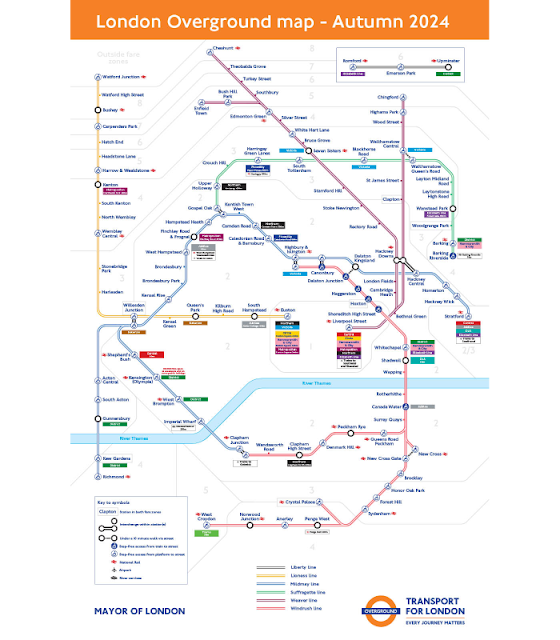
London The Unfinished City
Image Copyright TfL

So, from Autumn 2024, the six London Overground lines are to be given distinct names and colours.

London Mayor, Sadiq Khan, has finally followed through with one of his 2021 Labour Mayoral manifesto pledges, which was to overhaul and rename the London Overground lines. The total cost of the project is around £6.3 million, which is an eye-watering amount of money, especially with current financial woes. 

But, hey, it will make things clearer and easier... won't it?

After hearing this news, I thought it would be fun to look at the etymology of the London Underground line names, before looking at the new ones.

Bakerloo - A portmanteau of the 'Baker Street and Waterloo Railway'.

Central - Originally called the Central London line it was shortened to Central line in 1937.

Circle - Quite simply the line is a loop. Easy. Except, as of 2009, it no longer runs in a complete circle.

District - Originally built by the Metropolitan District Railway, it became known as the District line so as not to be confused with the Metropolitan Railway.

Elizabeth - Originally this line was to be called Crosstrail, but, no. Once again a more regal name was chosen, and so was named in honour of HM Queen Elizabeth II.

Hammersmith & City - Quite simply it runs from Hammersmith and through the City. Boring.

Jubilee - Originally proposed as the Fleet line, various financial issues, construction delays and changes to its route saw it called the Jubilee line, in honour of Queen Elizabeth II's silver jubilee in 1977. Nice, but the line didn't open until 1979 and wasn't completed until 1999.

Metropolitan - The world's first underground railway was built by the Metropolitan Railway Company. I think the clue is in the name.

Northern - The City & South London Railway built the first proper underground line, built by boring a tunnel, rather than the cut-and-cover method. The Charing Cross, Euston & Hampstead Railway became owned by the Underground Electric Railways Company of London. In 1914 the Underground Electric Railways Company of London bought the City & South London Railway and, by adding extensions, allowed the lines to run on the same line. None of this explains why the name Northern was chosen though. 

Piccadilly - The Great Northern, Piccadilly & Brompton Railway ran from Finsbury Park under Piccadilly to Brompton. Quite simply, as the line reached the West End the name was shortened to simply Piccadilly.

Victoria - In 1955 plans were put forward for a new underground line between Victoria and Walthamstow. While planning the line various names were suggested. First there was the Walvic line (Walthamstow-Victoria) and the much better Viking line (Victoria-King's Cross). However, those that know best decided to be as boring as possible and call it the Victoria line. I much prefer Viking line.

Waterloo & City - The London and South Western Railway had their terminus at Waterloo Bridge, from where they ran trains to Southampton and back. However, for those people who needed to cross the river, this wasn't good enough. Thankfully, a new company named the Waterloo & City Railway Company obtained permission to build a new line from Waterloo Bridge to a new City station. The line was immediately called the Waterloo and City, although City station would be renamed Bank, the line kept its name.