Monday, April 01, 2024

'Identified Flying Object' (Bird Cage) by Jacques Rival

Identified Flying Object at night
Keilyn swinging inside the birdcage.

Since the redevelopment of the area around King's Cross many art installations have come and gone. 

One of these installations, that appeared in the sky above King's Cross, was Jaques Rival's IFO (Bird Cage), which, for 95% of the time, rests in the centre of the Battle Bridge Place.

Although this birdcage has white bars, at night it changes to a neon spectrum, releasing the energy that it has stored throughout the day.

Its bars are wide enough for people to walk through and, should you enter the birdcage,  you will find a swing at its centre.

Identified Flying Object at night
The rain allows for some great reflections.

The IFO (Identified Flying Object), designed by Jaques Rival, was originally intended as a framing device for street theatre, during the day. Once a month it was hoisted up into the sky, above Battle Bridge Place, to light up the area.

Identified Flying Object during the day
The IFO (Bird Cage).

This 9m (29.5 ft) high white cage, containing a swing, was installed in 2011 and was to be in place until 2013. Unbelievably, it is still there.

For me, the Bird Cage is a quirky piece of art that sticks out like a sore thumb, during the day, but looks perfectly suited to the area at night, when it becomes luminous.

Thursday, March 28, 2024

Greenwich Steam Ferry

London The Unfinished City
The Greenwich Steam Ferry was an engineering feat, but also a commercial failure.

Ferries had operated historically from Greenwich, at Billingsgate Dock, Garden Stairs and elsewhere, to the southern tip of the Isle of Dogs, since at least 1333.

Billingsgate was the main dock in Medieval Greenwich and was home to the large Greenwich fishing fleet, which relocated to Hull and Grimsby in the 1850s. This relocation was, in part, due to the arrival of rail transport. 

The earliest ferry from the Isle of Dogs to Greenwich was called Potter's Ferry, which began in the 17th century. This lucrative route's rights were coveted by Watermen who wished to control the waterways.

Up until 1812, only foot passengers were permitted to be ferried across the River Thames. Following an 1812 Act of Parliament a horse ferry was established.

The Ferry House pub
The building where the ferrymen waited between crossings.

The Billingsgate ferry was replaced after 1821 with one at Horseferry Dock, a little further down river. Billingsgate Dock was widened and enlarged, by an Act of Parliament  in 1850, to help improve the docks use by the public.

These ferries ran until they were closed by the Metropolitan Board of Works Act of 1883. Five years later, in 1888, the Greenwich Steam Ferry began operation.

Johnson's Draw Dock
Johnson's Draw Dock, north bank, close to the pier where passengers embarked on the ferry to Greenwich.

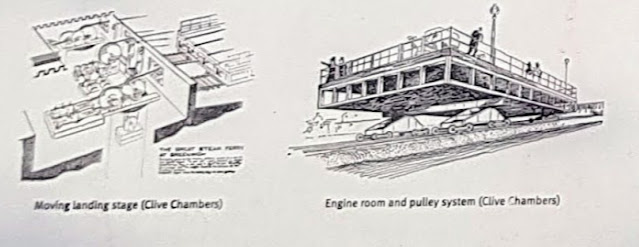
The Greenwich Steam Ferry was an innovative design whereby passengers and vehicles were transported down the foreshore on moving platforms to waiting ferries. This design, although unique in England, was used throughout America and overcame the problem of reaching the ferry at low tide.
London The Unfinished City
Diagrams of the moving platforms and pulley system.

These moving platforms were pulled up and down on cables operated by engines in the cellar of the ferry terminal buildings. These landing platforms could be raised and lowered according to the tide, thus allowing the heavy cargo trucks and carriages to have a smooth access to and from the waiting ferries.
Potter's Ferry north ramp
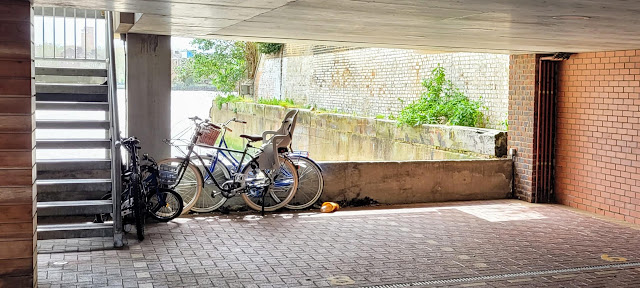
The north ramp for the Potter's Ferry.

Commercial and operational difficulties meant that the Greenwich Steam Ferry was suspended in the 1890s. Then, with the Blackwall Tunnel opening in 1897 and construction of the Greenwich Foot Tunnel, beginning in 1899, the Greenwich Steam Ferry finally closed in 1899.

The ferry terminal building, on the south bank, remained standing until the 1990s.

London The Unfinished City
The ramp on the south foreshore.

Today, all that remains are the concrete ramps, on the north and south foreshores, and the walls on south terminal still retain the three cable ports, used to raise and lower the moving platforms.

Monday, March 25, 2024

Jukebox at St Pancras International

St Pancras Jukebox
The St Pancras free-to-play jukebox.

If you enter St Pancras International station, from Pancras Road, and head to your right, you will see a jukebox tucked away below platforms 11 to 13.

It was installed in 2017 and is free-to-play and has over 50,000 tunes to play. These cover Top 40 hits from the last 50 years from over 18.000 artists. 

These include: The Beatles, David Bowie, Ed Sheeran, Elvis Presley, Iron Maiden, Rag'n'Bone Man and many more.

Sunday, March 24, 2024

'Dock Life Renewed': A talk by photographer Niki Gorick

Book Cover
'Dock Life Renewed' by Niki Gorick.

Thursday March 21, 2024.

It was a little bit of rush to leave work, head home, get changed and walk to Watford Metropolitan station, to catch the train to London. My mum, who had made her way to Croxley station, was waiting on the platform as my train pulled in.

Once aboard we settled down and enjoyed the ride to Finchley Road, where we switched to a Jubilee line train for the rest of our journey to the Isle of Dogs.

Arriving at Canary Wharf station we made our way along Bank Street and on to the South Dock, crossing the South Quay Footbridge to look for somewhere to buy a bite to eat.

Just along South Quay Walk, near Admirals Way, we found a collection of street food vendors. There was Burrito, Chinese, Greek, Indian and Lebanese. We opted for Lebanese, which was tasty and filling. The owner was friendly and obviously took a liking to the two of us, as he gave us a free drink and extra meat on our dishes. 

Street food vans
The Burrito Bro and Steam Momo vans. 

Lebanese street food van
Lebanese street food van.

With our hunger now satisfied, we made our way along South Quay Walk towards the Millwall Cutting and our destination... the Theatreship.

Theatreship nameplate
The venue.

After taking the obligatory photos of the surrounding buildings and the Theatreship we boarded the vessel, and made our way downstairs to the bar area. 

Saturday, March 23, 2024

'Theatreship', South Quay, Isle of Dogs

Theatreship at Millwall Cutting
Theatreship open for entertainment.

The Theatreship is a new, as of 2024, world-class performing arts space on a historic ship, moored on the Millwall Cutting on the Isle of Dogs. It is the Millwall Cutting that links the South Dock with the Millwall Inner Dock and, until the 1950s, continued to the River Thames via the Millwall Slipway.

I visited the ship just weeks after it opened to hear a talk by Niki Gorick, about her book 'Dock Life Renewed', for which the Theatreship was the perfect venue.

Lovingly restored and fitted with a new spacious interior bar area and an events space, with tiered seating, it is a remarkable piece of renovation and foresight.

Theatreship nameplate
A new name for a historic ship.

Brief History

The ship was built in 1913 and weighs 300-tonnes. She began life as a sailing cargo barge, that transported cargo like coal and grain from Europe to London. She would continue in service for over 100 years serving the ports of Northern Europe, before she was retired.