![]() |
| One of the silver dragons that adorns Holborn Viaduct. |
| One of the original dragons from the London Coal Exchange. |
"Not all those who wander are lost..." Come with me as I explore London's history, hidden gems and unusual places.
![]() |
| One of the silver dragons that adorns Holborn Viaduct. |
| One of the original dragons from the London Coal Exchange. |
This is a difficult question to answer, as there is no correct, or true, answer. At least not an answer that will satisfy everyone.
As London has changed throughout the centuries and its population has grown from 250,000, in 1663, to over 8 million today, its centre is hard to locate.
But, with satellite data, and people 'pinging' their locations, accuracy becomes more important.
So, let's take a look at where the centre of London is... Currently.
London's earliest central point was established, in 1663, with the original Charing Cross. This was erected by King Edward I in honour of his dead queen Eleanor. Today, a plaque marks this spot where all distances to London are measured from.
The plaque is set into the ground behind the Equestrian Statue of King Charles I, on the traffic island directly south of Nelson's Column.
However, as London has grown its centre has moved and various people and companies have suggested it to be in different locations.
In the grounds of the Ministry of Defence, on the Victoria Embankment side, there are a set of steps with a buttress and wall.
They are not an old entrance to the basement of the building, which now stands behind, but rather a rebuilt part of a terrace, originally built by Sir Christopher Wren, and were part of Whitehall Palace.
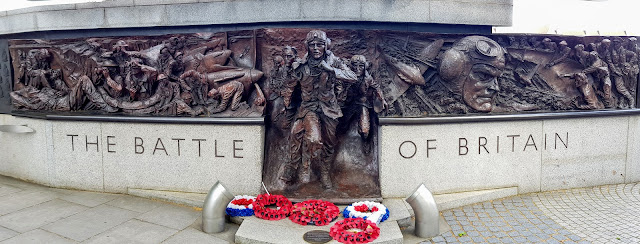
![]() |
| "Scramble!" |
![]() |
| "Never in the field of human conflict was so much owed by so many to so few." |
![]() |
| River Thames Tide Gauge Hut. |
However, this copper turret houses some important scientific equipment, which you can see if you peer through one of the two small windows in the door.
![]() |
| Home of the Thames Tide Recorder instruments. |
The Tide Recorder measures the depth of the River Thames at Westminster Bridge, or more accurately the mean sea level rather than the river bed, which it then sends to the Thames Barrier Control Room every fifteen minutes. This information is then published online.
Westminster City Council look after the upkeep of the exterior, while the tide reading equipment is maintained by the Environment Agency.
I have yet to discover when it was installed, but it has been in situ since the 1930's.
If anyone can find more information about its construction or when it was installed, I would be most grateful.
![]() |
| A piece of Egypt in London. |
As you walk along the Victoria Embankment, outside of the quaint Victoria Embankment Gardens, there stands an Egyptian Needle made of granite.
It is flanked by two bronze fake Egyptian sphinxes, which stare towards the needle, rather than having their backs to it in a typical guarding posture. This, apparently, was due to an error when they were installed.
![]() |
| My eldest, Alysha, sits with the undamaged sphinx. |
| Shrapnel Damage. |
Also, the benches along the Victoria Embankment have winged sphinxes as armrests, which adds even more of an Egyptian feel to the area.
![]() |
| One of the Egyptian styled benches that can be found along Victoria Embankment. |
| This bench uses Camels as the armrests. |
![]() |
| A Monument to "The Few". |