![]() |
| The plaque at Rotherhithe station. |
![]() |
| Keilyn at the bottom of the tunnel shaft. Notice the soot mark, from steam trains, still on the wall. |
"Not all those who wander are lost..." Come with me as I explore London's history, hidden gems and unusual places.
![]() |
| The plaque at Rotherhithe station. |
![]() |
| Keilyn at the bottom of the tunnel shaft. Notice the soot mark, from steam trains, still on the wall. |
![]() |
| Greenland Dock. |
![]() |
| This is how the area once looked. |
In the 1700s the free school raised new funds, as the six ponds per year was now insufficient to keep the school maintained. With new capital the school expanded, giving it room for 65 boys and 50 girls, too.
In 1739 an amicable fund was set up to supply funding to for an additional 12 boys.
In 1742 it became known as the Charity School. The original building was on the northside of Saint Marychurch street, adjoining St Mary's church.
| Charles 'Charlie' Rouse, circa 1850. |
This front wall is all that remains of the Old Rotherhithe Village Fire Engine House, which was built in 1821. It forms a pair with the nearby Watch House, both of which are on Saint Marychurch Street, and back on to a lovely green oasis, called St Mary's Churchyard Gardens.
This engine house once housed firemen and a single hand-operated wheeled fire engine. It must have been a small appliance as the entrance takes up a third of the wall, while two small windows take up the rest.
A fire appliance was kept here until the 1870s.
Although only a facade, now, I am still glad that it remains in situ, as part of the wall surrounding St Mary's Churchyard Gardens.
![]() |
| The Mural on the side of the Grand Entrance Hall. |
The Brunel Museum is located within the Brunel Engine House building, Rotherhithe. This small but very informative museum allows you to descend into the Rotherhithe Thames Tunnel Shaft and visit the Engine House, where you will learn exactly what went in to building the world's first tunnel beneath a navigational waterway.
Marc Isambard Brunel designed Engine House as part of the Thames Tunnel project. Steam-powered pumps, used to extract water from the tunnel, were originally housed here, although it was used as a boiler house, between 1825-43.
![]() |
| A Priming Pump from 1929. |
In 1961 the Brunel Engine House opened and offered visitors the chance to see the interior of the building, as well as the Rennie flat V steam engine.
In 1974 the Engine House and Chimney were Grade II Listed.
Between 1975-79 restoration work to stop structural decay was undertaken and completed.
![]() |
| The Chimney and Engine House. |
In 2006 the Brunel Engine House changed its name to the Brunel Museum allowing the museum to incorporate other projects by the Brunel's. A new mural was created on the side of the Tunnel Shaft and benches were created in the style of Brunel bridges, in the garden area.
![]() |
| The Royal Albert Bridge, Saltash, as a bench at the museum. |
Refurbishments, in 2007, included the moving of the Rennie flat V steam engine to the Chatham Historic Dockyard, thus creating a larger exhibition space and improved toilet facilities, within the Engine House.
![]() |
| Memorabilia for the Thames Tunnel. |
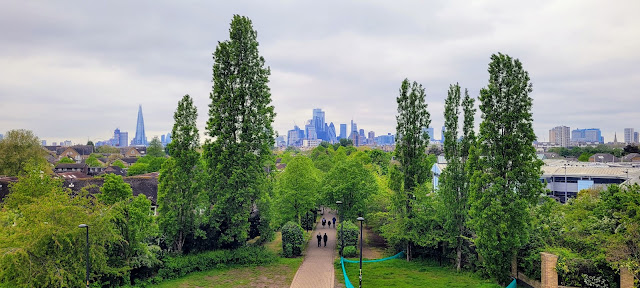
![]() |
| Looking towards the City of London. |
It was while on a recent trip to Rotherhithe that I finally visited Stave Hill viewpoint, and it was not a disappointment.
![]() |
| Approaching Stave Hill Viewpoint. |
Set in the Stave Hill Ecological Park this artificial hill stands stands 9 metres (29.5 feet) in height and offers incredible 360 degree views out across London. There are sixty concrete steps that need to be climbed, but it is definitely worth the climb. There is a handrail either side, to assist those less able.
![]() |
| The 60 Steps. |
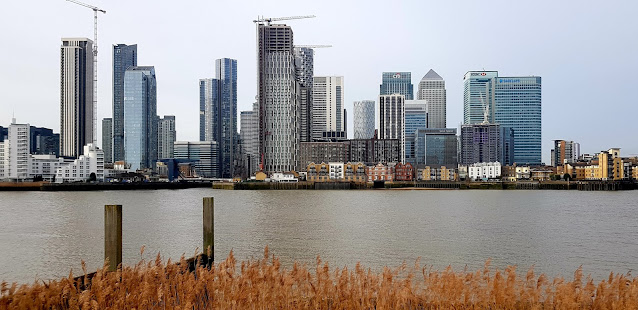
Obviously, the closest buildings to see are the ever increasing amount of buildings at nearby Canary Wharf, but there is more to see: Nine Elms, the BT Tower, Nine Elms, the City of London and all points in between.
![]() |
| Keilyn ready to visit the Brunel Museum. |
![]() |
| Keilyn at the Southwark Park Bandstand. |
![]() |
| The Caryatids of Rotherhithe Old Town Hall. |
![]() |
| Southwark Park Boating Lake. |
![]() |
| Brunel's Engine House plaque. |
![]() |
| Keilyn 50-feet down the Thames Tunnel Shaft. |
![]() |
| Some of the artefacts on display. |
![]() |
| Canary Wharf from the Olympian Way. |
Saturday January 27, 2024.
I had decided to take a trip with Keilyn to North Greenwich, in order to walk towards Tower Bridge, as we had previously walked from North Greenwich to the Woolwich Foot tunnel... and beyond. Emma decided that it might be good for us all to go, but Erin was dead against it, preferring to spend her Saturday with friends, rather than 'trudge' around London.
So, leaving her with her friends, the three of us jumped in a taxi to Watford Metropolitan station, jumped on a train, transferred to a Jubilee line train, at Finchley Road, and finally arrived at our starting point of North Greenwich just before 11:00.
![]() |
| 'The Tide' at North Greenwich. |
Our first stop was to the pop-up market, on Peninsula Square, for a hot drink, before heading towards 'The Tide', with its multi-coloured steps and great views.
From here we followed Olympian Way, which is part of the Thames Path, around the back of the O2 Arena, heading towards Greenwich proper.
![]() |
| 'Liberty' by Gary Hume. |
The first of the public art installations that we discovered, along the Olympian Way, was 'Liberty Grip' by Gary Hume, a strange piece of work that is modelled on mannequin arms. Vey odd, but still a delight to see.
![]() |
| At the back of the O2 Arena. |
As I had never walked this part of the Thames Path, it was strange seeing the back of the O2 Arena, with its little pocket park for staff to use and the parts of the arena that you don't normally get to see.
![]() |
| 'Tribe and Tribulation' by Serge Attukwei Clottey. |
The next piece of public art we discovered was 'Tribe and Tribulation' by Serge Attukwei Clottey, which was a stack of container boxes, piled on top of each other. But, as you drew closer, you could hear sounds emanating from within the boxes. These 'sounds' were recordings from various Slave Fort locations along the former Gold Coast. It was delightful and disturbing, in equal measure.
![]() |
| 'Here' by Jon Thomson and Alison Craighead. |
Next, Keilyn spotted a signpost, which I had paid no mind to, seeing as it was just a signpost. However, I was wrong. This signpost had a name and was a simple piece of art, entitled 'Here', and was created by Jon Thomson and Alison Craighead.
![]() |
| 'A Slice of Reality' by Richard Wilson. |
But what I had heard about and was looking forward to seeing was suddenly in view. Quite possibly the largest piece of public art in London. 'A Slice of Reality' by Richard Wilson. A vertical section of an ocean-going dredger, left to rust in the River Thames. It was quite something to behold, when stood right next to it. It is a pretty awesome piece.
![]() |
| An old rotting dock with the new Canary Wharf. |
We continued along the Thames Path, watching the skyline on the Isle of dogs change as our route meandered along the River Thames. There were plenty of other people using the route, too. Joggers, cyclists, dog walkers, but next to no families. Very odd. We passed the Greenwich Peninsula Golf Range, with Keilyn trying to reach through the mesh fencing to try and grab a golf ball. Fortunately, we found a few that escaped the confines of the range, so she was happy and hurriedly put them in her pockets.
![]() |
| The biggest 'Beer' sign that I have ever seen. |
We discovered waterside pubs, a place where the Necrobus and other buses and cars were kept, boat repair yards, industrial works and much more.
![]() |
| Where some of the buses sleep. |
![]() |
| Repairing the boat 'Alfie'. |
Soon we could see Greenwich Power Station and, beyond, the Old Royal Naval College, and the masts of 'Cutty Sark'. All the while the kept looking across to the Isle of Dogs, trying to spot any new towers, since our last visit, to the Canary Wharf skyline.
![]() |
| Trinity Hospital. |
After a slight detour, away from the river, we were soon passing the gigantic Greenwich Power Station, Trinity Hospital and heading along Crane Street, with its colourful pennants draped across the street, while signs and smells enticed weary travellers in for food and beer.
![]() |
| Pennants. |
![]() |
| The Blacksmiths Arms, Rotherhithe. |
![]() |
| Isle of Thanet plaque. |
![]() |
| Me standing where Queen Elizabeth The Queen Mother once stood. |
![]() |
| The Historic Mayflower. |
![]() |
| Behind the bar of The Mayflower. |
![]() |
| King Edward IIIs Moated Manor house. |