 |
| It is NOT a Police Station. |
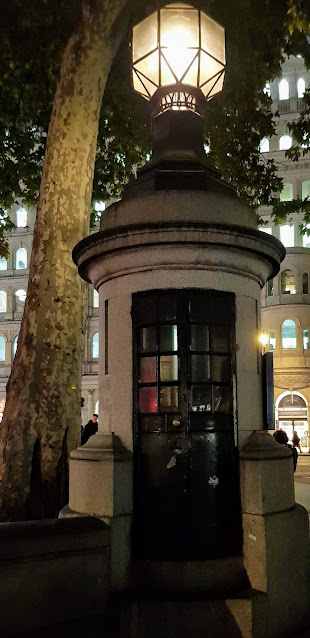
Supposedly, on Trafalgar Square's south east corner, stands the UK's smallest Police Station. It is not! It never has been and it never will be.
The closest that it has been to being a Police Station was from 1928 until the 1970's, when it was used as a Police Observation Post.
So, let's clear this matter up.
According to many websites the Police Station was erected at the behest of Sir Lionel Edwards, who was in charge of the Office of Works.
However, no such person ever existed.
There was a Sir Lionel Earle, permanent secretary to the Office of Works, and a Mr G. Edwards OBE of the Metropolitan Police. These two men did correspond with each other and it is entirely plausible that the names were confused, at some point, and Sir Lionel Edwards came into being.
 |
| "the Telephone Box inside the great granite base of the big lamp". |
Now, the Police Station.
There had been correspondence between the Metropolitan Police and the Office of Works about having a Police Box erected in Trafalgar Square since the late 1910's.
A wooden telephone box was installed by the entrance to Trafalgar Square underground station in 1919, but the Police were after something bigger and more permanent. Their rationale was as Trafalgar Square was a place where protesters met, usually without any warning, they needed somewhere from which to keep an eye on the crowds and have the ability to call for reinforcements, if necessary.
In 1921 the wooden box was still affixed to the London Underground entrance, but London Underground it removed as they had plans of their own.
At one point there was the suggestion put forward that an observation post could be installed on the roof of the National Gallery. This was turned down by the Metropolitan Police and was never mentioned again.
There was also the idea of erecting a wooden Police Public Call Box, but it would have been too conspicuous, so this idea was rejected, too.
Following the General Strike riots, of 1926, Sir Earle wrote to Mr Edwards with the suggestion that "...it might be possible to get the Telephone Box inside the great granite base of the big lamp at the end of the balustrade...".
Mr Edwards wrote back that he had had the same idea, but had dismissed it.
In July 1927 Sir John Anderson, the Permanent Under-Secretary of State at the Home Office, approved the observation box, which was estimated at costing £550.
 |
| Nothing more than an Observation Post. |
New granite was ordered and transported to London from Cornwall.
In March 1928 the Observation Post was completed and the old wooden telephone box was removed.
During the 1930s the lamp, which had been run using gas, was converted to electricity. In addition the lamp was controlled in such a way that it blinked when the telephone rang, so that the officers could see it from across the square.
In the 1970's, with the introduction of radio communication, the observation post became redundant and has since had the telephone removed.
Sadly, it is now just used for storage., but Police Officers from around the world still come to see, and have their photo taken with, what they believe is London's smallest Police Station.
London's smallest Police Station was in Wellington's Arch from 1851 until at least 1968.
London's smallest Police Station, currently, is Pinner Police Station in the Borough of Harrow and within the Metropolitan Police's Greater London coverage.


