![]() |
| London Necropolis Railway Station |
Wandering around the south of the River Thames, near Waterloo Station, you are surrounded by some fantastic architecture.
Come with me as I explore London's history, hidden gems and unusual places.
![]() |
| London Necropolis Railway Station |
![]() |
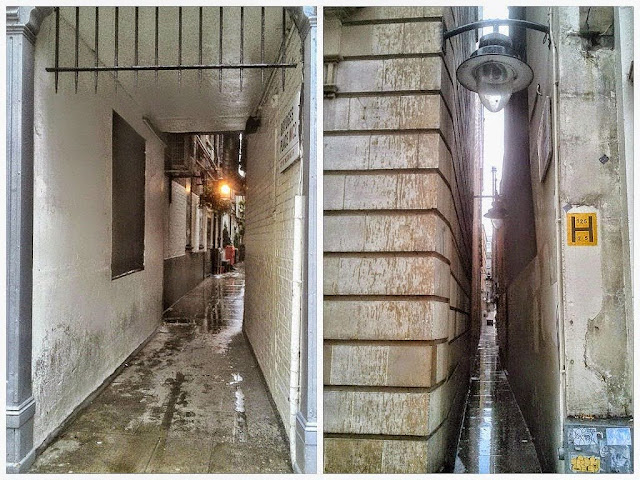
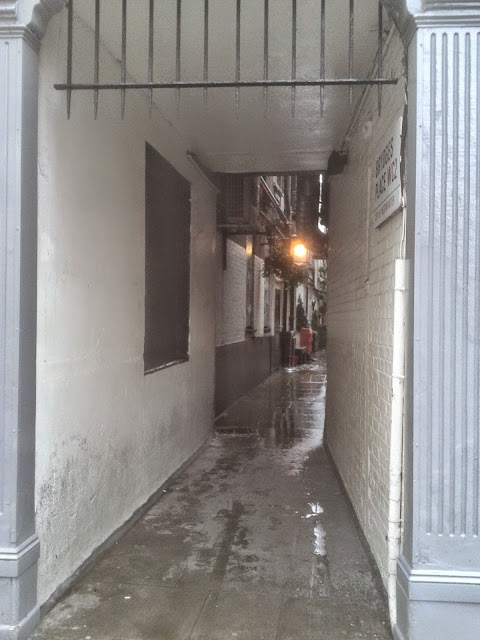
| Brydges Place, Bedfordbury entrance |
It was during one of my meandering strolls around the West End that discovered this entrance on Bedfordbury, Charing Cross. I decided to wander along it, to see where it took me.
The entrance was of a typical width of about 6 feet and about 80 feet along another entrance appeared, on my left, which leads to Chandos Place. This entrance was considerably wider and was obviously built to allow vehicles to enter for loading and unloading.
Continuing along Brydges Place, which runs for roughly 280 feet, the only people I saw were restaurant staff exiting the rear of their premises to place rubbish in the bins. It did make me wonder if, besides those who work along its length, anyone does use this alley as a shortcut.
A sense of unease started to plague me as, slowly, the walls appeared to be closing in on me. By the time I reached the end of Brydges Place, my shoulders were almost touching both sides of the alley.
![]() |
| Brydges Place, from St. Martin's Lane. |
![]() |
| A comparison of both entrances. |
![]() |
| The only surviving gateway to the City of London. |
![]() |
| The London Stone, in its new housing, on Cannon Street. |
I first discovered The London Stone back in January 2009, when wandering the streets one evening.
It was hidden in a recess, on Cannon Street, with glass and a metal grate to protect it. The grime, from the passing traffic, had discoloured the protective glass and, although it was lit, it was hard to make out.
I took a photo, just to document what I had seen, and headed on my way.
It was only following some research in to this strange lump of limestone, that I discovered its importance.
I have returned to see the London Stone in its new home, still on Cannon Street, and am pleased to report that it now sits clearly, for everyone to see.
![]() |
| The remains of St Mary Aldermanbury church. |
Thursday October 29, 2020
Meandering my way through Holborn on my way toward Euston station, I passed by the remains of St Mary Aldermanbury church, which is situated beside the City of London Police HQ.
Considering its location within the City of London, it is a tranquil place to sit and relax. The footprint of the church is all that remains, with trees and shrubs having been planted to bring the area to life.
Benches are placed around a small square, so that you can relax and soak up the atmosphere.
Although only parts of the walls remain, the church lives on... across the Atlantic Ocean.
![]() |
| "Its origin and purpose still a total mystery." |
Wednesday October 28, 2020.
I have long been an enthusiast of science fiction films and books, with Stanley Kubrick's 2001: A Space Odyssey being among my favourites.
I had heard that the original concept for the 'monolith' called for it to be transparent, which would allow for visual effects to be layered onto it.
However, when Kubrick saw the finished piece he decided against using it, opting to go with the now famous black basalt 'monolith'.
![]() |
| 'Monolith' plaque. |
After a little online searching I found that the original acrylic 'monolith' was on display, in London, so I set about discovering it. I found it, too, affixed to a wall in St Katharine Docks.
![]() |
| Candid conversations and sermons. |
It took Niki over 200 visits over four years, with unprecedented access to family weddings, festivals, events and some hidden rituals. Each photograph was caught as it happened, with nothing posed or staged.
The result is a book that captures and reveals the close ties between the 40-odd churches, that lie within the Square Mile, and the financial district of London, all captured in over 150 photographs. The introduction is by art critic Edward Lucie-Smith and the foreword is by the Lord Mayor of London, William Russell.