![]() |
| Walbrook. |
![]() |
| Outside St Botolph’s Church, Aldgate. |
Situated throughout London, the City of London and right across the British mainland, these Police Public Call Posts would have been a common sight, from the 1920s onwards.
Come with me as I explore London's history, hidden gems and unusual places.
![]() |
| Walbrook. |
![]() |
| Outside St Botolph’s Church, Aldgate. |
![]() |
| Emergency Services in Marylebone Green, Regent's Park. |
It is not uncommon, when traversing London's streets and parks, to see a myriad of different helicopters and aircraft flitting across the sky. Passenger jets, news and police helicopters along with the occasional military aircraft or chinook.
However, there are two London Air Ambulance helicopters, one on duty one in reserve, that can often be seen flying anywhere within the M25.
It is even more rare is to see one land and then takeoff.
It was while walking besides The Regent's Park that I heard the sound of a helicopter landing and immediately went looking for it.
![]() |
| 'Rowan'. |
Fortunately, on this occasion, the helicopter wan't needed as the ambulance crew had everything in hand.
![]() |
| Some of the detail on the mosaic. |
One of those wonderful little things that I love about London are the surprising finds that you can discover.
One such discovery is the Queenhithe Mosaic which, having been installed in 2014, I have seldom seen or heard about.
The 30 metre mosaic tells the timeline of London from Roman times to the Diamond Jubilee of Queen Elizabeth II.
![]() |
| Well worn plaque. |
![]() |
| These stairs lead to a viewing area looking out over the River Thames. |
Exploring London, as I do, I invariably discover new shortcuts, pieces of history or some hidden gem that I knew nothing about.
So it was on this particular Bank Holiday as I, Keilyn and my friend Gary made our way from Aldgate, via a meandering route, towards Baker Street, taking in the sites along the way.
As we approached The Monument I remembered that there was a stairway that would lead to a viewing area, above the north bank of the River Thames, so we set about finding it.
The stairway was easy to find, being situated on the corner of Monument Street and Pudding Lane, so up it we climbed, with Keilyn going ahead and looking for fossils in the stone walls of the office building.
At the top of the stairway, with the offices to our right, we could look down on Pudding Lane on our left, while ahead was an information board and an engraved slab.
![]() |
| Roman London information board. |
![]() |
| Bonner Gate. |
One of the parks and, to be honest, areas of London that I have rarely walked around is Victoria Park and, by extension, the East End. I have always had a fascination with the East end, but seldom visit it, considering its history.
So I took the opportunity of having some time away from work to explore the park, which covers some 86 hectares.
Having walked from the Queen Elizabeth Olympic Park I entered Victoria Park, via St Mark's Gate, and immediately turned right, having spotted two brick alcoves that were once part of London Bridge and, a little further up the path, the War Memorial.
![]() |
| One of the two alcoves from the old London Bridge. |
This brought me to the Model Boating Lake, splashpool, skatepark and the children's main playground and cafe. To my right, hidden behind some trees there was an Old English Garden, unfortunately not in full bloom, so not as impressive at it usually looks, but still nice to see.
As I continued the East Fishing Lake came into view, on my right, along with the Burdett-Coutts Drinking Fountain and bandstand, while to my left the open green spaces continued.
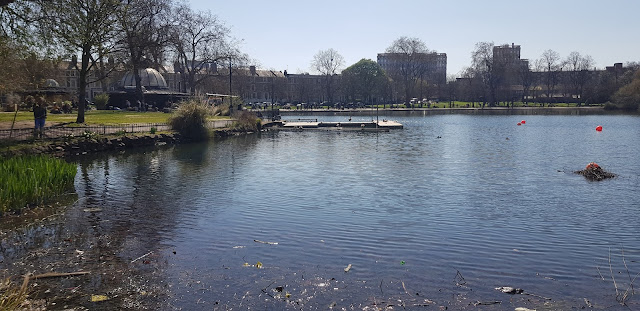
Crossing Grove Road, via Diamond Jubilee Gate, I entered the West Park and found myself by the West Boating Lake, with its abundance of wildlife. Herons, ducks, cormorants and geese of various species. The trees surrounding the lake were filled with the sound of Parakeets, screeching to one another.
![]() |
| The West Boating Lake. |
Following the path to the right, around the lake, to my right the green spaces continued along with another children's play area. As I moved out of the trees I spotted a Chinese Pagoda to my left across a bridge.
![]() |
| Pagoda Island. |
![]() |
| Sir William Wallace Memorial. |
The memorial, above, was installed in 1956, and adorns the wall of St Bartholomew's Hospital, close to where the execution took place.
Below the English text follows an inscription in Latin and Gaelic that translates as:
"I tell you the truth, son, freedom is the best condition, never live like a slave."
"Victory or Death."
The Smithfield area, originally known as Smoothfield, of London was once used by the Romans as a place to muster troops and to bury the dead, and was a large area of open ground outside of the Roman walls.
Once the Romans had left Londinium the land was used for many different uses throughout the centuries, that included the grazing of livestock, summer fairs, jousting and executions.
Executions took on varying forms that included burning at the stake, for heretics, hanging, and the most vicious execution of all... hanged-drawn-and-quartered, usually reserved for treason. Executions would carry on at this spot until some time in the 1400s, when the gallows were moved to Tyburn.
The execution area was known as the Elms, which was a medieval word for scaffold.
It is impossible to quantify the amount of people who were put to death here, throughout the centuries, but the most notable for me would be the execution of Sir William Wallace.
![]() |
| Aquatics Centre. |
With the first week of the Easter holidays begun and with the weather on our side Keilyn, my 9 year old daughter, and I decided to take a trip to London. On Keilyn's insistence we headed to Stratford, via the Jubilee line, as she wanted to explore the Queen Elizabeth Olympic Park.
Our journey was uneventful and after grabbing a hot drink and some food, at Stratford station, we made our way to the park.
![]() |
| West Ham FC Stadium. |
Crossing WaterWorks River, via Stratford Walk, we were immediately in front of what is now West Ham FC Stadium, while below us, on the river, the Water Chariots and swan pedalos were moored up.
![]() |
| Water Chariots and Swan pedalos. |
Turning right we headed towards the Pleasure Gardens Play Area, which Keilyn thought was 'Okay'. We continued by following the course of the River Lea via Middlesex Way, which brought us to Eastcross Bridge, next to which the 'Agitos' stood tall and proud against the blue sky.
![]() |
| Agitos. |
Following the path around brought us to the London Blossom Garden and the Tumbling Bay Playground. Keilyn was suitably impressed with this little park.
![]() |
| Keilyn just swinging around. |
From here we clambered up and down hills to see the Olympic Rings, set among a small copse of trees.
![]() |
| Keilyn, an Olympian in the making? |
Then it was back down the hill to Gaskell's Fort play area, which Keilyn loved.
![]() |
| Gaskell's Fort Play area. |
Then we crossed Knights Bridge and turned left and ourselves back on Middlesex Way, which we followed until we reached Marshgate Lane. We followed this until we turned onto Bassett Lane, which took us across the River Lea Navigation.