Monday, April 08, 2024

Walking with friends: Canary Wharf to Mudchute... and beyond

Morrissey Girls and Alfie
Erin, Keilyn and Alfie, ready for London.

Saturday April 6, 2024.

With Emma having gone away for the weekend, with her friend, and Gary staying with us, along with his son, Alfie, we decided to take Alfie on his first trip to London.

With lunches packed we set off for the short walk to Watford Metropolitan station, where we caught a train to Finchley Road and then a Jubilee line train to Canary Wharf. Alfie fell asleep as we left Watford and didn't wake until we reached Canary Wharf station. As the train pulled in to Finchley Road Keilyn showed off her 'Mind the Gap' t-shirt to the driver, making him chuckle. 

Leaving Canary Wharf station we took the obligatory photo of everyone in Richard Hudson's 'Tear', which everyone should do when visiting the area.

Reflected in a tear

Mudchute Park and Farm is just a short twenty minute walk from Canary Wharf station, which allowed us to take plenty of photos of the buildings, docks. boats and more.

Canary Wharf South Dock

Dog Stars

A quick stop at Asda, to get drinks, use the facilities and for Keilyn to have her photo taken with a postbox.

Keilyn with a postbox

Crossing the Asda car park brought us to the entrance to Mudchute Park and Farm, just as lunchtime approached, so we sat and had something to eat, before taking Alfie to see the animals. Donkeys, peacocks, rabbits, goats, pigs, chickens, sheep and much more were in the various fields, paddocks, pens and stables.

Erin, Keilyn, Gary and Alfie with an ack-ack gun

Alfie and a ram

Thursday, April 04, 2024

Macclesfield Bridge: Or, the 'Blow Up' Bridge

The 'Blow Up' Bridge from the west
Approaching the 'Blow Up' Bridge, from the west.

I have walked Regent's Canal on many an occasion, passing beneath bridges and through tunnels, but one bridge stands out from the rest. Not because it is ornate or is the oldest, but because it had to be replaced after it was blown up, by accident.

The barge 'Tilbury' was one of six barges being pulled along Regent's Canal by a steam tug, destined for the Midlands. Its cargo contained coffee, nuts, barrels of petroleum and about five tons of gunpowder. It is believed that one of the people onboard 'Tilbury' struck a match, just before 05:00 on the morning of Friday October 2, 1874, just as they were passing below the Georgian Macclesfield Bridge.

Wednesday, April 03, 2024

Walking with friends: King's Cross to Camden... and beyond

Canalside Green Steps
Canalside Green Steps.

Monday April 1, 2024.

As it was Easter Bank Holiday Monday, my friend Steve and I decided to take a trip to London, specifically to visit the regenerated King's Cross area and then to see where our feet led us.

Our journey began from from Watford Metropolitan station straight to King's Cross, taking less than an hour.

Exiting King's Cross station we headed into St Pancras International, so that I could point out the free jukebox and the model of 'HMS Alice Liddell' to Steve, who had never seen them before. This took us out onto Battle Bridge Place, where children and families were enjoying the IFO (Bird Cage), and we took a left up King's Boulevard towards Regent's Canal and Granary Square.

The first coffee van that we stopped at was having an issue with their machine, so we crossed to Granary Square, where we discovered 'Matchado'. This was a revelation as this little van, near Granary Square, is London's first Matcha specialist café, specialising in Japanese Matcha and hand-crafted special Matcha sweets. Steve opted for a latte, while I had a Sencha green tea. Both were excellent.

Matchado kiosk
London's first Matcha specialist café.

From here we began our wander by heading to Coal Drops Yard, then Stable Street, which was full of food, clothing and jewellery stalls, before turning west to see Gasholder Park. 

Gasholders Park
Gasholder Park.

Then we headed through Lewis Cubitt Square and Lewis Cubitt Park, before heading down York Way, so that I could see the old York Road underground station. This station opened in 1906 and was closed in 1932.

York Road disused underground station
York Road station (disused).

We then turned down Handyside Street and into the Granary Square building. The architecture of this building, including its interior, is something to behold. These Victorians warehouses and ancillary buildings were obviously built to last and I am glad that the regeneration of the area has saved as many of these buildings as possible.

Granary Square building interior
Inside the Granary Square building.

After this we found ourselves in a wonderful canopied area full of market stalls.

Canopy Market
Canopy Market, where there is something for everyone.

After a good peruse of the stalls, where artists, jewellers, seamstresses and more were displayed their wares, we decided it was time for a spot of lunch. And there was much to choose from. Rice dishes, oysters, burgers, Thai noodles, Indian dishes, pastries and so much more. In the end we decided to try 'The Frenchie', who was selling duck burgers.

The Frenchie Duck Burgers
We did duck ourselves.

Monday, April 01, 2024

'Identified Flying Object' (Bird Cage) by Jacques Rival

Identified Flying Object at night
Keilyn swinging inside the birdcage.

Since the redevelopment of the area around King's Cross many art installations have come and gone. 

One of these installations, that appeared in the sky above King's Cross, was Jaques Rival's IFO (Bird Cage), which, for 95% of the time, rests in the centre of the Battle Bridge Place.

Although this birdcage has white bars, at night it changes to a neon spectrum, releasing the energy that it has stored throughout the day.

Its bars are wide enough for people to walk through and, should you enter the birdcage,  you will find a swing at its centre.

Identified Flying Object at night
The rain allows for some great reflections.

The IFO (Identified Flying Object), designed by Jaques Rival, was originally intended as a framing device for street theatre, during the day. Once a month it was hoisted up into the sky, above Battle Bridge Place, to light up the area.

Identified Flying Object during the day
The IFO (Bird Cage).

This 9m (29.5 ft) high white cage, containing a swing, was installed in 2011 and was to be in place until 2013. Unbelievably, it is still there.

For me, the Bird Cage is a quirky piece of art that sticks out like a sore thumb, during the day, but looks perfectly suited to the area at night, when it becomes luminous.

Thursday, March 28, 2024

Greenwich Steam Ferry

London The Unfinished City
The Greenwich Steam Ferry was an engineering feat, but also a commercial failure.

Ferries had operated historically from Greenwich, at Billingsgate Dock, Garden Stairs and elsewhere, to the southern tip of the Isle of Dogs, since at least 1333.

Billingsgate was the main dock in Medieval Greenwich and was home to the large Greenwich fishing fleet, which relocated to Hull and Grimsby in the 1850s. This relocation was, in part, due to the arrival of rail transport. 

The earliest ferry from the Isle of Dogs to Greenwich was called Potter's Ferry, which began in the 17th century. This lucrative route's rights were coveted by Watermen who wished to control the waterways.

Up until 1812, only foot passengers were permitted to be ferried across the River Thames. Following an 1812 Act of Parliament a horse ferry was established.

The Ferry House pub
The building where the ferrymen waited between crossings.

The Billingsgate ferry was replaced after 1821 with one at Horseferry Dock, a little further down river. Billingsgate Dock was widened and enlarged, by an Act of Parliament  in 1850, to help improve the docks use by the public.

These ferries ran until they were closed by the Metropolitan Board of Works Act of 1883. Five years later, in 1888, the Greenwich Steam Ferry began operation.

Johnson's Draw Dock
Johnson's Draw Dock, north bank, close to the pier where passengers embarked on the ferry to Greenwich.

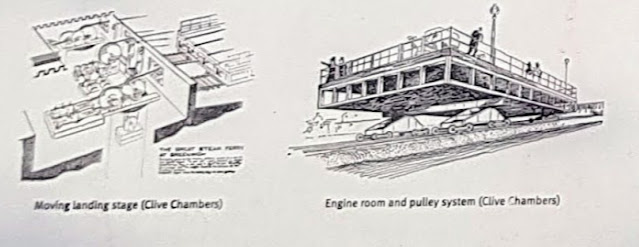
The Greenwich Steam Ferry was an innovative design whereby passengers and vehicles were transported down the foreshore on moving platforms to waiting ferries. This design, although unique in England, was used throughout America and overcame the problem of reaching the ferry at low tide.
London The Unfinished City
Diagrams of the moving platforms and pulley system.

These moving platforms were pulled up and down on cables operated by engines in the cellar of the ferry terminal buildings. These landing platforms could be raised and lowered according to the tide, thus allowing the heavy cargo trucks and carriages to have a smooth access to and from the waiting ferries.
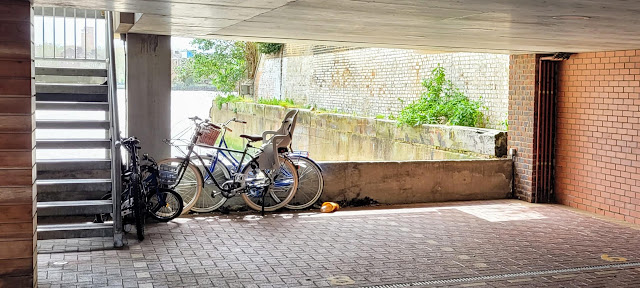
Potter's Ferry north ramp
The north ramp for the Potter's Ferry.

Commercial and operational difficulties meant that the Greenwich Steam Ferry was suspended in the 1890s. Then, with the Blackwall Tunnel opening in 1897 and construction of the Greenwich Foot Tunnel, beginning in 1899, the Greenwich Steam Ferry finally closed in 1899.

The ferry terminal building, on the south bank, remained standing until the 1990s.

London The Unfinished City
The ramp on the south foreshore.

Today, all that remains are the concrete ramps, on the north and south foreshores, and the walls on south terminal still retain the three cable ports, used to raise and lower the moving platforms.