
Tuesday, August 08, 2023

River Thames Tide Gauge Hut

London The Unfinished City
River Thames Tide Gauge Hut.

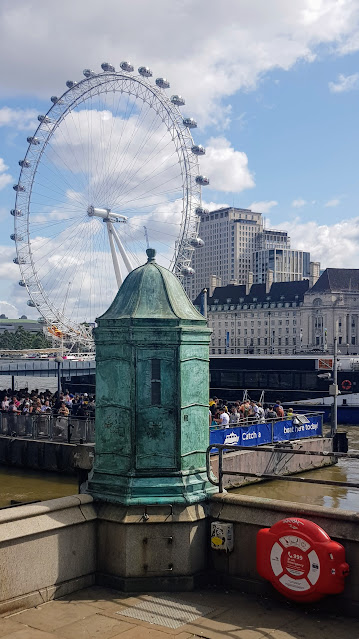
If you were to leave Westminster Station via the Westminster Pier exit, or made your way down the north steps from Westminster Bridge, you will quite possibly have walked by this odd little green turret without giving it a moment's thought.

However, this copper turret houses some important scientific equipment, which you can see if you peer through one of the two small windows in the door.

London The Unfinished City
Home of the Thames Tide Recorder instruments.

The Tide Recorder measures the depth of the River Thames at Westminster Bridge, or more accurately the mean sea level rather than the river bed, which it then sends to the Thames Barrier Control Room every fifteen minutes. This information is then published online.

Westminster City Council look after the upkeep of the exterior, while the tide reading equipment is maintained by the Environment Agency.

I have yet to discover when it was installed, but it has been in situ since the 1930's.

If anyone can find more information about its construction or when it was installed, I would be most grateful.

Thursday, August 03, 2023

Walking with Keilyn: Westminster Bridge to Battersea Park... and beyond

London The Unfinished City
Keilyn with the heart for our friend and colleague Khalid Jamil.

Sunday July 30, 2023.

Keilyn loves walking through and around London, almost as much as I do, so we decided to walk through a different part of the city, on this visit.

London The Unfinished City
On our way to London for another epic walk.

The day began with our usual walk to the Watford underground station, changing at Finchley Road and then exiting at Westminster.
London The Unfinished City
Our starting point.

We began by crossing Westminster bridge, with its tourists from a myriad countries, before descending the stone steps to the Albert Embankment. and the National Covid Memorial Wall and looked across at the Palace of Westminster.

We decided to follow the Albert Embankment, which stretches for a mile from Westminster Bridge to Vauxhall Bridge, passing St Thomas' Hospital and Lambeth Palace before grabbing a coffee and a hot chocolate from a street vendor near Lambeth Bridge.

London The Unfinished City
Lambeth Fire Station.

We then continued along the Albert Embankment, passing the Lambeth Fire Station, until we were near Vauxhall Bridge, where we had to make a slight detour due to the still ongoing construction of the Thames Tideway Tunnel. This did, however, give us a chance to see the main entrance to the SIS (MI6) building, which is a side of the building that I had not really seen.
London The Unfinished City
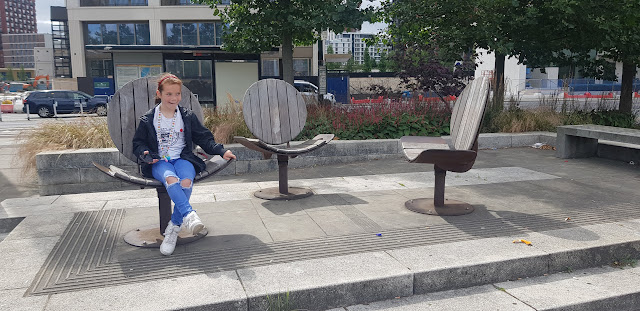
Keilyn with some riverside chairs.

Soon we were back walking along the Riverside Walk, where Keilyn found some wooden chairs that spun round. A few steps further and we could see the Embassy of the United States of America, which is the largest American Embassy in Western Europe, and looks like a glass cube with small 'sails' covering three sides. 

London The Unfinished City
Embassy of the United States of America.

We continued along Riverside Walk before having to make another short detour before finding ourselves in the Tideway Village, with its converted trawlers and house boats. 

London The Unfinished City
'St Michael' is a converted trawler that you can stay on.

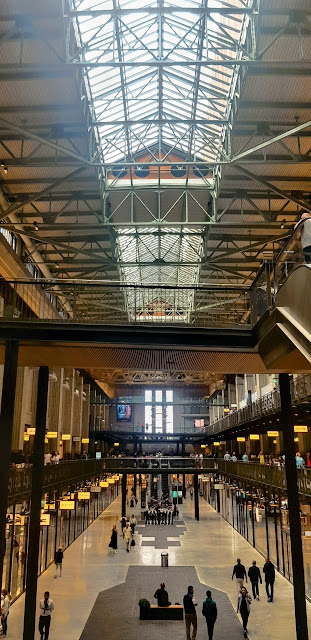
One final detour and we arrived at Battersea Power Station, which we entered so that Keilyn could get a sense of the scale of the building. With her suitably awestruck and with us both having made use of the facilities, we headed out of the south entrance and continued our walk.
London The Unfinished City
Battersea Power Station interior.

We passed beneath a railway bridge, passed by Battersea Dogs and Cats home before stopping at a Tesco Express for some extra provisions, before passing beneath another railway bridge and heading into Battersea Park.

It was still quite warm, although the clouds were threatening rain, as we sat in the Rosery Gardens and ate our lunch, while joggers and dog walkers busied there way through the gardens.

London The Unfinished City
The Rosery Gardens.

Suitably rested we headed ever westward along the south of the Boating Lake, before turning north and entered the Sub-Tropical Garden, with its ferns and palms. These were interspersed with colourful bedding plants.

London The Unfinished City
The Sub-Tropical Garden.

London The Unfinished City
The Sub-Tropical Garden.

We then continued along the tree-lined path, passing the Bowling Green Pavilion, the Bandstand, the Tea Terrace and formal gardens, until we reached the London Peace Pagoda, where stopped for another short break alongside the River Thames. 

London The Unfinished City
The London Peace Pagoda.

Next to us, in the small car park, the UK Bungee Club were using a crane with a basket attached to jump from. Their screams echoed as they plummeted earthward.

Tuesday, August 01, 2023

Tothill Fields Bridewell Gateway

London The Unfinished City
The Old Stone Gateway.

Sunday July 30, 2023.

It was while walking through the City of Westminster, on a Sunday afternoon with drizzle falling from the leaden sky, that I passed by this odd little stone gateway.

It is not completely out of keeping with the area and fits nicely with the building behind which it stands, but I was still unsure as to what its purpose was.

The engraved stone above the gateway states...

“Here are several Sorts of Work for the Poor of this Parish of St Margaret’s Westminster. As also the County, according to law. and for such as will beg and live idle in this City and Liberty of Westminster, Anno 1655.”

This didn't exactly clear up the matter of the gateway for me, but rather made its purpose more confusing.

Tuesday, July 11, 2023

South Bank Lion

London The Unfinished City
Shining white against a black night.

Crossing Westminster Bridge, heading south, you will be met with a sculpture of a White Lion, standing on a plinth beside County Hall. 

The lion has been there since 1966, although, as it turns out, it is much older than it appears. 

An inscription on one of the lion's paws reads... 'WFW Coade 24 May 1837'.

William Frederick Woodington was a sculptor at the Royal Academy's School of Sculpture and used Coade Stone, a ceramic material, to sculpt the lion in 1837.

London The Unfinished City
A wonderful profile of the lion.

The lion sculpture once adorned the top of the Lion Brewery, which stood roughly where the Royal Festival Hall now stands today.

Tuesday, June 13, 2023

The Mall

London The Unfinished City
Looking west towards Buckingham Palace and the Victoria Memorial.

The Mall has to be one of the most popular places for tourists to visit, in London, and is open to both pedestrian and vehicle traffic.

Whether it is to see Buckingham Palace, Admiralty Arch, Horse Guards, St James's Palace or either of the two parks, Green and St James's, it is always busy.

London The Unfinished City
A gun salute in Green Park.

Then there are the events that take place along its length, such as Changing the Guard, Royal processions including coronations, state openings of Parliament and state visits.

London The Unfinished City
Changing the Guard always draws the crowds.

Although vehicles are allowed to travel down it, scheduled bus routes are forbidden, unless permission is given by the monarch. This has only been granted twice and occurred in 1927 and 1950. 

Sunday, June 11, 2023

'The Blackfriar', City of London

London The Unfinished City
The Blackfriar public house.

On the odd occasion that I fancy a drink, when walking around London, I never stop at one of those pubs that has no character, preferring to find a pub with a bit of history.

So it was while walking westward along the River Thames that I spotted this odd shaped building, across the road from Blackfriars station. 

London The Unfinished City
The wedge shaped Blackfriar pub.

As I approached I realised that it was a pub and, so, headed in. And what a place it is.

London The Unfinished City
Some of the bronze relief around the top of the bar.

The pub is remarkably deceptive as, when viewed from the outside, it looks long and narrow, but, once inside, the pub opens up with a substantial bar area, for a pub this small, that contains booths, tables and areas to just stand. 

London The Unfinished City
Scenes from the life of a monk.

A dining area, set under the adjoining railway arch, which I didn't visit on this occasion, is furnished with sculptures.

London The Unfinished City
A day in the life of a monk.

Around the tops of the walls bronze reliefs showed Dominican Friars going about their daily tasks, while a stained-glass window allowed a rainbow of light to filter into the room.

London The Unfinished City
Stained Glass Window.

There was obviously some serious history to this pub, so I bought a pint of ale and sat outside at one of the tables. 

Thursday, June 08, 2023

Was this London's Smallest Police Station?

London The Unfinished City
It is NOT a Police Station.

Supposedly, on Trafalgar Square's south east corner, stands the UK's smallest Police Station. It is not! It never has been and it never will be.

The closest that it has been to being a Police Station was from 1928 until the 1970's, when it was used as a Police Observation Post.

So, let's clear this matter up.

According to many websites the Police Station was erected at the behest of Sir Lionel Edwards, who was in charge of the Office of Works.

However, no such person ever existed.

There was a Sir Lionel Earle, permanent secretary to the Office of Works, and a Mr G. Edwards OBE of the Metropolitan Police. These two men did correspond with each other and it is entirely plausible that the names were confused, at some point, and Sir Lionel Edwards came into being.

London The Unfinished City
"the Telephone Box inside the great granite base of the big lamp".

Now, the Police Station.

There had been correspondence between the Metropolitan Police and the Office of Works about having a Police Box erected in Trafalgar Square since the late 1910's.

A wooden telephone box was installed by the entrance to Trafalgar Square underground station in 1919, but the Police were after something bigger and more permanent. Their rationale was as Trafalgar Square was a place where protesters met, usually without any warning, they needed somewhere from which to keep an eye on the crowds and have the ability to call for reinforcements, if necessary. 

In 1921 the wooden box was still affixed to the London Underground entrance, but London Underground it removed as they had plans of their own.

At one point there was the suggestion put forward that an observation post could be installed on the roof of the National Gallery. This was turned down by the Metropolitan Police and was never mentioned again.

There was also the idea of erecting a wooden Police Public Call Box, but it would have been too conspicuous, so this idea was rejected, too.

Following the General Strike riots, of 1926, Sir Earle wrote to Mr Edwards with the suggestion that "...it might be possible to get the Telephone Box inside the great granite base of the big lamp at the end of the balustrade...".

Mr Edwards wrote back that he had had the same idea, but had dismissed it.

In July 1927 Sir John Anderson, the Permanent Under-Secretary of State at the Home Office, approved the observation box, which was estimated at costing £550.

London The Unfinished City
Nothing more than an Observation Post.

New granite was ordered and transported to London from Cornwall. 

In March 1928 the Observation Post was completed and the old wooden telephone box was removed.

During the 1930s the lamp, which had been run using gas, was converted to electricity. In addition the lamp was controlled in such a way that it blinked when the telephone rang, so that the officers could see it from across the square.

In the 1970's, with the introduction of radio communication, the observation post became redundant and has since had the telephone removed.

Sadly, it is now just used for storage., but Police Officers from around the world still come to see, and have their photo taken with, what they believe is London's smallest Police Station.

London's smallest Police Station was in Wellington's Arch from 1851 until at least 1968.

London's smallest Police Station, currently, is Pinner Police Station in the Borough of Harrow and within the Metropolitan Police's Greater London coverage.