The Marine Policing Unit (MPU) is one of the most fascinating corners of London’s law enforcement history. While Robert Peel’s "bobbies" took to the streets in 1829, London’s river police were already decades into the job. In fact, they are recognised as the oldest continuously serving police force in the world.
Today, they are the waterborne arm of the Met, swapping heavy boots for lifejackets and pavement beats for 47 miles of the River Thames.
The Shocking Origin: The Marine Police Office (1798)
In the late 18th century, London's docks were absolute chaos. The Port of London was the busiest in the world, and an estimated £500,000 worth of imported cargo, which was a staggering sum at the time, was being stolen every year by organised river pirates and corrupt dockworkers.
I have been flowing since before this island had a name, a silver ribbon winding through the shifting clay, birthed from the quiet springs of the Cotswolds and pulled relentlessly toward the grey embrace of the North Sea.
Humans have called me many names, but it is Thames that they now call me. They think they mastered me. They built their stone walls to hem me in, threw their iron bridges across my back like saddles, and dug deep into my belly to hide their trains. But I remember when I was wild. I remember when the woolly mammoth stepped heavily into my shallows to drink, and when the first frightened tribesmen built wooden huts on my marshy banks, looking at my currents with a mixture of reverence and fear.
I am a river of secrets, the great liquid spine of history.
For centuries, I have been London’s silent accomplice. I watched the Romans plant their wooden pilings into my mud, bringing the noise of a distant empire to my quiet shores. I carried the grand, gilded barges of Tudor kings and queens, listening to the whispered court gossip that drifted across my waters. I felt the heat and tasted the falling ash of the Great Fire in 1666, my surface reflecting a sky turned blood-red while terrified citizens threw their treasured possessions into my depths for safekeeping.
For Keilyn's 13th birthday my mum bought her a ticket to climb over the O2 Arena. Not wanting to miss out, Emma bought me a ticket, so that I could join her. My uncle Martin would be joining us for the day, although he wouldn't be taking part in the climb. Instead he would be taking photos of our ascent and descent, while also exploring the public art along Olympian Way.
Arriving at Base Camp, we checked in and I was issued with a rubber wristband that contained a sensor, before we were ushered into a waiting room, where a video showed us what to expect from our climb. It went on to show climbs completed in the evening, at Christmas and at sunset.
It then showed climbers taking part in yoga classes, listening to live music, dancing, performing record-breaking displays, along with a lot more, all on top of the O2 Arena.
Our group of thirteen was then joined by Conner, who would be our guide for the climb. He left us to watch a four-minute safety video, before taking us through to get kitted out for the climb. Keilyn, who was wearing trainers, was issued with a pair of sturdy high-grip shoes, while I was okay to wear my walking boots. I was issued with a gilet, which had zipped pockets to store our phones in, with 'Get Over It' emblazoned across the back. Once Keilyn had placed her shoes in a blue storage box, picking one with a 'SpongeBob SquarePants' sticker on it, rather than a number, we handed it to Conner and collected a clasp each, before he issued us each with a harness.
We then made our way outside and formed a line as Conner explained how to put on the harness, fasten it tight and to attach the 'C' clamp. He then checked each individual harness, before sending us up the stairs to the start point. Keilyn's harness was different from mine, as it had zipped pockets incorporated into its design, so she secured her phone in it.
A cloudy start turning sunny in the afternoon, at 21°C (69°F).
For Keilyn's 13th birthday, last Thursday, my mum bought her a ticket for the 'Climb Up at The O2', which was something that she has always wanted to do. Emma purchased me a ticket, so that I could do the climb with Keilyn, as it was something that I wanted to do, too. As my mum was unable to accompany us, my uncle Martin would be joining us for the day, to take photos of our climb.
We set off from Croxley station, where we boarded a Metropolitan line train towards Baker Street, alighting at Finchley Road, where we took a Stratford-bound Jubilee line train to North Greenwich. The journey time was around 1 hour, so we ended up at The O2 with plenty of time to spare.
Martin purchased a drink and a roll, from Starbucks, which he ate in the shade, while Keilyn and I tucked into our sandwiches and drinks.
Just after 11:30 Keilyn and I made our way to 'Base Camp', with Martin waiting in the shade. As we were early we were allowed to join the 11:45 climb, and made our way through the waiting area. We were soon joined by 11 more climbers and our guide, Conner, who, after showing us a four-minute safety video took us through to get kitted out.
We then made our way outside, where we put on our harness, and clamp, before heading up the stairs to the starting point. By now Martin had headed towards Base Camp, from where he would watch and take photos of our ascent. Here we were met by Emma, who took photos of us all, before we set off on the 30° incline, with Keilyn leading the pack.
We stopped where the walkway took on a less acute angle, allowing the others to catch up, before setting off for the centre of the O2. Daisy's group, that had started before us, were still taking in the sights, from the viewpoint, so we joined them, before they headed down and left the thirteen of us to take in the view.
'The Shared' was a collaboration between the sculptor Austin Emery, Leathermarket JMB (Southwark's largest resident-managed housing organisation), and the local community.
In October 2012 free, open stone sculpting workshops took place on Tyers Estate, with over 100 members of the public, both adult and child alike, creating their own pieces of sculpture.
To make the sculpture whole, much like a community, Austin Emery joined the pieces together to form 'The Shared' totem-like sculpture, which now stands on the Tyers Estate.
Austin then added his own embellishments and crafted animal habitats within the piece.
Cloudy skies with light winds, brightening in the late morning to hazy sunshine, 13°C (55°F).
It was a cool 4°C (39.2°F), with light mist, as we left our house and began our gentle walk to Watford High Street station, where we boarded a Lioness train, that took us to Kensal Green. Keilyn and I sent a selfie to Dyan, who responded with a photo of Harrow & Wealdstone station. We informed her that we would be passing through in a few minutes and Dyan managed to take a photo of our train approaching, while she waited for the train that would take her to work.
On leaving Kensal Green station we crossed Harrow Road and entered Kensal Green Cemetery, via its main entrance. Keilyn, always the inquisitive one, wanted to find the graves of Isambard and Marc Brunel, while I was interested in seeing Harold Pinter's grave. So, off we went in search of the graves.
Kensal Green Cemetery was the first of London's eight garden cemeteries to open, which was back in 1833. It covers an area of 72 acres and has many famous people buried within the grounds. These include Isambard Kingdom Brunel and his son Sir Marc Isambard Brunel, Harold Pinter, Steve Peregrin Took, Wilkie Collins, Prince Augustus Frederick The Duke of Sussex, Erich Fried, Medi Oliver Mehra, Marigold Churchill, Charles Babbage, William Makepeace Thackeray, among countless others.
It didn't take us long to find the grave of Isambard Kingdom and his son Sir Marc Isambard Brunel, before we continued our search for other graves of interest. Peculiarly, the grave of Steven Ross Porter, better known as Steve Peregrin Took (member of the band Tyrannosaurus Rex), was fairly easy to find, while that of Harold Pinter took some searching.
After a good exploration we made our way out onto Ladbroke Grove, heading south. We crossed the Grand Union Canal and continued following Ladbroke Grove, buying hot drinks at an independent coffee shop, called Mowgli Coffee.
If you walk along the Thames Path, east of Woolwich, you will discover these small red lighthouses. They can be found at Margaretness (or Tripcock Ness), Crossness and Coldharbour.
They are not lighthouses, in the traditional sense, but more like navigational light masts.
The Margaretness Lighthouse was installed in 1902, by Trinity House (the General Lighthouse Authority for England), but has been operated by the Port of London Authority, since 1993.
In 1566, Queen Elizabeth I empowered Trinity House to set up "so many beacons, marks and signs for the sea whereby the dangers may be avoided and escaped and ships the better come into their ports without peril."
Light rain changing to clear skies, with winds up to 5 mph, 13°C (55°F).
An unplanned trip to London resulted in an epic excursion with various modes of transport used.
As there were engineering works on the Metropolitan line, resulting in trains not going further north than Harrow-on-the-Hill, a rail replacement bus service was in place. Deciding against this we took a taxi to Watford High Street station.
At Watford High street station we waited for a train to Euston. As it pulled into the station Keilyn gave the driver a wave, which he responded to with a wave and a 'toot' from the train horn. The Lioness line train whisked us off to Willesden Junction, where we changed to a Richmond-bound Mildmay line train, which took us through Acton and across the River Thames.
On leaving Richmond station we grabbed a hot drink from Costa and began our walk.
The Quadrant brought us onto The Square and then Sheen Road. We followed this road, passing wonderful architecture and some remarkable almshouses, all the while aeroplanes flew lower as they began their approach to Heathrow Airport.
We continued heading west until we reached East Sheen Cemetery. This cemetery is home to many Commonwealth War Graves, actors, such as Roy Kinnear, along with ordinary people. The cemetery is also the last resting place of William Ellsworth Robinson (1861-1918), who the world knew as Chung Ling Soo.
Tuesday February 17, 2026: Sunny with winds at 2 mph, 7°C (44.6°F)
Another day and another trip to London with Keilyn. This time Keilyn wanted our trip and what we would visit to be a surprise, so I planned a route in secrecy,
A taxi dropped Emma, Keilyn and myself at Watford Metropolitan station, while Erin remained at home as she was going out with her friends, later in the day. Emma, meanwhile, was off to see her parents in Chesham, so left the train at Moor Park, leaving Keilyn and I travelling onward.
We boarded a Jubilee line train, at Finchley Road, and took it to Green Park, where we changed to a Victoria line train to Victoria.
On exiting the station we headed southwest, along Buckingham Palace Road, passing Victoria coach station, the National Audit Office and the offices of the British Transport Police, before turning up Pimlico Road.
A beautiful drinking fountain, a sculpture of St George and the Dragon and a wonderful statue of Wolfgang Amadeus Mozart were spotted as we made our way ever westward.
Pimlico Road brought us onto Royal Hospital Road, with the Margaret Thatcher Infirmary and Cemetery to our left, followed by the Royal Hospital Chelsea. As Keilyn is now a fully fledged Army cadet I had decided that I would take her to the building next to the Royal Hospital... The National Army Museum.
After the obligatory photo with the Challenger 2 tank, which stands outside of the museum, we headed inside to begin our exploration.
Walking along the Thames Path there is always something new to see or discover.
It was while walking east, from Crossness, that I first saw this World War II-era pillbox. It is typical of the time and was used as an observation post, with a wide 'window' which offered a wide field of vision.
There were many versions of pillbox design, with different areas and counties having their own specific design. This one was adapted, at some point, to be fitted with an anti-aircraft gun. This, obviously, has been removed.
This pillbox has a wide field of vision.
Brief History.
Pillboxes were small, hardened concrete bunkers with loopholes for firing weapons, designed as fixed firing positions. They were part of a network of defensive structures, built in the late 1930s and early 1940s, to defend against a potential enemy invasion and to protect key sites.
If you walk along the Victoria Embankment you, like many others, will quite possibly have missed the large bronze lion heads that adorn the embankment walls, as they face the River Thames.
They were commissioned by Joseph Bazalgette to line the Albert and Victoria Embankments as part of the Victorian sewage system he had engineered. They were sculpted by Timothy Butler, between 1868–1870, who added mooring rings to each lion's mouth.
Although this was more of a nod to the river, barges and boats would use them when mooring along the river. As the water levels changed and mooring points moved on, the lions eventually lost this role and were no more than redundant features on the river wall.
Having taken a few days off work, Emma and I took Keilyn to London, while Erin was staying with friends.
We set off, via taxi, to Watford Metropolitan station to board a train to Finchley Road and from there a Jubilee line train to Waterloo.
On leaving Waterloo station we crossed Waterloo Road and headed for the Bus Cafe, for a spot of lunch. Full English breakfasts were ordered and devoured, washed down with coffee and tea.
With our bellies full we left the bus garage and headed along The Cut and onto Union Street. We passed the Embassy Tea House and the London Fire Brigade Headquarters, before crossing Southwark Bridge Road. We then passed the old Tram shelter, which is now a gourmet burger restaurant, and the Mint & Gospel Lighthouse Mission building, before turning up Redcross Way beside Crossbones Graveyard.
Redcross Way brought us to Dirty Lane and the arches beneath the mainline railway of Cannon Street station. This eventually brought us to Clink Street. Keilyn's face lit up when she discovered that we were going into the Clink Prison Museum, a place she had wanted to visit for ages.
"The Clink": the prison that gave its name to all others.
We descended the stairs, paying our dues at the booth, before entering the site of the original Clink Prison. The prison that gave its name to all others.
Information boards told the history of the prison from its earliest inception, in 1144, to its closure in 1780. Manacles, locks, swords, torture implements, chastity belts and much more were on display, many of which could be handled, allowing you to feel the weight of the chains, giving a sense of how it would feel to be manacled for days on end.
There was also information on Crossbones Graveyard and the Winchester Geese, the Liberty of the Clink, the Bishop of Winchester and a brief mention of the other five prisons that were in Southwark.
"Off with his head!"
As we walked through the Clink Keilyn was keeping an eye out for the 'ghosts' that had been hidden around the museum. These 'ghosts' were small puppets and, should you find all ten, you received a sweet on leaving the gift shop. Of course, Keilyn spotted all ten and received her lollipop as we left the prison.
We continued along Clink Street and joined the throng of tourists, passing the Golden Hinde and turned onto Cathedral Street and then Montague Close, where we sat in Minerva Square to rest our legs and have a drink. We then continued along Montague Close and joined Tooley Street, before turning along St Olaf Stairs and joining The Queen's Walk along the River Thames. Countless wooden sheds were in various stages of being built and painted, ready for the Christmas season, while the old City Hall is in the middle of a major refurbishment, with much of its glass having been removed.
A Victorian era postbox.
We looked at the Royal Mail Penfold Postbox, a relic of the Victorian era, before we turned south along Duchess Walk to Queen Elizabeth Street. After buying an ice cream, for Keilyn, and some more refreshments and snacks, we walked along Tower Bridge Road and headed for our hotel... Premier Inn London Tower Bridge Hotel.
The view from our hotel room.
After checking in, Keilyn grabbed the room key and took the lift to the top floor, all the while we were hoping for a room with a view. And we were not disappointed. We could just make out the top of the London Eye and half of the dome of St Paul's Cathedral, but we had a clear view of The Shard, which was perfect.
'Thames Made Modern' is an artwork and poem project, at Globe View, on the north bank of the River Thames.
It is a multi-generational project, by ARTBASH, alongside the architects Rivington Street Studio and in collaboration with the lighting designers FPOV.
The artwork was developed following a series of workshops with several different communities.
The artwork is a layered montage. The backgrounds were painted by the children of Aldgate Primary School, who were inspired by mudlarking activities that they had participated in.
The buildings were then added by students from Haggerston Community School, inspired by the views at Globe View.
It was a collaborative effort, by artists, residents and the congregation of St James Garlickhythe, that added the wildlife to the artwork. The congregation also helped with the poem.
The poem uses The Doves Type typeface. This typeface was believed lost, in 1916, when a disgruntled printer, TJ Cobden-Sanderson, threw his famous typeface into the River Thames, to spite his business partner. However, in 2014, the original metal type was salvaged from the River Thames by divers and mudlarks. With the type now in hand, Robert Green, a graphic designer, set about digitally reconstructing it and so was able to use it here.
In all there are six paintings, each with its own piece of poetry, which can be found below.
Mighty heart, mighty London Spanning. Timeless Ethelred's Hythe to Queenhithe Welcoming Charles II's landing Southwark Bridge in steel stealing Dicken's heart Riverside House looking buoyant Glorious views from Globe View Blues, greens, aquamarines & a glimpse of grey
European Eels swarming and waving With shoals of Bream chasing & biting The ebb, the flow, the perpetual flux Thames made modern
In a bustling metropolis like London, it's easy to overlook the small, yet significant, historical markers scattered throughout the city. Among these are the numerous drinking fountains and animal water troughs, silent sentinels that tell a story of Victorian philanthropy, public health, and a bygone era before bottled water became ubiquitous.
Imagine London in the mid-19th century. The River Thames, while a vital artery for trade, was also a significant source of drinking water for many, often contaminated and leading to devastating outbreaks of cholera and other diseases. Access to clean, safe drinking water was a luxury, not a right, and for the working classes, it was a daily struggle. This pressing public health crisis spurred a wave of social reform, and a key initiative was the provision of free, clean drinking water for all.
The Metropolitan Drinking Fountain and Cattle Trough Association, founded in 1859, became the driving force behind this movement. Their mission was simple: "to promote the erection of drinking fountains in the streets of London, and also of cattle troughs for the use of animals."
These fountains and troughs were more than just practical necessities; they were symbols of Victorian compassion and a commitment to public welfare. Funded by generous donations from individuals, charitable organizations, and even royalty, they sprung up in parks, market squares, and busy thoroughfares across the city.
Keilyn and I had worked out that we hadn't visited London, together, in quite a few weeks, which was a shock.
So, as soon as I had finished work and Keilyn had arrived home from school, we both got changed, grabbed some snacks and took a taxi to Watford Metropolitan underground station. An Aldgate-bound train was waiting at platform 2, which we hurriedly boarded, grabbing seats near the centre of the train. Within minutes we were on our way.
Pulling into Harrow-on-the-Hill station we were informed, by our driver, that the train pulling in beside us would be leaving first. So, a mass exodus of travellers, including us, crossed the platform and boarded the other train. A ridiculous thing to do, really, as this would only shave a few minutes from our journey time. Sure enough, though, we were soon moving again.
We exited Aldgate station and headed west, turning down Fenchurch Street until we reached Fen Court, where we stopped to look at the 'Gilt of Cain', which is a sculpture that commemorates the abolition of the slave trade.
It is a remarkable piece. Composed of a granite podium, with steps, and columns that are shaped like sugar cane acting as a congregation. Each column is etched with lines from the poem 'Gilt of Cain', by Lemn Sissay.
We then made our way towards Fenchurch Street station, where we purchased some hot food, which we ate on the benches on Fenchurch Place.
Suitably filled with energy we made our way back to Fenchurch Street and turned down St Katherine's Row and through French Ordinary Court. This eventually brought us out onto Crutched Friars and, then, Savage Gardens which brought us to Trinity Square. I do love the City of London's street names.
Crossing Tower Hill we stopped to take some photos of His Majesty's Royal Palace and Fortress of the Tower of London, spotting some of the poppy installation flowing down the wall of the Medieval castle.
From here we headed down to the River Thames and onto Three Quays Walk. The light was fading as we reached the river, making Tower Bridge really stand out, with its lights illuminating its profile. Sugar Quay Jetty offered the perfect place to grab some photos of the bridge, HMS Belfast and The Shard.
Approaching Grant's Quay Wharf we noticed that the top of The Shard had lights running up its uppermost levels, signalling the time was now 19:00.
London Bridge, like the rest of the bridges we would see, was illuminated with coloured lights, reflecting off the turbulent waters of the outgoing tide.
Walking around Rotherhithe it is hard to imagine that, just 40 years ago, this was a completely different area. Almost every part of it would have been docks, basins and cuts, rather than what now greets people. Housing estates, schools, shops, business centres, a farm, green spaces, ecology parks and, at its centre, Stave Hill Viewpoint have now replaced the docks that once covered this entire area.
Of course, some small areas of water can be found, like Globe Pond Nature Reserve, Lavender Pond Nature Reserve and Surrey Water. Then you have some of the original docks, such as Canada Dock, Greenland Dock, Norway Dock and South Dock.
Brief History
Located in Rotherhithe, on the Surrey side of the River Thames, this area had been a hub of commercial activity since the 17th century.
The Howland Great Wet Dock was built between 1695 and 1699 and was the oldest of London's riverside wet docks. In 1763 the dock was sold and renamed Greenland Dock, due to the amount of whalers that used it. Greenland Dock became the central hub for the Surrey Commercial Docks.
During the 1800s expansions and improvements resulted in the formation of the Surrey Commercial Docks Company. These docks were part of the larger Port of London, which handled a significant amount of commercial shipping trade to and from the UK.
This is how the area once looked.
Many docks were named for what they imported or from where the products derived, while others had simpler names. There were docks named Albion, Canada, Greenland, Island, Lady, Lavender, Norway, Russia and Stave. Plus, the South and West Docks.
Thomas Peirson Frank. (Elliott & Fry, Public domain)
During World War II, especially during The Blitz, London was heavily bombed.
Bombers flew along the River Thames, dropping bombs on the dockyards and industrial sites, before moving towards the City itself, using Tower Bridge as a point of reference.
Because London is a low-lying city the River Thames embankments were targeted, too, in the hopes of flooding some of the area.
However, they didn't know about Thomas Peirson Frank.
Thomas Peirson Frank was born into a farming family in Yorkshire, in 1881. He was educated at Pickering Grammar School and Huddersfield Technical College, before gaining three years of practical experience training under Huddersfield borough engineer, K.P. Campbell.
Over the next few years he gained further experience in general construction, the laying of sewers and water mains, maintenance of roads and tramways and much more.
In 1908, he became the city engineer for Ripon. During the four years that he worked here he was responsible for extending the sewage disposal works and also the construction of two river dams.
He then spent between three or four years in various roles in Cardiff, Liverpool, Plymouth and Stockton-on-Tees. In Cardiff he acted as a surveyor and performed a similar role in Liverpool. While in Plymouth he was responsible for construction work, which included roads and sewers for a housing scheme. In Stockton-on-Tees he was the borough engineer. During his time in Liverpool he also lectured at Liverpool University.
It is hard to believe, now, but that this small building once stood on the north bank of the River Thames.
Originally an entranceway with stone steps that was used to reach the river, where boats moored along the river's edge could be boarded.
This building has not been moved. But the River Thames was narrowed, in 1862, when construction began on the new sewer system and Victoria Embankment was created, which has resulted in this building now resting some 133 metres (436 feet) from the banks of the river.
A large tablet close to the gateway reads:
THIS GATEWAY MARKS THE POSITION
OF THE NORTHERN BANK OF THE RIVER THAMES
BEFORE THE CONSTRUCTION
OF THE VICTORIA EMBANKMENT 1862.
It was built in 1626 by Nicholas Stone.
Master Mason for George Villiers, 1st Duke of Buckingham, to serve
as the watergate to York House, which the Duke had acquired from
the Archbishop of York, in 1624. The arms on the river front and the motto
'Fidei Coticula Crux' (the Cross is the Touchstone of Faith) on the land side
are those of the Villiers family. York House was demolished in 1675 and
streets were laid out on the site. In 1893, the gate having fallen into
decay, the London County Council obtained parliamentary powers
to acquire and preserve it as an object of public interest.
However, although the tablet attributes its erection to Nicholas Stone, Indigo Jones and Balthasar Gerbier may also have had a part in it.
It is built of stone in three bays, with rusticated bands on the side facing the river. The two lions on the top hold shields with anchors to symbolise the Duke of Buckingham's service as Lord High Admiral.
Today, it lacks its balustrade, stone-paved landing stage and steps.
If you look down on the northeastern support of the Hungerford Bridge and Jubilee Bridges, across the River Thames, you will see the scattered remnants of broken skateboards.
This is not just some random littering spot, but rather a memorial to a fallen skateboarder.
Friday June 18, 1999.
Timothy Baxter and his friend, Gabriel Cornish, had spent the midsummer day skating over and around the concrete obstacles of the Undercroft, beneath Queen Elizabeth Hall.
In the evening they went for drinks, much like everybody else, and enjoyed the summer evening. As they headed home, a little after 04:00, via the Golden Jubilee Bridges, they were confronted by six strangers; three teenagers and three young adults; five male and one female.
The strangers took Timothy's rucksack and threw it into the cold water of the River Thames, before beating on Timothy and Gabriel. The last thing Gabriel heard, before passing out, was, "Let's throw them in the river. It will be fun."
The world's longest continually-used skate spot.
Gabriel survived, by using his rucksack to stay afloat, and was rescued two miles downstream with hypothermia. Timothy never regained consciousness and his body was recovered 36 hours later.
The six individuals were caught and charged with murder and attempted murder. In April 2000, following a ten-week trial, they were all found guilty and were sentenced to life imprisonment, in May 2000.
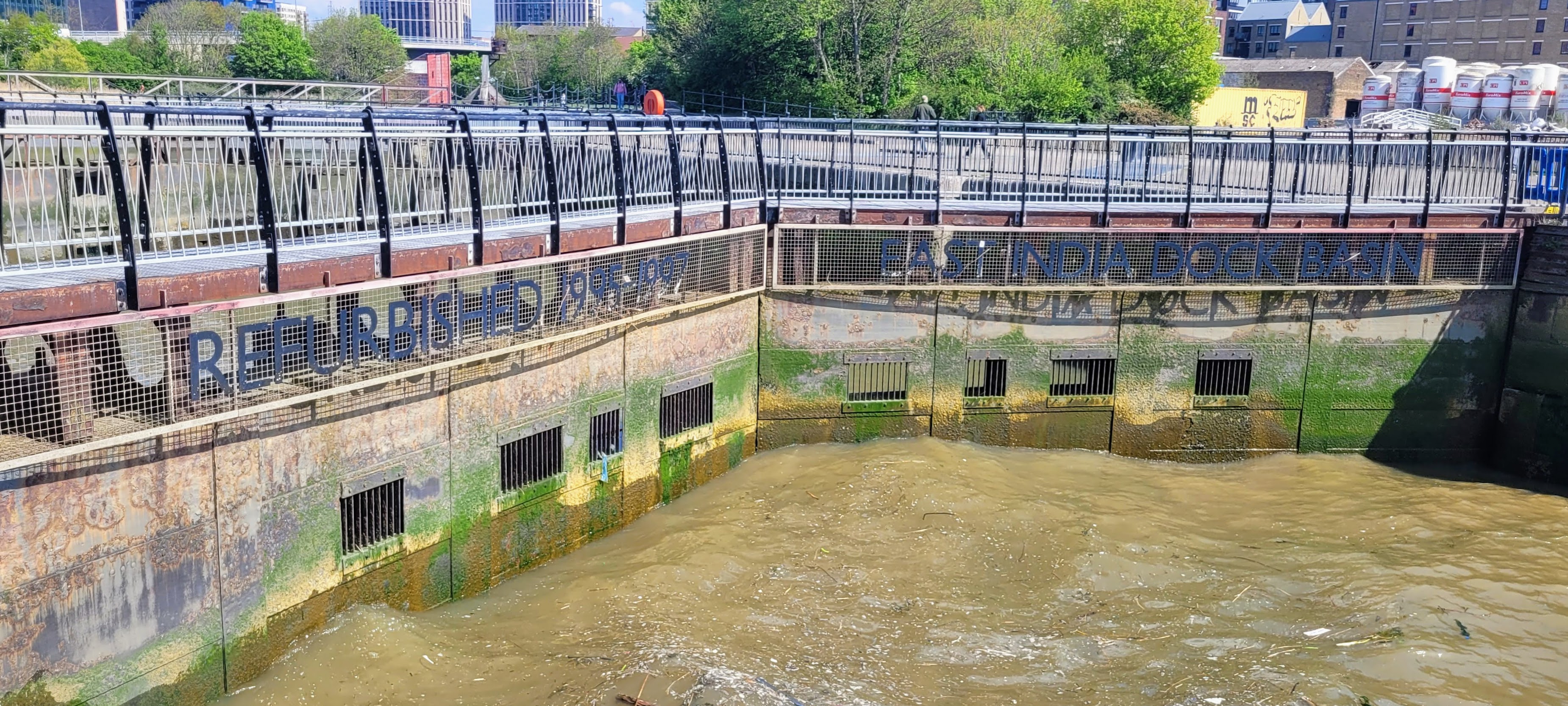
The East India Docks were constructed between 1803-1806 and were the third set of wet docks built on the River Thames, in the early 19th century. By the end of the 18th century East Indiamen ships had been sailing from Blackwall for almost 200 years.
The East India Company, founded in 1600, shipped valuable goods from the East to the River Thames. It was a rich, powerful and well organised body using the largest two ships that frequented the Port of London. The valuable cargoes were moved by barge to the city, then carried to the company's spacious warehouses on Billiter Street and Cutler Street.
In January 1804 the lock was widened to 48 ft across to allow the largest East Indiamen, of up to 1,500 tonnes, to enter the docks.
The Export Dock
In September 1804 Hugh McIntosh used a horse operated bucket dredger to excavate 8,000 tonnes of mud from the former ship repair yard, Brunswick Dock, to give a uniform depth of 22 ft. The south wall was built in brick, but the original timber walls of the Brunswick Dock were retained on the other three sides.
The Export Dock was also home to the emigrant's ships. In the 19th century companies including Green's, Wigram's and Dunbar's all used the docks as their embarkation point. By 1905 the Export Dock was principally used by sailing ships and steamers.
After suffering from bomb damage, during World War II, the Export Dock was sold in 1946 and filled in to make way for Brunswick Wharf Power Station. The power station was closed down in the 1980s and demolished. Now the site is home to Virginia Quay.
The Import Dock
The most important element of the East India Docks was the Import Dock. Covering almost 60 acres it provided room to unload the precious goods from the East Indiamen returning from their voyages.
Excavations began in 1803 using pumps, buckets, rods, pipes, and valves impounding 18 acres of water.
The work included a labour force of up to 400 men and 100 horses. Dredging 625,000 cubic yards of earth. Making nine million bricks from the excavated topsoil to form the dock walls and using 50 tonnes of old iron hoops to strengthen the walls.
The walls of the Import Dock were constructed with a curved profile which was ideally suited to the shape of the hulls of the East Indiamen.
During World War II the Import Dock played an important role in the construction of the Mulberry floating harbours for the D-Day landings in Normandy, in 1944. After World War II the Import Dock was filled in and a number of new developments, including the Financial Times Print Works (1987-88) and Telehouse Europe (1988-90), were built.
The Lock
The Entrance Lock, with a width of 48 ft, was the largest lock in the Port of London. It had a curved or rounded bottom, unlike the shallow inverts of the locks constructed at West India Docks.


.jpg "Drinking Fountain")